New to me anyway...
So pretty much all of the 3D printers I've been posting about and watching for the past few years have been one of two basic techniques, one of which has two basic technologies.
The first technique is the "extrude and build up" technology. This is when you take a long thread or strip of plastic or ABS or some other material and it is pushed through a guide (the "extruder") and then heated at the tip (the "print head") so it melts and deposits a bit of material which then builds up the object.
The second technique is for the printer to be full of a material and the top of the material has some binding agent, or melting process which creates a layer of solid material, which is then pulled below the surface and another layer is bound or melted on top. This is done both with liquids (which are usually bound with ultraviolet or laser light) and with powders (which are usually melted or solidified using a binding agent, like glue).
In general the low cost printers are those that use the extruder build-up process and the higher cost, higher quality printers are the ones that use the dust or liquid.
But there is a new type of printer that I saw in my "Make" magazine, and I find it really intriguing. It uses a UV activated liquid resin and an off-the-shelf projector to create the layers. the layers are built up from below (meaning the image is projected through a layer of glass from underneath).
The reason I find this new printer so intriguing is that it doesn't build the object bit by bit. It actually solidifies an entire layer of resin all at once by focusing an image of the object layer onto the resin. So each layer is a solid sheet of hardened resin, with no weak spots where the material was glued together, nor are there any areas where the material dangles or drips because the print head had to move with some melted plastic or binding agent still dripping off (they call that "stringing"). So it creates exceptionally clean, smooth results. Plus they are as detailed as the projector can focus in the X-Y dimensions, and as detailed as the machinery can elevate the object in the Z dimension. The results of the prototype I saw were simply stunningly detailed and smooth compared to the other printers.
I was totally blown away.
The prototype I saw will end up costing about $2,500 I think. And it has a "build area" of about 4x4x4 inches, which is pretty tiny.
But wow, what awesome results.
One of the things that is always able to get a chuckle out of me is "science reporting" in the news. The sheer level of stunning ignorance on display always gives me hope for the employability of the mentally disadvantaged.
Earlier this year the "big news" splashed across newspaper and web pages around the world was the awesome celestial display of the upcoming "Super Moon". A "Super Moon" is when the full moon occurs close to the moon's perigee (closest point in its orbit). This week the news has been somewhat less breathless, but the basic message has been similar because the last full moon we had was a "Micro Moon", which occurs when the full moon occurs close to the moon's apogee (farthest point in its orbit).
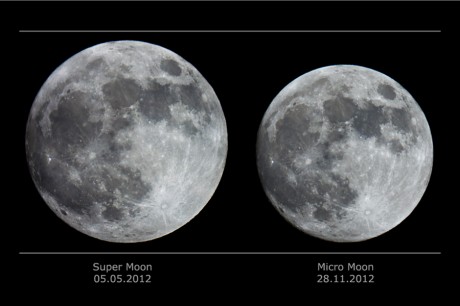
So, with all the breathless superlatives being slung around, you'd think that the actual moon in the sky would be dramatically different in size. The fact is that the great majority of people, and by great majority I mean on the order of 99.9% of them, would never have noticed any difference in the moon's size or brightness unless the NY Times ran a story about it. Not because the difference is negligible (it's not, see below) but because there is no real frame of reference in the sky that allows the human eye to really judge its size anyway, much less compare the size of a full moon to another several months later. Here is a photo of the moon comparing its relative size between "Super" and "Micro" moons:
So you can see that there is a roughly 10% difference in the apparent size of the moon (the "Super moon" is 12 - 13% larger in apparent size than the "Micro moon" if you want to be more accurate)
So, now having said that, this brings me to another bone of contention about people's general understanding of celestial events and their presumed significance.
I cannot tell you how many times in my life I have had a conversation with someone who has waxed poetic about the "impossibly improbable coincidence" that the sun and moon are the "exact same apparent size" in the sky, which allows for the most dramatic celestial showcase in our sky, the "total solar eclipse". Usually this is in the context of "proving" that the earth is so unique that it must have been divinely designed.
Well, the truth is that just as the moon varies in size by up to 13%, the earth's orbit is also an ellipse, meaning that the sun's apparent size also varies by a few percent over the course of the year (the earth is actually at apogee, meaning the sun is furthest away and therefore appears smallest in the sky in the summer for the Northern Hemisphere, which always seems to surprise people in America and Europe).
These two variations in the size of the earth and moon mean that solar eclipses also vary considerably, with some occuring when the sun is at its largest while the moon is at its smallest, and vice versa. When the moon's apparent size is significantly smaller than the sun's apparent size, that is known as an "annular solar eclipse" and during such an eclipse the edge of the sun will be visible all around the smaller moon. The reverse case means the moon will more fully obscure the sun, hiding more of the sun's solar prominences and corona. An eclipse where the sun and moon are almost exactly the same time is actually somewhat rare.
As the moon continues to spiral slowly farther and farther away from the earth, the moon's apparent size will continue to get smaller and smaller until eventually all solar eclipses will be annular eclipses.
A long time ago I used to play the game "Magic:The Gathering". I even played in a tournament once, and won a few games before being sent home by a guy with a deck full of moxes and lotuses (lotii?)
If you don't know what moxes and lotii are, consider yourself lucky.
Because the game was based on the concept of building decks out of randomly available cards, to play the game you had to buy packs of cards from which you would construct your deck. A pack of cards cost (back then) something like $7 and would contain one "rare" card, a couple "uncommon" cards and several "common" ones. Of course most of the best cards were rare so players ended up buying so many common and uncommon cards that they were virtually worthless, so the rare cards were the only ones that had any real value.
I was unfortunate enough to begin playing just after the "beta" run, so my first purchases were from the "Unlimited" set (also known, I think, as "Third Edition") and the "Revised" set (aka "Fourth Edition"). The business model of the game is that you have the "base edition" cards, which make up the great bulk of cards sold, and then there are "expansion packs" which are "special" cards that you can add to your deck to make it more powerful, or just to mix things up with new creatures, spells or effects.
Between each new edition, some cards are retired, others are added, but the bulk of the cards remain the same. The expansion packs are always completely new and different. Since I started after beta I missed out on purchasing the most collectible cards, some of which are worth hundreds of dollars even today, well after the Magic card market crashed about a decade ago. But I'm getting ahead of myself.
So back then I was not willing to just shell out hundreds of dollars to buy cards (and neither was my wife) so I concocted a scheme to fund my Magic hobby. After building up a decent collection of reasonably valuable cards, I went to a local store which sold the cards and arranged a consignment sales system so that I sold my most valuable cards to individual buyers in search of specific cards to complete their decks. I paid the store 10% or something like that. But I made enough cash on the sale to purchase entire boxes of Magic Cards directly from Wizards of the Coast, which I would then open and pick out a few cards I wanted to play with, but then sold all the more valuable cards to fund more purchases of new cards.
Doing this netted me a fairly substantial collection of cards, the vast majority of which were worthless. But some were valuable. I kept them in my basement home office in a couple of large cardboard boxes designed to hold collectible cards. I kept a few in a notebook with plastic card protectors.
Then I went on vacation and my basement flooded. By the time I got home my entire collection had been in standing water (or under water) for days. They were totally ruined. Or most of them were. I did have one box I had stacked on top of other boxes and that box only had one section that had soaked up water.
Surprisingly my insurance company paid for the lost cards at fair market value, which at that time was quite a bit more than I realized. I think I got over a thousand dollars for the ruined cards, money I used to buy my first serious amateur photography equipment. Equipment I sold a decade later to buy a guitar. So in a sense I guess my Magic hobby has funded two other hobbies, one of which I still enjoy.
But I lost interest in Magic about that time and since then I've just kept that last batch of cards in a new box in my closet. I figured they weren't worth much, all of my really nice cards had been ruined.
But for some reason, pure happenstance, that box included most of my "dual land" cards, cards that weren't that valuable back then, but have appreciated considerably since then.
Last night just for kicks I pulled out my dual land cards and looked them up on eBay.
My dual land cards are currently worth around $800 - $900. That's looking at what people are actually BIDDING on them, not what people are asking for them. Most of them are worth around $30 - $40, but a few are worth as much as $80 each, and I've got about two dozen of them.
I do have a bunch of other rare cards, but most of them are only worth a buck or two. I probably have another two dozen cards that average in the $10 - $20 range.
But all the rest of my cards are just junk. Wasted space.
So I'm now trying to decide if I should sell out my cards for whatever I can get for them (I am estimating I can probably get $500 or so from a trader) or hang onto them in the hopes they appreciate more. My worry is that if I do wait, they will become worthless when Wizards releases a new edition or expansion that re-introduces the same card. I do have several cards that used to be valuable but are no longer worth anything because they were re-introduced. I'd hate to lose out on a potential for a chunk of cash because I waited too long.
I have been invited to join a group of shooting enthusiasts this Saturday for a full day of shooting prairie dogs on some private land where the owner of the land has deemed the prairie dogs to be dangerous pests which threaten his horses and cattle.
The purpose of the activity appears to be a combination of lots of alcoholic beverages, bushels of gunpowder, metric tons of lead and a keen application of ballistic principles to the liberation of smelly rodents from their vital organs.
So, given the opportunity, what would you do?
So here is an interesting situation...
I've been making molds and casting things out of plaster and resin now for almost a full year. In that time I've made thousands of items out of plaster and probably at least a hundred out of resin.
But the only things I have created that have actually been "productive" are some non-game things I've made for the Cosmic Daughter who sells them online to fans of the "Once Upon a Time" series. For example, one of the key artifacts in the show is a chipped teacup that Rumplestiltskin treasures because it was chipped by Belle. Originally the Cosmic Daughter was buying ceramic tea sets from Hobby Lobby and painting them and "chipping" them to make earrings. But after a while it was clear that this was not very profitable since the cups were only part of the tea set and the tea set was pretty expensive. So I made a mold of some generic teacups and have been casting dozens of cups for her to paint and chip and turn into earrings. She is expecting to sell several sets during the Christmas season, so I've been casting some more for her.
My brilliant scheme to make car bumper icons for fly fishing and stargazing has not panned out. Not because they wouldn't sell, but because I just never followed through with any attempts to sell them.
But the fundamental concept of making molds, casting stuff and selling them has at least been successful for the teacups. I just need to figure out how to expand that business model.
Yes, I am still fascinated with the potential of 3D printing. I am still regularly checking on the progress of the current 3D printing technologies, and I am looking into the cost and convenience of 3D outsourced printing.
I have been using "Sketchup" lately. I need to use it more. I think today I'm going to finally watch some of those Sketchup Youtube tutorials.
But, the reason for this post is that last night I was at a local bookstore ("The Tattered Cover", a bookstore I highly recommend to anyone coming to Denver) and happened to see a copy of a special winter edition of "Make:" magazine. (Yes, the colon is part of the title).
I was quite surprised to see the number of products that are now available for 3D printing. There's over a dozen 3D printers that you can buy, ranging from about $400 to about $4,000. The most popular printers are in the $1,500 range. The magazine has a section of reviews of about a dozen of the most popular models, but I've only managed to get through a couple of them so far. Not surprisingly, I suppose, there is a rough correlation between functionality and price, but not a hard and fast one. There appear to actually be some bargains out there if you are in the market for a printer today.
But more and more I am thinking that for now it is probably more cost-effective and wiser to outsource your 3D printing if you can deal with the delays associated with printing. There are a number of companies that will take your 3D digital file and print your result and mail it to you. Since the technology is still advancing rapidly and costs are still on the way down while capability is still on the way up, outsourcing the printing might very well be the best option by far. It also allows you to experiment with different materials and allows you to print using materials (such as bronze-infused stainless steel) which would be impossible to print at home. Ponoko.com is one such 3D printing company.
I think the approach I'm going to take is to first and most importantly get up to speed with Sketchup to see if I can even create the sorts of digital files needed to print FROM before I look at the next step of actually printing something.
A Magic:The Gathering player was murdered in his home, apparently after playing Magic with his "friends" who beat him to death and sold his estimated $25,000 - $100,000 card collection for profit.
William Cormier, 31, is accused of beating Dugas to death Aug. 27 at his home in Pensacola.
Dugas' cards, valued at somewhere between $25,000 and $100,000, ultimately were sold in Pensacola, Georgia and Tennessee, police said.
Dugas' body was taken to Winder, Ga., where it was found Oct. 8, buried in a plastic container in the backyard of a home. Now held in Georgia, William Cormier and his twin brother, Christopher, will be returned to Pensacola to face charges in the homicide.
Now, I'm not going to pretend all of this is new, but 3D printers take the convenience of making a real-world copy of an item to a new level.
With the release of the new Makerbot Replicator (models 1 & 2) the legal and political world is suddenly taking notice of this newfangled technology. And the result has been fairly predictable.
It's all about copy protection. There have even been calls by some lobbying firms to outlaw 3D printers. Especially toy companies, many of which make the majority of their profits on mass produced plastic trinkets with limited or no mechanical functionality.
But before we get into the legality of 3D printing, which will assuredly end up in a morass of rhetorical argument and counter-argument, I would first just like to discuss the ethics involved.
First let's abstract this thing out so that it is not tied to current or near-future functionality. Let's say, for the sake of argument, that you could purchase, at a reasonable cost, a machine that could to a 3D scan of an existing object, create a computer model of the object, then recreate the object at any scale within a reasonable range (say from less than an inch to several feet across) out of the same materials as the original, and paint it exactly as the original was painted. All at the touch of a button.
What should or shouldn't you do with such a device?
Should you replicate the Mona Lisa? Well, it's not likely that you would HAVE the original Mona Lisa, so let's be more realistic. Let's say you are redecorating your house and you find an exquisite light switch plate, hand-made, hand-painted and just exactly what you want. You can either buy a couple dozen of them for all of your rooms, or you can buy one and then print out copies of the rest. Should you print copies?
Let's say you have a set of legos, and you want more blocks. Print them or buy them?
Your daughter wants a pair of earrings just like her friend's earrings. Scan and print?
You have a new birdfeeder and your neighbor wants one exactly like it, but they don't have the money, nor do they have a 3D printer of their own. Do you just print one up and give it to them, or just charge them a nominal fee to cover materials and maintenance?
What are the limits of the use of the thing?
So, tomorrow our team has a "team building event" scheduled. The purpose is to become better at problem solving and "thinking outside the box".
Yeah. I know.
Anyway.... so the coordinator of this event has reached far outside of the box of team building exercises to pull forth .... building a bridge out of paper.
So, of course, I've been doing some quick research on bridge building out of paper.
The simplest way I've seen is to make paper tubes into triangular trusses which can become the sides of the bridge. That's about the quickest, strongest way to build something. It's a bit more complex to try to build a suspension bridge or an arched bridge, etc..
The bridge just has to be strong enough to hold a can of soda, and high enough for a can of soda to pass under it. We will have a team of four people and an hour to do the work.
My recommendation is going to be to build two towers out of simple rolled up paper, with a platform on top. The bridge itself will be made by cutting (or tearing) paper into 1/4 size sheets, then rolling them up into tubes. Those tubes will become the triangular support beams. The "roadway" can be made by accordion folding paper and covering it up with paper with tape to hold the folds in place. That essentially becomes a bunch of triangles, which again is the fastest/easiest way to create structural strength.
Then it's just assembly.
So I figure the work breaks down like this (Four person team breaks down to me and T1, T2, T3)
Me: Tear paper to the right sizes. I figure this will take maybe ten minutes.
T1: Rolls up tubes. We'll need about sixteen, maybe twenty tubes.
T2: Accordion folds paper.
T3: Makes platform pieces from accordion folded paper and flat paper.
Me: Final assembly
I figure within 30 minutes we'll easily be done.