Cosmic Conservative

Rational Conservatism from the heart of America

Futurism

Fusion breakthrough?

By CosmicConservative
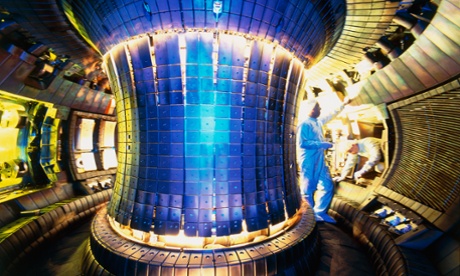
This week I've seen three separate stories about three different fusion "breakthroughs". This story is about an announcement from Lockheed's "Skunkworks" experimental development team. Luckily it includes a cool technical looking photo that probably has nothing to do with the actual fusion reactor, but it looks great. If this story, or one of the others I've seen, pans out, this could be the biggest thing that has happened to the human race since the industrial revolution. Maybe even bigger.

The end of the 40 hour work week

By CosmicConservative
time_clock One of the things I've been contemplating for quite a long time is the inevitable impact of automation and technology on the traditional concept of "working for a living." There are at least two major forces in play that will change the way we think about how individual members of society add value to society and gain reward for doing so. 1. Automation and technology will replace at least 80% of the jobs most people do today, especially young and/or unskilled workers. Flipping burgers, stocking shelves, running cash registers, digging ditches, mowing lawns... all of that will be gone. Even the jobs of many skilled workers will fade into the sunset as cars, trucks, taxis, airplanes, buses and any other means of transportation are controlled by automated driving systems. Building homes will be replaced with giant machines that create a home in place according to architectural plans that are both standardized and customizable at the touch of a computer screen. It is hard to come up with a job that is not in a creative field that will not be replaced or greatly diminished by automated systems. That simply means there will not be enough work to employ a majority of human beings. Not the way we currently think of "work" anyway.
2. Wealth generation has become increasingly divorced from human muscle and skill for over a century now. This trend is also accelerating. The first things to be automated will be factories that make stuff that used to be made by people. In a short time the limiting factor on the production of goods will not be the availability of muscle, skill and resources, instead it will be the lack of liquid cash alone. Which is interesting since liquid cash is supposedly simply a means to facilitate the production of goods and services. That strongly suggests that we need a new economic model, one which eventually totally divorces the concept of "working for a living" from the ability to amass goods and receive services. At some point in the future it will be pointless to make people "work" for basic necessities of life, including housing, food, water and a wide selection of consumer products including most of what people spend their hard-earned money on today. Obamacare is, perhaps intentionally, perhaps coincidentally, accelerating this. Pretty soon you will start seeing a push for the work week to be reduced, probably to 32 hours at first, but eventually to 20 hours or less. This will be the first order approximation to adjust to a new world where human muscle and skill is no longer the driving force of the economy. But in the end I believe "work" will be completely divorced from the economics of basic human needs, and "work" will then become what people do to earn status alone. And status will have some other markers than "money". I'm not sure what it will be, but it will probably be some sort of social ranking that is attained through investment of time and effort into creative endeavors such as the arts, or contributing to social improvements through teaching, mentoring or organizing cultural activities. There will still be some level of direction that will require humans to run, at least until the worldwide artificial intelligence eventually takes over that too. But that will be determined through the social status, not through the acquisition of wealth. I can see a time in the not so distant future where being the world's best video game player provides the status that is needed for someone to become a political power.
IPCC "dials back" Global Warming alarmism

By CosmicConservative
This Wall Street Journal story is actually a significant one that will be ignored by the mainstream media and the political power brokers who have preyed on people's fears of trumped up Global Warming Alarmism. Global-Warming What is happening is that the Intergovernmental Panel on Climate Change (IPCC) the U.N. body that has been at the heart of trumped up Global Warming alarmism for the past 25 years or so is retreating from their claims of doom and gloom. At least they will be if this leaked version of their next report ends up being what is published. I am sure the Michael Mann zealots within the IPCC are fighting tooth and nail to keep the IPCC from retreating at all, and they could still prevail before the official version is released. But I suspect not. I suspect that the true scientists who have had their names tied to this mess for years have finally decided that science is not served by zealotry, political favoritism and the enslavement of the name of "science" in the service of ideological goals. The bottom line is that if this report is accurate and is what is published, the IPCC will have marched a long way to what I have been saying for years. And that is that whether Global Warming is happening or not, the role of CO2 has been highly exaggerated, the consequences have been ridiculously hyped and there are very true and compelling benefits to the world warming up a bit more, including longer and wetter growing seasons and the opening up of literally tens of thousands of square miles of previously unsuitable land for new farming areas. The geography of the earth just happens to be such that the further north you go, the more land mass you find. That means that warming the earth up a degree or so opens up huge areas in Alaska, Canada and Russia to become suitable land for farming. And a warmer world is a wetter world, which should mean less need for irrigation. This is the first time in 20 years that I've seen compelling evidence that the zealots are losing control of the narrative within the scientific community. That's big news.

What about all that Global Warming hoopla?

By CosmicConservative
global-warming So, I've noted before on this blog that when I was in high school I did a senior research paper on the impending threat of doom that "Global Cooling" presented to civilization. Since then I've watched as a series of environmental disasters has been hyped up by an entirely corrupt and incompetent press. Just in case you aren't keeping track, here's my list of impending environmental disasters that the press has warned you about in my adult life (going back to the mid-seventies):
  1. Global Cooling - This was a huge deal. Based on a five year dip in temperatures leading scientists (including some very prominent ones such as Carl Sagan) testified in front of Congress asserting the certainty of their projections which predicted an oncoming ice age. I'm not kidding. Some of these scientists are the very same ones promoting "Global Warming" today. You can look it up.
  2. Nuclear fallout/poisoning from Three Mile Island, Chernoble, decaying missile silos or waste from fission nuclear reactors. At one point I was seeing proposals to recommission Saturn V rockets for the purpose of sending our nuclear waste on a one-way trip to the sun. Dire predictions of mass mutations and deformity were all the rage back then. Somehow I never hear about nuclear waste any more. Did it all go away? Did we solve that problem? I don't think so.
  3. Acid Rain. OMG, you should have seen the craziness that the acid rain zealots dreamed up. Back in the early 80s it was being reported by supposedly sensible, responsible, educated reporters that entire forests would be wiped out "within a decade" if we didn't stop burning coal, like right friggin' NOW! For some reason the Black Forest in Germany and the forested area of the Great Smoky Mountains of the US were the most likely forests to die out horribly in just a few years. Now both of those forests have actually increased, and are increasing more today. Why? Because trees sort of like high levels of CO2 in the atmosphere. Who knew?
  4. The Great Ozone Hole! The hyperbole and hysteria surrounding the "hole in the ozone layer" was perhaps the single most amazing "news" story I've ever seen. Every cartoon character from Snoopy to Bill the Cat was drawn in skeleton form due to their skin and soft tissue being burned away by the horrible hole in the ozone layer.
  5. Then there was my personal favorite. The Disposable Diaper Deluge! Yes, disposable diapers were filling up landfills at alarming rates! Projections published in sober, rational newspapers like USA Today predicted that every single landfill in the USA would be full of disposable diapers within a decade. I remember getting into a heated argument with a co-worker about disposable diapers and in spite of my clear proof that disposable diapers were a tiny fraction of the volume of landfill waste that came from newspapers and junk mail, which had somehow never threatened global catastrophe, she continued to insist that disposable diapers were going to kill us all and that any parent who used them was an enemy to mankind. Sound familiar?
  6. Plastic water and soda bottles. They had created an entire vast floating island in the middle of the Pacific Ocean! They were suffocating baby harp seals! They were overflowing landfills even faster than the detestable disposable diaper debacle of the previous decade!
There are more. Lots more. This is just a sampling. The one thing all of these overhyped, under-documented, quickly forgotten environmental armageddons have in common is that all of them had one and only one solution to them. People had to stop living the way they were, and had to live more like "Progressives" wanted them to. Not that people should do what the actual progressive spokespeople THEMSELVES actually did, that would be too crazy. Progressive spokespeople are always exempt from the moral preening and lecturing that they inflict on us lesser beings. Barbara Streisand can wall off her 1,000 acre beachfront mansion while lecturing others about "free access" or "living simply". That's just how it is. What's important isn't how our "betters" actually live, what matters is that we do what they tell us. That means living a "simple" life of sacrifice and austerity, all for the sake of saving the world. I suspect that "Global Warming" has about five more years before the divergence of the sacred prophecies from reality are too much to ignore anymore. I'm already looking for the next plague. I strongly suspect the next end of the world perpetrator is going to be "genetically modified foods." Stay tuned. Of course, all this hype goes on while the true environmental disasters of overfishing the seas and washing our precious topsoil into the ocean continues unabated and unnoticed by those who lecture us endlessly.

3D printing update

By CosmicConservative
Yes, I am still fascinated with the potential of 3D printing. I am still regularly checking on the progress of the current 3D printing technologies, and I am looking into the cost and convenience of 3D outsourced printing. I have been using "Sketchup" lately. I need to use it more. I think today I'm going to finally watch some of those Sketchup Youtube tutorials. But, the reason for this post is that last night I was at a local bookstore ("The Tattered Cover", a bookstore I highly recommend to anyone coming to Denver) and happened to see a copy of a special winter edition of "Make:" magazine. (Yes, the colon is part of the title). I was quite surprised to see the number of products that are now available for 3D printing. There's over a dozen 3D printers that you can buy, ranging from about $400 to about $4,000. The most popular printers are in the $1,500 range. The magazine has a section of reviews of about a dozen of the most popular models, but I've only managed to get through a couple of them so far. Not surprisingly, I suppose, there is a rough correlation between functionality and price, but not a hard and fast one. There appear to actually be some bargains out there if you are in the market for a printer today. But more and more I am thinking that for now it is probably more cost-effective and wiser to outsource your 3D printing if you can deal with the delays associated with printing. There are a number of companies that will take your 3D digital file and print your result and mail it to you. Since the technology is still advancing rapidly and costs are still on the way down while capability is still on the way up, outsourcing the printing might very well be the best option by far. It also allows you to experiment with different materials and allows you to print using materials (such as bronze-infused stainless steel) which would be impossible to print at home. Ponoko.com is one such 3D printing company. I think the approach I'm going to take is to first and most importantly get up to speed with Sketchup to see if I can even create the sorts of digital files needed to print FROM before I look at the next step of actually printing something.

On colonizing newly discovered exoplanets...

By CosmicConservative
I don't know how much differently my mind works than other people's minds. For example, when I see the discovery announced of a "new earthlike planet discovered!" my immediate reaction does not stop with "Oh cool!" It immediately jumps to "Hmm... if that planet is actually a rocky planet with surface water, could humans actually live on it?" For example, there is a story out right now about a newly discovered "super earth" which is a planet about 45 light years away (right next door in galactic terms) that is in its star's "Goldilocks zone". Sounds good so far, right? But then it turns out that the planet is 7 times the mass of the earth. Hmm... seven times the mass? What does that mean? Does that mean gravity is seven times as much as earth? Because if so that means humans would experience a "g force" of 7g just trying to stand on the surface. That's comparable to the g force you would experience at the bottom of an extreme roller coaster loop. (Actually, a bit of research shows the highest roller coaster g force to be rated at 6.3g. Most are in the 5g range for their highest g force.) You MIGHT be able to stand up for a few minutes, but it would not be long before you simply could not stand. But what would the force of gravity be on a rocky planet with seven times the mass of earth? Well, fortunately we can do some math. If we assume that the "super earth" has the same basic density as earth (not much of a reach, Mercury and Venus have densities very similar to earth), then a planet with seven times the mass of earth with the same density of earth, would end up with a surface gravity of almost exactly 2g. 2g is not ideal, but it's not necessarily impossible to deal with. Especially with exoskeletons to help people move and special beds to support them as they sleep. How long a person could survive on such a planet is debatable, but if that planet has seas, sea life might be able to live with very little adjustment since sea life is generally buoyant. So even if humans couldn't live permanently on the surface, such a planet could very possibly be farmed extensively and short visits to the surface by humans would be possible. I don't know what sort of experiments have been done on humans to determine the absolute g limits for humans to be able to live permanently on the surface of an exoplanet without suffering so much from the different g forces that living wouldn't be worth it. But just for the sake of argument I'm going to say that living within .75 to 1.25 g is probably acceptable. That would mean g values of between about 7 m/sec^2 to about 12 m/sec^2. So, with those parameters, and assuming equal density with earth, what does that mean in terms of the mass of exoplanets? Well, it turns out that would mean that inhabitable planets would be those that range from 1/2 to about 2 earth masses. But... there is actually reason to believe that earth is somewhat denser than most exoplanets. For whatever reason our solar system seems to have a higher concentration of heavy elements than most star systems. I don't know exactly what that means in terms of density, but since iron is one of those abundant elements that is apparently not so abundant in other systems, and earth is almost a big iron ball, I think it's not unreasonable to suggest that many exoplanets probably have a density that is as much as 20% less than earth. So, if that is true and we find exoplanets with 80% the density of the earth, what masses are we now looking at as potential for habitation? That changes the habitable mass to be from .6 earth masses to 3 earth masses. Since we have found several exoplanets in the range of 4 - 8 earth masses, this is starting to look more promising. Of course by the time we reach out to such planets, we might well have developed bio and genetic engineering to such a degree that living on planets with much higher g forces might even be possible. I suspect that in the long run we are likely to find lots of planets with masses in the acceptable range. After all we have two in our own solar system, along with two more that are pretty close and a couple of moons that are also in that range.

The New MakerBot Replicator

By CosmicConservative
Macintosh moment indeed.

The New MakerBot Replicator Might Just Change Your World | Wired Design | Wired.com.

The BotCave is home to MakerBot, a company that for nearly four years has been bringing affordable 3-D printers to the masses. But nothing MakerBot has ever built looks like the new printer these workers are currently constructing. The Replicator 2 isn’t a kit; it doesn’t require a weekend of wrestling with software that makes Linux look easy. Instead, it’s driven by a simple desktop application, and it will allow you to turn CAD files into physical things as easily as printing a photo. The entry-level Replicator 2, priced at $2,199, is for generating objects up to 11 by 6 inches in an ecofriendly material; the higher-end Replicator 2X, which costs $2,799, can produce only smaller items, up to 9 by 6 inches, but it has dual heads that let it print more sophisticated objects. With these two machines, MakerBot is putting down a multimillion-dollar wager that 3-D printing has hit its mainstream moment.
I am SOOO buying one of these. Now I just gotta figure out how to swing it...

Googling asteroids

By CosmicConservative
Well, someone with some actual cash is actually going to pursue exactly the space exploitation approach I've been championing for literally all of my adult life. This is good news.

James Cameron, Google Founder Back Space-Mining Venture - WSJ.com.

A new company backed by two Google Inc. GOOG -0.54% billionaires, film director James Cameron and other space exploration proponents is aiming high in the hunt for natural resources—with mining asteroids the possible target. The venture, called Planetary Resources Inc., revealed little in a press release this week except to say that it would "overlay two critical sectors—space exploration and natural resources—to add trillions of dollars to the global GDP" and "help ensure humanity's prosperity." The company is formally unveiling its plans at an event Tuesday in Seattle.

Making money with 3D modeling

By CosmicConservative
There's room to grow with Shapeways as well. Once you're satisfied with your design, you can list it for sale on the site. You choose the material options and markup, and they handle the ordering, printing, and shipping. "Three-D modeling started as a hobby," says van der Linden, but after launching a product line that includes kinetic toys, geometric sculpture, jewelry, and desk lamps (Shapeways can print objects up to about 27 × 15 × 22 inches), it's quickly becoming a healthy source of income. Roman Vasyliev, a freelance designer, had been building model cars and airplanes for years before discovering 3D printing. His obsessively detailed World War I—era aircraft models now net a steady stream of income. (The top seller is a 1:44-scale model of the Caudron G.4, a French biplane bomber.) "I was really surprised that 3D modeling has become another branch of my hobby," he says, "and now, my work." Read more: How to Get Started 3D Modeling and Printing - Popular Mechanics

How to Get Started 3D Modeling and Printing - Popular Mechanics.

Polywell fusion update

By CosmicConservative
EMC2 Fusion doesn't have tens of millions of venture capital to play with — but it does have a $7.9 million Navy contract to test a plasma technology known as inertial electrostatic confinement fusion, also known as Polywell fusion. The idea is to accelerate positively charged ions in an electrical cage to such an extent that they occasionally spark a fusion reaction, releasing energy and neutrons. The concept was pioneered by the late physicist Robert Bussard, and carried forward by the EMC2 Fusion team in Santa Fe, N.M. Some of the leading team members went on leave from Los Alamos National Laboratory to work on EMC2. Rick Nebel, the Los Alamos engineer who led the company since Bussard's death in 2007, retired from the company last November. Taking his place as acting chief executive officer is Jaeyoung Park. The 41-year-old physicist says he's given up his position at Los Alamos to focus fully on EMC2. "We had a lot of milestones to meet in the last six months or so," Park told me today. "It's been pretty hectic." via Cosmic Log - Fusion goes forward from the fringe.
I just want it noted that I've been one of the few who has supported the wiffle ball inertial confinement concept from the start. Not only is this approach less costly than the typical laser-magnetic "jar" approach championed by the elites, it is less dangerous and more portable, meaning a Polywell device could be set up in a remote area much, much easier than the "conventional" type of fusion reactor. To quote Glen Reynolds... "Faster, please."