Cosmic Conservative

Rational Conservatism from the heart of America

Memory Lane

Youth passes

By CosmicConservative
"The Professor" and Reuben Kinkaid are no longer with us. image image While I was never a huge fan of "The Partridge Family" I must have seen every episode of "Gilligan's Island" at least twice. I suppose that's mostly because "Gilligan's Island" reruns were timed more or less perfectly to match the time I got home from school, and it became sort of a habit to relax by watching the castaways before heading out for our nightly shenanigans. I don't recall when "The Partridge Family" came on, but I think it may have been still an active show coming on once a week in prime time, and for pretty much all of my youth, I almost never watched TV in prime time, there was too much else to do. Still, I watched enough PF to fall madly in love with Laurie, but so did every other humanoid equipped with a Y chromosome within five years of me either way I think. I have always thought Gilligan's Island deserved more credit than it got, and "The Professor" was one reason why. Those who watched the show from it's start know that the first year or two the theme song covered Gilligan, the Skipper too, the millionaire and his wife, the movie star and the rest" Where "the rest" was, of course, Mary Ann and The Professor. Bob Denver ("Gilligan") went to the show's producer and essentially demanded that Dawn Wells and Russell Johnson get equal billing with the rest of the cast in the show's intro, and the song was changed to "the professor and Mary Ann" from that point on. I've always had a lot of respect for Bob Denver since learning that. Russell Johnson won a purple heart as a bomber pilot after being shot down in the Pacific and having to survive as a refugee with two broken ankles. He starred in a lot of B movies, particularly of the cheesy science fiction variety in the late 50s and 60s. I know I've also seen him on some "Twilight Zone" episodes. I seem to recall him being in a "Gunsmoke" episode as well. I don't have nearly the same level of recollection about Dave Madden the famously frustrated and confused manager of the "Partridge Family" traveling family band. I do have a vague recollection of seeing one episode where he and Shirley Jones had their characters fall in love and perhaps even get married. I have vague recollections of seeing his face in some other shows, but if so, those were few and far between. I don't know anything about his personal life. What I do know is that only Dawn Wells and Tina Louise of the original cast are still with us, and they likely won't be around much longer. These things always remind me of my own mortality and make me feel like the world is barreling forward like a freight train and leaving whole cars to fall off and fade away as the train roars on.

Movie Review: Jobs

By CosmicConservative
When I first saw the trailer for this movie, my immediate reaction was "Ashton Kutcher? Seriously?" jobs-movie Having seen the movie now, I don't think Kutcher was a bad choice to play Jobs. Physically he bears a strong resemblance to Jobs and he does a fair job with makeup pulling off the illusion of being Jobs. Except for one thing I'll mention here and try to overlook for the rest of this review. Starting about 1/3 into the movie, Kutcher adopts a very awkward gait while walking. He sort of hunches his shoulders over, leans forward and splays his legs out as he walks. The result is decidedly uncomfortable looking, and on several occasions it feels like Kutcher is focused more on achieving this strange gait than on the scene around him. I was mostly curious about this movie because of my close association with Apple back in the 80s. I was, back then, a certified Macintosh developer and attended multiple Apple Developer conferences and other Apple events including some of the events where Steve Jobs was the keynote speaker. I had even met some of the people in the movie, albeit very briefly and only in the context of being part of a group attending a workshop or mingling during meals, between sessions or during some of the "get to know Apple" activities. People who knew me at that time will remember that I did not have a high opinion of Steve Jobs, and my opinion of him has not really changed that much since then, although I give him more credit for his marketing savvy and ability to spot a trend-setting market opportunity than I did then. Back then I more or less considered Steve Wozniak to be the real genius behind the creation and success of Apple Computer, and meeting Woz was much higher on my "want to do" list than meeting Jobs. Although I never actually met either of them in spite of being in several sessions where one or the other (or both) spoke. My main curiosity in watching the movie was how well the movie would match my own memories of the time, particularly around the creation and production of the Lisa and the Macintosh computers. As it turns out the movie was much more of a character portrait than any sort of historically meaningful life story. What historically relevant information there was, and there was very little, was mostly focused on the iconic imagery of Jobs, Woz and Apple. The humble beginnings in Jobs parent's garage, the production of the first kit computer (now known as the Apple I), the creation of the Apple II, etc. There was virtually no meaningful technological history. For example, there was no mention of Jobs visiting Xerox's Palo Alto Research Corporation (which is where most of the technology that made the Mac so visionary had been produced) or any real exploration whatsoever of what made the Apple II any better than the dozens of competing computers set up in booths beside Apple's introduction of the Apple II. Anyway, the movie was all about what sort of person Jobs was, and how he grew, or didn't grow. I suppose the point was to try to show how visionaries are different than normal people. But what emerged was not so much a comparison of visionaries vs normal folks as a comparison of assholes vs geeks vs corporate greedheads. Unfortunately the characters other than Jobs mostly fit some one-dimensional caricature, including, amazingly, major figures like Steve Wozniak who came across as a fairly typical overweight, socially awkward, business ignorant engineer. I've never met Woz personally, but I've been present in the room several times when he was presenting and I've seen tons of interviews with him and that is a seriously unfair representation of a pretty complex and interesting individual. There is a certain amount of irony in a movie that portrays the single greatest failing of Steve Jobs to have been his singular focus on his own needs, desires and goals to the detriment of everyone around him, and then treats every other character in the movie as a cardboard, meaningless drone who exists for no other purpose than to be a cog in the Steve Jobs machine. In fact the depiction of the other characters is so limited that there's really no point in critiquing them. Sure I could snark about how awful the members of the Board of Directors were portrayed, particularly the Farmers Insurance guy playing the "bad guy" board member with the subtlety of a careening Mack truck, but that's the sort of depiction that was needed to allow the movie to be all about Steve Jobs. Which begs the question of how does the Steve Jobs of the movie actually come out? Well, the Cosmic Wife's reaction was "what a total jerk!" Which is pretty accurate as far as my understanding of Steve Jobs is. The movie is sometimes surprisingly unsympathetic to Jobs, especially in any scene where Jobs has to interact with anyone outside of creating a product for Apple. You end up wondering if Steve actually remembers his wife's name. Since the movie offered no real insight into what made Jobs successful, other than that he was a driven jerk, and it offered no real context for how Apple became the technology juggernaut it was in the early 80s and has become again with the iPhone and iPod, I really can't recommend the movie as a way to spend a few hours, especially at movie theater prices. I'd give it 1.5 misaligned circuit boards out of 5 and say wait until it's on the Lifetime channel on a rainy Sunday afternoon if you want to see it.
Battleship!

By CosmicConservative
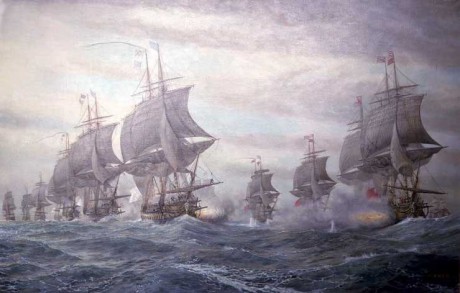
Yeah, my brain has continued to delve into my understanding of naval history and terminology, as checkered, incomplete and perhaps confused as it may be. Consider the naming of ships. A century ago Naval warfare was dominated by the "Battleship." The actual name "battleship" is a contraction of "line of battle ship", which referred to the 18th century naval tactic of lining up several "ships of the line" to fire massive multi-ship broadsides at the enemy. Back then a ship involved in the line of battle was not designated as a "battleship" but instead was designated as a "ship of the line". line_of_battle I find this sort of historical rumination to be incredibly fascinating. Back at the end of the 18th century, the newly created US Congress had approved the construction and maintenance of nine ships of the line. The first of these, as I recall, was the USS Independence, and as has become the custom since, the subsequent ships created in the same design were called "Independence class" ships of the line. At that time Great Britain probably had several dozen ships of the line, which should give some indication of the difference in naval power between the USA and Great Britain. It would be difficult, for example, to consider nine ships to constitute an "armada". And that would be if the US had actually completed the nine ships commissioned. In fact the USA had a rather dismal record in creating ships of the line. Attempts to build such ships during the Revolutionary War period were rapidly abandoned or the shipyards captured so no such ships were completed. An additional set of ships originally intended to be built around 1800 were abandoned as the USA decided to honor George Washington's admonition to avoid foreign entanglements. It wasn't until the aftermath of the War of 1812 that the USA decided that such a show of force would actually be beneficial, and while the resulting few ships of the line along with the small navy of frigates and other smaller ships might not have been much of a deterrent to the massive fleets of European nations, they did allow the USA to discourage piracy against US naval and merchant ships. Eventually the US did manage to launch the approved nine-ship "fleet" of such ships, but it took almost a decade to do so, and in the process several ships were aborted in the build process due to the rapidly changing nature of warfare. By the time the ninth ship was officially launched in 1820 the nature of naval combat was already changing due to the advancement of artillery technology, and the USA focused further shipbuilding on faster, smaller ships armed with more advanced guns. As for the "ships of the line" themselves, these first "battleships" for the most part had remarkably unimpressive careers. In part that was because the period between 1820 and the Civil War was a period the USA managed to avoid major conflict with European powers who could overwhelm the tiny American line. Most of the ships barely saw any combat at all and most served as flagships or performed diplomatic duties while the day-to-day naval engagements of the period were managed by the more numerous and less costly frigates of the navy. The Civil War itself introduced the concept of iron-clad ships and that so radically changed the nature of naval combat that ships of the line become obsolete more or less overnight. About the only thing that these ships bequeathed to their metal successors was the name "battleship" which was never an official designation until the Age of Sail was over and the steam-powered dreadnaughts ruled the seas.

Iron Lady Rust in Peace

By CosmicConservative
Margaret Thatcher has died. thatcher She always hated seeing the Anglosphere in decline, so I would not be surprised if she was ready to go. She will be missed. She and Reagan may well be the last great world leaders from the Anglosphere.

Pondering World of Warcraft

By CosmicConservative
So I was on a long conference call where I only had to apply about 1/4 of my brain so I ended up randomly reading through old posts on this blog. I managed to come across an old World of Warcraft post and ended up re-reading several old posts. I am a bit perplexed by my reaction to reading them. I'm about 33% wanting to play WoW or some other MMORPG again, about 33% "OMG, I used to do THAT?" and about 34% finding it difficult to even remember how much time and effort I used to put into raiding. I read old posts and they say things like "I wasn't able to commit to the Thursday night raid so I probably won't be able to play Wednesday either." Or a post makes it clear that I participated in four raid events in a week. Wow... Again, not sure if I'm ashamed of having allowed myself to participate in such a time sink, or if I'm proud of having accomplished the pinnacle of online gaming activities. Sort of like reading something written by someone else.
The Royal Cosmic

By CosmicConservative
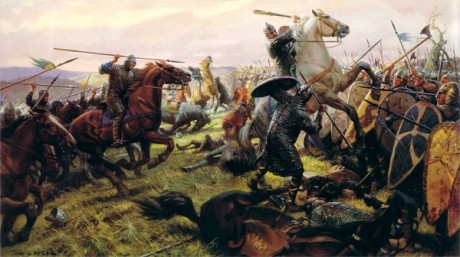
william-the-conqueror So, last night the Cosmic Mother sent me an interesting email detailing the supposed genealogical history of her maternal grandfather. The story (which was written up in a local newspaper upon his passing, so its got some level of credibility) is that at the age of 19, in 1893, this guy pulled up stakes and moved from Maine to Idaho, where he settled down to become a fixture as an early pioneer in the area. Now, think about that for a minute. Maine to Idaho. 1893. Now, I suppose he could have gone from Maine to Albuquerque and then up to Idaho, but in 1893 there weren't a whole lot of easy ways to get from Maine to Idaho. And the straightest, shortest, and most likely cheapest route took you through or very near the Lakota Sioux nation. No biggie right? Well, except that the last major "war" between the Lakota Sioux and the US Government took place in 1891. Just two years before my great-grandfather moseyed through that same region. That had to have been a gut-check. The guy must have had some serious cojones. But that's not what the story was about. That was a minor lead-in to the supposed family history of my great-grandfather. The real story was that he was supposedly a direct descendent of one of William the Conqueror's right-hand men in the "Battle of Hastings", which was the decisive battle for the control of England during the Norman Invasion. As a reward for his gallantry and bravery, William supposedly awarded my ancestor a royal appointment as Lord of a huge swath of land including some of England's most famous landmarks and towns. I'm not listing them because some of them are famous enough that a quick google search could probably determine who I am talking about. Anyway, this ancestor of mine had two sons. The eldest, of course, inherited all the lands, estates and fortune that William had granted to his father. The second son, as was the case in feudal society at the time, inherited nothing beyond a small estate and patronage. The eldest son had no male children, so all of that estate was absorbed back by the King and disposed of in the manner of Kings rewarding favored subjects. C'est la vie, I suppose. The younger son's children did OK over the years though. Most married well into other royal families and the genealogy indicates a number of important figures in the blood line, but the laws of inheritance favored only the first sons for many generations, and eventually one unfavored son apparently hopped on board one of the early ships sailing for the new world and appeared in Virginia in or around the mid-seventeenth century. It is from that individual that the Cosmic Mother's maternal line derives. Interesting stuff. If true then I have some slight taint of royal blood, and one of my ancestors was instrumental in the course of world history. Pretty cool. Of course I don't believe a word of it. But it's fun to speculate.

Not quite a Hall of Shame yet

By CosmicConservative
I'm pretty sure my regular readers know my position on this.

NEW YORK -- Steroid-tainted stars Barry Bonds, Roger Clemens and Sammy Sosa were denied entry to baseball's Hall of Fame, with voters failing to elect any candidates for only the second time in four decades.

Bonds received just 36.2 percent of the vote, Clemens 37.6 and Sosa 12.5 in totals announced Wednesday by the Hall and the Baseball Writers' Association of America. They were appearing on the ballot for the first time and have up to 14 more years to make it to Cooperstown.

via No players elected to Baseball Hall of Fame by writers - ESPN.

Craig Biggio got the most votes? He might make it next year? Well... I suppose you could make a case for him. Next year we see Greg Maddux and Tom Glavine. I suspect you'll see Greg Maddux get the highest percentage of first time votes of any player in decades.

RIP Peter Parker

By CosmicConservative
So, Peter Parker gets murdered.

In comic book publishing, the decision to kill off a long-running and beloved character may seem, at first glance, like a terribly unwise business move. But when Marvel Comics released its latest issue of Amazing Spider-Man—#700, which ends with Peter Parker, the webbed crusader’s alter ego, getting murdered—the issue began flying off the shelves.

via Death! Sex! The Comic Book Sales Bump - Businessweek.

Now "Spiderman" is a half black half latino dude name "Miles Morales". Meh. Who cares?

Magic Cards...

By CosmicConservative
A long time ago I used to play the game "Magic:The Gathering". I even played in a tournament once, and won a few games before being sent home by a guy with a deck full of moxes and lotuses (lotii?) If you don't know what moxes and lotii are, consider yourself lucky. Because the game was based on the concept of building decks out of randomly available cards, to play the game you had to buy packs of cards from which you would construct your deck. A pack of cards cost (back then) something like $7 and would contain one "rare" card, a couple "uncommon" cards and several "common" ones. Of course most of the best cards were rare so players ended up buying so many common and uncommon cards that they were virtually worthless, so the rare cards were the only ones that had any real value. I was unfortunate enough to begin playing just after the "beta" run, so my first purchases were from the "Unlimited" set (also known, I think, as "Third Edition") and the "Revised" set (aka "Fourth Edition"). The business model of the game is that you have the "base edition" cards, which make up the great bulk of cards sold, and then there are "expansion packs" which are "special" cards that you can add to your deck to make it more powerful, or just to mix things up with new creatures, spells or effects. Between each new edition, some cards are retired, others are added, but the bulk of the cards remain the same. The expansion packs are always completely new and different. Since I started after beta I missed out on purchasing the most collectible cards, some of which are worth hundreds of dollars even today, well after the Magic card market crashed about a decade ago. But I'm getting ahead of myself. So back then I was not willing to just shell out hundreds of dollars to buy cards (and neither was my wife) so I concocted a scheme to fund my Magic hobby. After building up a decent collection of reasonably valuable cards, I went to a local store which sold the cards and arranged a consignment sales system so that I sold my most valuable cards to individual buyers in search of specific cards to complete their decks. I paid the store 10% or something like that. But I made enough cash on the sale to purchase entire boxes of Magic Cards directly from Wizards of the Coast, which I would then open and pick out a few cards I wanted to play with, but then sold all the more valuable cards to fund more purchases of new cards. Doing this netted me a fairly substantial collection of cards, the vast majority of which were worthless. But some were valuable. I kept them in my basement home office in a couple of large cardboard boxes designed to hold collectible cards. I kept a few in a notebook with plastic card protectors. Then I went on vacation and my basement flooded. By the time I got home my entire collection had been in standing water (or under water) for days. They were totally ruined. Or most of them were. I did have one box I had stacked on top of other boxes and that box only had one section that had soaked up water. Surprisingly my insurance company paid for the lost cards at fair market value, which at that time was quite a bit more than I realized. I think I got over a thousand dollars for the ruined cards, money I used to buy my first serious amateur photography equipment. Equipment I sold a decade later to buy a guitar. So in a sense I guess my Magic hobby has funded two other hobbies, one of which I still enjoy. But I lost interest in Magic about that time and since then I've just kept that last batch of cards in a new box in my closet. I figured they weren't worth much, all of my really nice cards had been ruined. But for some reason, pure happenstance, that box included most of my "dual land" cards, cards that weren't that valuable back then, but have appreciated considerably since then. Last night just for kicks I pulled out my dual land cards and looked them up on eBay. My dual land cards are currently worth around $800 - $900. That's looking at what people are actually BIDDING on them, not what people are asking for them. Most of them are worth around $30 - $40, but a few are worth as much as $80 each, and I've got about two dozen of them. I do have a bunch of other rare cards, but most of them are only worth a buck or two. I probably have another two dozen cards that average in the $10 - $20 range. But all the rest of my cards are just junk. Wasted space. So I'm now trying to decide if I should sell out my cards for whatever I can get for them (I am estimating I can probably get $500 or so from a trader) or hang onto them in the hopes they appreciate more. My worry is that if I do wait, they will become worthless when Wizards releases a new edition or expansion that re-introduces the same card. I do have several cards that used to be valuable but are no longer worth anything because they were re-introduced. I'd hate to lose out on a potential for a chunk of cash because I waited too long.

A hero passes

By CosmicConservative

Neil Armstrong, the first man to walk on the moon, died Saturday, weeks after heart surgery and days after his 82nd birthday. 

Armstrong commanded the Apollo 11 spacecraft that landed on the moon on July 20, 1969, and he radioed back to Earth the historic news of "one giant leap for mankind." He spent nearly three hours walking on the moon with fellow astronaut Edwin "Buzz" Aldrin.

via Astronaut Neil Armstrong, first man to walk on moon, dies at age 82 - Cosmic Log.

Sad indeed. Neil Armstrong is the closest thing I probably have to a personal "hero" from popular culture, sports or science. People who know me know that I don't go much for hero-worship and I don't idolize people just because they were successful at one very visible thing. But Neil Armstrong was special. Neil Armstrong was like the George Washington of the astronauts and test pilots. Most people had or have a general awareness of Neil Armstrong but the respect Armstrong had from his peers is legendary. It is no simple coincidence that Neil Armstrong was the man that NASA pinned their hopes for the success of the most ambitious government program in the history of the world. People think of Neil Armstrong as an astronaut. But he was first, and in his mind, foremost, a pilot, and a test pilot at that. After serving his country with honor and distinction as a Naval aviator in the Korean War, Armstrong became one of the nation's elite test pilots and flew, among many others, the X-1, X-15 and the aborted but forward-looking "Dyna-soar" space vehicle. Armstrong was one of the first civilians to join the NASA astronaut program. And he did so in spite of the jeers of other test pilots such as Chuck Yeager who ridiculed astronauts as "monkeys", a reference to the practice of early test flights having primates strapped into the capsule to test survivability. Armstrong was the mission leader of "Gemini 8" and he and David Scott became the first men to successfully dock two spacecraft in orbit. The Apollo 11 mission has been documented and scrutinized for years, and yet still I am surprised by how few people realize what Armstrong did on that mission. One of the reasons for the ridicule of pilots like Yeager was that the program called for the entire moon landing sequence to be done by computer, with no human control. Of course Armstrong and the other Lunar Lander pilots were taught how to "fly" the Lunar Lander, but the hopes of the NASA engineers and administrators was that human intervention would not be needed. But that was not the case. If you listen to the tapes of the landing sequence, you will hear a very calm voice announce a code (I can't remember the exact code) but the code was supposed to mean a landing abort. Armstrong did not recognize the code (there were hundreds of codes possible that the pilots had to memorize, but this one either had not been on the list, or was one Armstrong failed to remember). Since it was not in his mental list of critical errors, Armstrong instead decided to continue the landing and within a few seconds a frantic mission control search of codes and their causes resulted in mission control agreeing with Neil's split-second decision. Continuing on, Neil recognized that the lunar scenery was "wrong". The landing site was chosen for it's smoothness, but Neil was seeing huge boulders and craters outside the window and saw nothing but more boulders and craters in the direction the lander was moving. Again Armstrong made the split-second decision to assume manual control of the Lander. Now. This is important. Flying a Lunar Lander is not like flying an aircraft. It's more like balancing a beach ball on four water jets. To "fly" the lander meant simultaneously controlling multiple rocket nozzles which adjusted the Lander's altitude, yaw and pitch. And it meant doing it in lunar gravity, something that was impossible to accurately simulate on earth. Neil was on his own, flying a brand-new rocket type in lunar gravity over a boulder-strewn landing area with nothing but a tiny window to look out of and with the entire world watching. His heart rate and blood pressure skyrocketed. But his voice does not falter for an instant. Because their descent had overshot their planned landing area by several miles, there was no way to get back to that location and Neil had to locate a flat area to land amidst all the boulders and craters visually through a window about the size of a dinner plate. Think about that. And at first he saw no safe place to land. He flew on, making his best guess from the limited view he had of where he might find a flat place to land. Every second spent precious fuel he could never get back. His blood pressure and heart rate remained at alarming levels, but he simply keeps looking. Finally, with no more than a few seconds of fuel left, he finds a spot and settles the Eagle down. It was because Armstrong believed that human reaction and adaptability would likely be required when the moment of truth came that he was able to shrug off the taunts of Chuck Yeager and the other non-astronaut test pilots. And in the end he flew the Eagle to a safe landing, something no "monkey" could have accomplished. And for all the years afterward Neil avoided the spotlight and fame that could have been his for the taking. He did his job, ignored those who tried to bring him down and delivered one of the most uplifting human achievements in human history and called it "just doing his job." Rare, rare man. He will be missed.