 So you can see that there is a roughly 10% difference in the apparent size of the moon (the "Super moon" is 12 - 13% larger in apparent size than the "Micro moon" if you want to be more accurate)
So, now having said that, this brings me to another bone of contention about people's general understanding of celestial events and their presumed significance.
I cannot tell you how many times in my life I have had a conversation with someone who has waxed poetic about the "impossibly improbable coincidence" that the sun and moon are the "exact same apparent size" in the sky, which allows for the most dramatic celestial showcase in our sky, the "total solar eclipse". Usually this is in the context of "proving" that the earth is so unique that it must have been divinely designed.
Well, the truth is that just as the moon varies in size by up to 13%, the earth's orbit is also an ellipse, meaning that the sun's apparent size also varies by a few percent over the course of the year (the earth is actually at apogee, meaning the sun is furthest away and therefore appears smallest in the sky in the summer for the Northern Hemisphere, which always seems to surprise people in America and Europe).
These two variations in the size of the earth and moon mean that solar eclipses also vary considerably, with some occuring when the sun is at its largest while the moon is at its smallest, and vice versa. When the moon's apparent size is significantly smaller than the sun's apparent size, that is known as an "annular solar eclipse" and during such an eclipse the edge of the sun will be visible all around the smaller moon. The reverse case means the moon will more fully obscure the sun, hiding more of the sun's solar prominences and corona. An eclipse where the sun and moon are almost exactly the same time is actually somewhat rare.
As the moon continues to spiral slowly farther and farther away from the earth, the moon's apparent size will continue to get smaller and smaller until eventually all solar eclipses will be annular eclipses.
The Moon, the Sun and common misperceptions
By CosmicConservativeOne of the things that is always able to get a chuckle out of me is "science reporting" in the news. The sheer level of stunning ignorance on display always gives me hope for the employability of the mentally disadvantaged.
Earlier this year the "big news" splashed across newspaper and web pages around the world was the awesome celestial display of the upcoming "Super Moon". A "Super Moon" is when the full moon occurs close to the moon's perigee (closest point in its orbit). This week the news has been somewhat less breathless, but the basic message has been similar because the last full moon we had was a "Micro Moon", which occurs when the full moon occurs close to the moon's apogee (farthest point in its orbit).
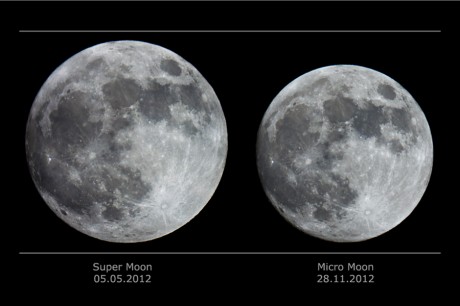
So, with all the breathless superlatives being slung around, you'd think that the actual moon in the sky would be dramatically different in size. The fact is that the great majority of people, and by great majority I mean on the order of 99.9% of them, would never have noticed any difference in the moon's size or brightness unless the NY Times ran a story about it. Not because the difference is negligible (it's not, see below) but because there is no real frame of reference in the sky that allows the human eye to really judge its size anyway, much less compare the size of a full moon to another several months later. Here is a photo of the moon comparing its relative size between "Super" and "Micro" moons:
So you can see that there is a roughly 10% difference in the apparent size of the moon (the "Super moon" is 12 - 13% larger in apparent size than the "Micro moon" if you want to be more accurate)
So, now having said that, this brings me to another bone of contention about people's general understanding of celestial events and their presumed significance.
I cannot tell you how many times in my life I have had a conversation with someone who has waxed poetic about the "impossibly improbable coincidence" that the sun and moon are the "exact same apparent size" in the sky, which allows for the most dramatic celestial showcase in our sky, the "total solar eclipse". Usually this is in the context of "proving" that the earth is so unique that it must have been divinely designed.
Well, the truth is that just as the moon varies in size by up to 13%, the earth's orbit is also an ellipse, meaning that the sun's apparent size also varies by a few percent over the course of the year (the earth is actually at apogee, meaning the sun is furthest away and therefore appears smallest in the sky in the summer for the Northern Hemisphere, which always seems to surprise people in America and Europe).
These two variations in the size of the earth and moon mean that solar eclipses also vary considerably, with some occuring when the sun is at its largest while the moon is at its smallest, and vice versa. When the moon's apparent size is significantly smaller than the sun's apparent size, that is known as an "annular solar eclipse" and during such an eclipse the edge of the sun will be visible all around the smaller moon. The reverse case means the moon will more fully obscure the sun, hiding more of the sun's solar prominences and corona. An eclipse where the sun and moon are almost exactly the same time is actually somewhat rare.
As the moon continues to spiral slowly farther and farther away from the earth, the moon's apparent size will continue to get smaller and smaller until eventually all solar eclipses will be annular eclipses.
Comments (0)
No comments on this post.