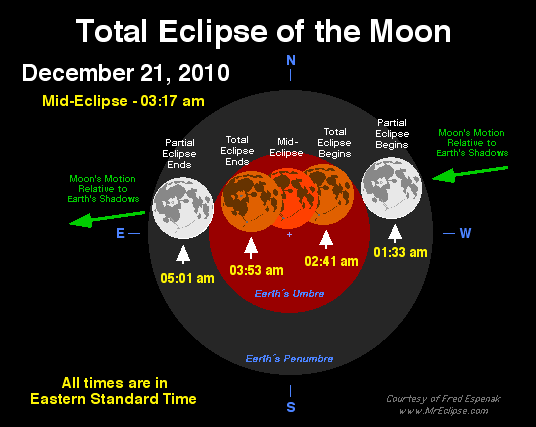
 Late tonight or early tomorrow morning, depending on where you live, there will be a lunar eclipse. This is the first time in several hundred years that the winter solstice and a lunar eclipse occur on the same calendar day. Prime viewing time will be around 3:00 am Eastern time, 2:00 am Central, 1:00 am Mountain and midnight Pacific time. That's when the moon will be entirely within the "umbra" or the portion of the earth's shadow which blocks all sunlight. For a couple hours before and after that, the moon will be moving through the penumbra and umbra which will give the moon a sort of unbalanced look. At the peak, when entirely within the umbra, the moon may appear to be reddish. How red it looks depends on a variety of atmospheric conditions on the earth. If the sun's light goes through portions of the atmosphere that are dusty or contain stormclouds, the redness might be more than if the light mostly passes through clear skies. In this case NASA is suggesting that conditions might be optimal for the moon to appear very red.
A lunar eclipse happens when the moon's orbit takes it directly through the earth's shadow, so it always happens on a full moon.
If you've never seen a lunar eclipse, and you can stay up that late, it's worth seeing. Of course you can just look at all the photos taken by amateur astronomers the next morning too...
Lunar Eclipse tonight
By CosmicConservative
Late tonight or early tomorrow morning, depending on where you live, there will be a lunar eclipse. This is the first time in several hundred years that the winter solstice and a lunar eclipse occur on the same calendar day. Prime viewing time will be around 3:00 am Eastern time, 2:00 am Central, 1:00 am Mountain and midnight Pacific time. That's when the moon will be entirely within the "umbra" or the portion of the earth's shadow which blocks all sunlight. For a couple hours before and after that, the moon will be moving through the penumbra and umbra which will give the moon a sort of unbalanced look. At the peak, when entirely within the umbra, the moon may appear to be reddish. How red it looks depends on a variety of atmospheric conditions on the earth. If the sun's light goes through portions of the atmosphere that are dusty or contain stormclouds, the redness might be more than if the light mostly passes through clear skies. In this case NASA is suggesting that conditions might be optimal for the moon to appear very red.
A lunar eclipse happens when the moon's orbit takes it directly through the earth's shadow, so it always happens on a full moon.
If you've never seen a lunar eclipse, and you can stay up that late, it's worth seeing. Of course you can just look at all the photos taken by amateur astronomers the next morning too...
Comments (10)