My mind was wandering earlier today and stumbled across this little gem somewhere in the depths of my cranium... Superman would be a much more interesting comic book if kryptonite was addictive.
Well, apparently this movie is setting all kinds of Christmas season movie records. I expected it to do well, but I honestly did not expect it to do as well as it is doing so far. It will be interesting to see what sort of legs it has.
I am still bemused by the decision to take this short little enchanting fairy tale and turn it into three movies. When I first heard it was going to be TWO movies I sort of shook my head and chalked it up to pure, unadulterated greed.
I still think it's primarily greed that is driving the decision to split this into three movies. However, I will do my best to address the movie on its own merits instead of from the perspective of how it will make untold additional billions for the filmmakers and New Zealand tourism.
So, how was the movie?
It was fun. There are too many dwarves to keep track of, but I felt that way when reading the book, so that's not really a knock on the movie. Had they reduced the number of dwarves to make the characters easier to follow, there would have been howls of protest from all quarters (including this one) so I just sort of had to accept that the dwarves had to be viewed more or less as some sort of ensemble cast playing one role. Other than Thorin that is. So in my mind the movie really became the story of Bilbo, Gandalf, Thorin and a bunch of nameless, faceless minions of Thorin. Which was fine. I do wish they had done a bit more connection between Bilbo and either Fili or Dwalin, since I believe that was true in the book. They sorta tried in a few scenes but since the dwarves all blended into one faceless mass, when Bilbo had any one-on-one time with an individual non-Thorin dwarf, it was just too hard to try to remember which one it was, so there wasn't any real connection there.
In terms of content the movie had three major elements. Those were:
1. Stuff from the actual book.
2. Stuff from supplemental material associated with LotR, the Silmarillion, appendices and random notes in Chris Tolkien's head.
3. Stuff the movie makers just made up for fun.
In some respects these three elements worked well together. I liked the exploration of the activities in Dol Goldur. When reading the book I felt Tolkien had left that too mysterious and unresolved, and LotR never really explained what had happened either. So I actually thought weaving the Dol Goldur and White Council story elements into the overall Hobbit plot worked both from a narrative and a thematic perspective. I was, in fact, somewhat disappointed that they didn't have a short sequence with Aragorn and Arwen at Rivendell. If I recall the timeline from the several books properly, during Bilbo's adventure is just about when Aragorn and Arwen were spooning in the dark corners of Rivendell under the disapproving glare of Elrond. I think that would have been pretty cool to put into the story. Plus any chance to see Liv Tyler in a see-through elvish gown is always appreciated...
But in other respects this weaving together of the different elements was jarring and interrupted the story too much. Radagast the Brown was perhaps the worst of this. I have no idea why they deliberately made Radagast such a disgusting and nearly incompetent figure. In the books he is only mentioned briefly and in passing, but when he is mentioned Gandalf speaks highly of him and he is described as a sort of middle earth druid who protects the wild from evil forces. Saruman does indeed sneer at Radagast, but Saruman's sneering is one of the key foreshadowings of Saruman's eventual fall into evil. In the movie Saruman's sneering is entirely justified. Radagast is played for comedic effect and is so cartoonish that he comes off as a cross between Shaggy from Scooby-doo and Tommy Chong. Instead of foreshadowing Saruman's fall, Gandalf comes across as someone whose judgment might well be awry.
The most jarring aspect of the movie though is how the movie would stick almost literally word-for-word to the book for long (sometimes boring) sections, presumably to satisfy the fanbois who demand such things, but then would immediately go off on a completely made up action sequence that had no connection whatsoever to the original tale. It felt like Peter Jackson quite deliberately told the writers "throw the fanbois a few bones and we can do whatever we want".
For the most part those segments not only worked from a movie perspective, but they added some narrative elements that do tie the story into the larger LotR perspective. Which, again, I am mostly fine with. The vast majority of movie watchers will not read the book, so what the book says is largely irrelevant to them. What matters is whether the story is true to Tolkien's intentions and provides a story that people find entertaining.
And it does.
The main thing I have to say is that there was nothing in the movie that bothered me as much as the treatment of Frodo, Sam and Farimir bothered me in the LotR movies. I don't mind making stuff up if it doesn't violate the character concepts or hijack the plot. The stuff in "The Hobbit" (Radagast aside) was the sort of embellishment I was not only OK with, but in some cases I enjoyed.
So in the end I thought it was definitely worth seeing. It might not satisfy some purists, but I had a rollicking good time, and Bilbo came off very much the way I imagined Bilbo from the story.
I give it 4 out of 5 Rings of Power. CC says check it out.
New to me anyway...
So pretty much all of the 3D printers I've been posting about and watching for the past few years have been one of two basic techniques, one of which has two basic technologies.
The first technique is the "extrude and build up" technology. This is when you take a long thread or strip of plastic or ABS or some other material and it is pushed through a guide (the "extruder") and then heated at the tip (the "print head") so it melts and deposits a bit of material which then builds up the object.
The second technique is for the printer to be full of a material and the top of the material has some binding agent, or melting process which creates a layer of solid material, which is then pulled below the surface and another layer is bound or melted on top. This is done both with liquids (which are usually bound with ultraviolet or laser light) and with powders (which are usually melted or solidified using a binding agent, like glue).
In general the low cost printers are those that use the extruder build-up process and the higher cost, higher quality printers are the ones that use the dust or liquid.
But there is a new type of printer that I saw in my "Make" magazine, and I find it really intriguing. It uses a UV activated liquid resin and an off-the-shelf projector to create the layers. the layers are built up from below (meaning the image is projected through a layer of glass from underneath).
The reason I find this new printer so intriguing is that it doesn't build the object bit by bit. It actually solidifies an entire layer of resin all at once by focusing an image of the object layer onto the resin. So each layer is a solid sheet of hardened resin, with no weak spots where the material was glued together, nor are there any areas where the material dangles or drips because the print head had to move with some melted plastic or binding agent still dripping off (they call that "stringing"). So it creates exceptionally clean, smooth results. Plus they are as detailed as the projector can focus in the X-Y dimensions, and as detailed as the machinery can elevate the object in the Z dimension. The results of the prototype I saw were simply stunningly detailed and smooth compared to the other printers.
I was totally blown away.
The prototype I saw will end up costing about $2,500 I think. And it has a "build area" of about 4x4x4 inches, which is pretty tiny.
But wow, what awesome results.
Lindsay Lohan is in hot water again — she punched another woman in the face while in a Manhattan nightclub early Thursday, police sources said.
Lohan was questioned, along with witnesses, at the NYPD's 10th Precinct stationhouse. She is expected to be charged with misdemeanor assault for the 4 a.m dust-up inside Avenue, a Chelsea hot spot on 10th Ave.
A police source said it appears Lohan, 26, and the victim, Tiffany Eve Mitchell, 28, of West Palm Beach, Fla., were sitting in separate VIP sections when a scuffle involving other club-goers broke out.
I long ago concluded that Lindsey Lohan is determined to become the next Marilyn Monroe, and since her acting skills continue to degrade as her body is being battered by surgical procedures and hard drugs, eventually she will conclude that the only way to get the attention she craves will be to become a tragic figure.
The problem Lohan has in this regard is that the reason she can't be the next Marilyn Monroe is that she lacks pretty much every attribute that made Marilyn Monroe Marilyn Monroe. While Lohan is (or used to be) attractive enough in a "freckle-faced kid next door" sort of way, she has never had the sheer glam factor that Monroe had, and as her face and body are slowly being destroyed by plastic surgery and drugs, she is getting farther away from that goal, not closer. Coupled with the sheer lack of sex appeal is the complete lack of focus on acting as a craft. Lindsey Lohan was a vastly more appealing and accomplished actress a decade ago. And she continues to get worse as she goes.
A sad story really.
One of the things that is always able to get a chuckle out of me is "science reporting" in the news. The sheer level of stunning ignorance on display always gives me hope for the employability of the mentally disadvantaged.
Earlier this year the "big news" splashed across newspaper and web pages around the world was the awesome celestial display of the upcoming "Super Moon". A "Super Moon" is when the full moon occurs close to the moon's perigee (closest point in its orbit). This week the news has been somewhat less breathless, but the basic message has been similar because the last full moon we had was a "Micro Moon", which occurs when the full moon occurs close to the moon's apogee (farthest point in its orbit).
So, with all the breathless superlatives being slung around, you'd think that the actual moon in the sky would be dramatically different in size. The fact is that the great majority of people, and by great majority I mean on the order of 99.9% of them, would never have noticed any difference in the moon's size or brightness unless the NY Times ran a story about it. Not because the difference is negligible (it's not, see below) but because there is no real frame of reference in the sky that allows the human eye to really judge its size anyway, much less compare the size of a full moon to another several months later. Here is a photo of the moon comparing its relative size between "Super" and "Micro" moons:
So you can see that there is a roughly 10% difference in the apparent size of the moon (the "Super moon" is 12 - 13% larger in apparent size than the "Micro moon" if you want to be more accurate)
So, now having said that, this brings me to another bone of contention about people's general understanding of celestial events and their presumed significance.
I cannot tell you how many times in my life I have had a conversation with someone who has waxed poetic about the "impossibly improbable coincidence" that the sun and moon are the "exact same apparent size" in the sky, which allows for the most dramatic celestial showcase in our sky, the "total solar eclipse". Usually this is in the context of "proving" that the earth is so unique that it must have been divinely designed.
Well, the truth is that just as the moon varies in size by up to 13%, the earth's orbit is also an ellipse, meaning that the sun's apparent size also varies by a few percent over the course of the year (the earth is actually at apogee, meaning the sun is furthest away and therefore appears smallest in the sky in the summer for the Northern Hemisphere, which always seems to surprise people in America and Europe).
These two variations in the size of the earth and moon mean that solar eclipses also vary considerably, with some occuring when the sun is at its largest while the moon is at its smallest, and vice versa. When the moon's apparent size is significantly smaller than the sun's apparent size, that is known as an "annular solar eclipse" and during such an eclipse the edge of the sun will be visible all around the smaller moon. The reverse case means the moon will more fully obscure the sun, hiding more of the sun's solar prominences and corona. An eclipse where the sun and moon are almost exactly the same time is actually somewhat rare.
As the moon continues to spiral slowly farther and farther away from the earth, the moon's apparent size will continue to get smaller and smaller until eventually all solar eclipses will be annular eclipses.
A long time ago I used to play the game "Magic:The Gathering". I even played in a tournament once, and won a few games before being sent home by a guy with a deck full of moxes and lotuses (lotii?)
If you don't know what moxes and lotii are, consider yourself lucky.
Because the game was based on the concept of building decks out of randomly available cards, to play the game you had to buy packs of cards from which you would construct your deck. A pack of cards cost (back then) something like $7 and would contain one "rare" card, a couple "uncommon" cards and several "common" ones. Of course most of the best cards were rare so players ended up buying so many common and uncommon cards that they were virtually worthless, so the rare cards were the only ones that had any real value.
I was unfortunate enough to begin playing just after the "beta" run, so my first purchases were from the "Unlimited" set (also known, I think, as "Third Edition") and the "Revised" set (aka "Fourth Edition"). The business model of the game is that you have the "base edition" cards, which make up the great bulk of cards sold, and then there are "expansion packs" which are "special" cards that you can add to your deck to make it more powerful, or just to mix things up with new creatures, spells or effects.
Between each new edition, some cards are retired, others are added, but the bulk of the cards remain the same. The expansion packs are always completely new and different. Since I started after beta I missed out on purchasing the most collectible cards, some of which are worth hundreds of dollars even today, well after the Magic card market crashed about a decade ago. But I'm getting ahead of myself.
So back then I was not willing to just shell out hundreds of dollars to buy cards (and neither was my wife) so I concocted a scheme to fund my Magic hobby. After building up a decent collection of reasonably valuable cards, I went to a local store which sold the cards and arranged a consignment sales system so that I sold my most valuable cards to individual buyers in search of specific cards to complete their decks. I paid the store 10% or something like that. But I made enough cash on the sale to purchase entire boxes of Magic Cards directly from Wizards of the Coast, which I would then open and pick out a few cards I wanted to play with, but then sold all the more valuable cards to fund more purchases of new cards.
Doing this netted me a fairly substantial collection of cards, the vast majority of which were worthless. But some were valuable. I kept them in my basement home office in a couple of large cardboard boxes designed to hold collectible cards. I kept a few in a notebook with plastic card protectors.
Then I went on vacation and my basement flooded. By the time I got home my entire collection had been in standing water (or under water) for days. They were totally ruined. Or most of them were. I did have one box I had stacked on top of other boxes and that box only had one section that had soaked up water.
Surprisingly my insurance company paid for the lost cards at fair market value, which at that time was quite a bit more than I realized. I think I got over a thousand dollars for the ruined cards, money I used to buy my first serious amateur photography equipment. Equipment I sold a decade later to buy a guitar. So in a sense I guess my Magic hobby has funded two other hobbies, one of which I still enjoy.
But I lost interest in Magic about that time and since then I've just kept that last batch of cards in a new box in my closet. I figured they weren't worth much, all of my really nice cards had been ruined.
But for some reason, pure happenstance, that box included most of my "dual land" cards, cards that weren't that valuable back then, but have appreciated considerably since then.
Last night just for kicks I pulled out my dual land cards and looked them up on eBay.
My dual land cards are currently worth around $800 - $900. That's looking at what people are actually BIDDING on them, not what people are asking for them. Most of them are worth around $30 - $40, but a few are worth as much as $80 each, and I've got about two dozen of them.
I do have a bunch of other rare cards, but most of them are only worth a buck or two. I probably have another two dozen cards that average in the $10 - $20 range.
But all the rest of my cards are just junk. Wasted space.
So I'm now trying to decide if I should sell out my cards for whatever I can get for them (I am estimating I can probably get $500 or so from a trader) or hang onto them in the hopes they appreciate more. My worry is that if I do wait, they will become worthless when Wizards releases a new edition or expansion that re-introduces the same card. I do have several cards that used to be valuable but are no longer worth anything because they were re-introduced. I'd hate to lose out on a potential for a chunk of cash because I waited too long.
I have been invited to join a group of shooting enthusiasts this Saturday for a full day of shooting prairie dogs on some private land where the owner of the land has deemed the prairie dogs to be dangerous pests which threaten his horses and cattle.
The purpose of the activity appears to be a combination of lots of alcoholic beverages, bushels of gunpowder, metric tons of lead and a keen application of ballistic principles to the liberation of smelly rodents from their vital organs.
So, given the opportunity, what would you do?
One of the things I have seen suggested by certain "scientists" over the past few decades is the idea that humanity's evolution is no longer moving in a positive direction with regard to intelligence. A common theory is that because the day-to-day fight to survive pressure is no longer common in the industrialized world, humans are not merely no longer advancing, but are actually declining. There was a story floating around the internet earlier this week where a prominent evolutionary scientist was claiming that a human of 10,000 years ago would be smarter, have better memory and be able to react more appropriately to danger than a modern human.
Some of this comes from what I have come to call the theory of evolutionary entropy. That theory suggests that evolution progresses in the direction of stress, and in the absence of stress, traits degrade. The most commonly cited evidence of this tendency is the common "rail" family of birds, which includes a huge variety of short rounded-winged birds, most of which prefer to run on the ground unless forced to take to the air. Rails are poor flyers and as such tend to get blown around by storms a lot. This, somewhat paradoxically, seems to have made them one of the most successful island colonizers among non-seafaring birds. The rationale behind this is that rails tend to get blown off course easily and can be carried hundreds or even thousands of miles off course by strong storm systems (typhoons, hurricanes, Michelle Obama).
Because rails are so widespread, and tend to be island colonizers, it has not been uncommon over the geologic timescale for them to end up on islands with no natural predators and abundant food. In such cases rails tend to lose the ability to fly. This, and similar lack of evolutionary "pressure" has led some scientists to conclude that successful traits will breed out quickly in the absence of survival pressure.
So they conclude that intelligence in humans is suffering the same fate.
Now, I have to admit that when I look at human culture I sort of have to wonder about this theory. It could even be argued that many modern societies tend to selectively breed for what were once considered undesirable traits, such as sloth, ignorance and a desire to watch TV shows like "Honey Boo-boo."
It would certainly explain the recent rise and potential dominance of the Democrat party.
However, I am not convinced that it's true. First of all, evolution tends to work on timescales that dwarf our cultural frame of reference, so even if it is happening, it is hard to believe that it could be happening fast enough to explain the elections of, for example, Barack Obama or Joe Biden. Also I actually tend to believe that the modern environment humans live in is far more difficult and complex than anything our forebears of 10,000 years ago faced. Humans as a species have not been "pushed" to survive since the introduction of agriculture, which can be traced back at least 10,000 years. And in all that time every culture has had its share of indolent, intellectually vapid citizens. But in spite of that, human technology and culture has evolved and "advanced" at an ever accelerating rate, and shows no signs of stopping now.
Give Obama's policies a million years or so and I suspect we might see a general decline in IQ. But I just don't see it happening in a few, or even a few hundred, generations.

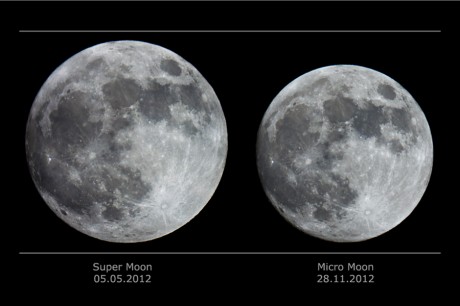 So you can see that there is a roughly 10% difference in the apparent size of the moon (the "Super moon" is 12 - 13% larger in apparent size than the "Micro moon" if you want to be more accurate)
So, now having said that, this brings me to another bone of contention about people's general understanding of celestial events and their presumed significance.
I cannot tell you how many times in my life I have had a conversation with someone who has waxed poetic about the "impossibly improbable coincidence" that the sun and moon are the "exact same apparent size" in the sky, which allows for the most dramatic celestial showcase in our sky, the "total solar eclipse". Usually this is in the context of "proving" that the earth is so unique that it must have been divinely designed.
Well, the truth is that just as the moon varies in size by up to 13%, the earth's orbit is also an ellipse, meaning that the sun's apparent size also varies by a few percent over the course of the year (the earth is actually at apogee, meaning the sun is furthest away and therefore appears smallest in the sky in the summer for the Northern Hemisphere, which always seems to surprise people in America and Europe).
These two variations in the size of the earth and moon mean that solar eclipses also vary considerably, with some occuring when the sun is at its largest while the moon is at its smallest, and vice versa. When the moon's apparent size is significantly smaller than the sun's apparent size, that is known as an "annular solar eclipse" and during such an eclipse the edge of the sun will be visible all around the smaller moon. The reverse case means the moon will more fully obscure the sun, hiding more of the sun's solar prominences and corona. An eclipse where the sun and moon are almost exactly the same time is actually somewhat rare.
As the moon continues to spiral slowly farther and farther away from the earth, the moon's apparent size will continue to get smaller and smaller until eventually all solar eclipses will be annular eclipses.