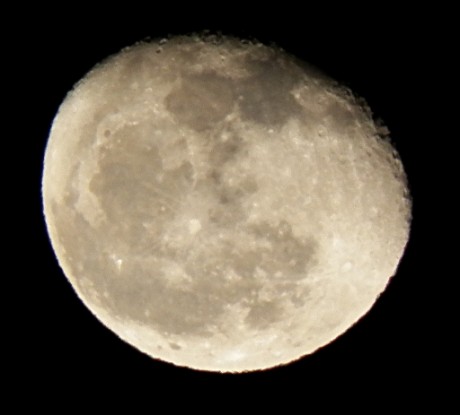
 It's not quite terrible, you can make out some features, but it's clearly not perfectly focused or exposed.
I'll try again. I also want to try stacking photos using some open source stacking software called "Registack". That is supposed to allow you to get more detail by combining data from multiple images.
Haven't figured that out though... And it's late, so I'm going to bed.
I actually scaled it down from it's original size. The raw image had the moon in a roughly 800 by 800 pixel area. That's pretty good actually, for a cheap point and shoot camera...
Moonshot
By CosmicConservativeSo I finally figured out how to use my camera's program modes and manual focusing capability. Or mostly anyway.
This is a photo of the moon I took. It was too cold to mess around much, so I only took three photos (it isn't really easy to reset shutter speed or manually focus this thing, I'm afraid to say... but you CAN do it).
It's not quite terrible, you can make out some features, but it's clearly not perfectly focused or exposed.
I'll try again. I also want to try stacking photos using some open source stacking software called "Registack". That is supposed to allow you to get more detail by combining data from multiple images.
Haven't figured that out though... And it's late, so I'm going to bed.
I actually scaled it down from it's original size. The raw image had the moon in a roughly 800 by 800 pixel area. That's pretty good actually, for a cheap point and shoot camera...
Comments (4)