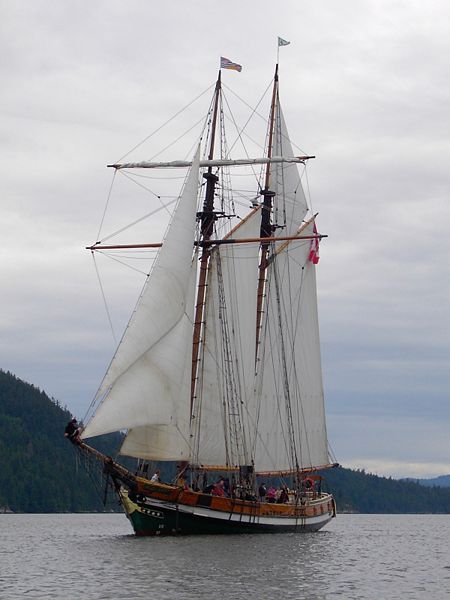
 You know how you know it's a schooner? Well, neither did I.
Turns out that schooners are two or more masted sailing ships whose rear mast is either the same size as the front mast, or is slightly larger. In fact the rear mast is the "main mast" which makes the front mast a "fore-mast." Schooners are also "fore and aft rigged" ships. That means the main mast (and usually the foremast) have sails that are parallel to the ship's length and are mounted in front of and behind the mast. There are lots of variations on the fore and aft rigging, the most common in modern times being the "bermuda rig".
The alternative to "fore and aft rigged" is called "square rigged". Square rigging means the sails are perpendicular to the length of the ship.
In the photo above, the main sails are fore and aft, with the classic triangular shape of fore and aft rigged sails. However, you will notice that there are some wooden "arms" located at the top of the mast that seem to be "square rigged." And in fact they are, but they are for "top sails" which are sails that are put on above the main sails to add additional lift to the ship. In this case, for this schooner, those are mounted as square rigged topsails. I don't know if that's standard or just something this particular ship did.
I can't claim to have understood even a fraction of what I read, but in general it appears that the advantage of square rigging is that it allows more sail area to be presented to a downwind track. That is good because it provides more thrust for the ship (actually I think they call it "lift") when it is sailing downwind. Unfortunately that is at the expense of the ability to sail UPwind. This is what the bermuda rigging (and other fore and aft rigs) excel at. The reason is because of the ratio of "lift" to "drag". A ship with high lift and low drag can sail upwind easier than a ship with high lift and high drag. If I understand it, which is debatable, square rigged ships can be built larger to carry more goods, but fore and aft rigged ships, with their lower drag, are faster, but generally can't be built as large as square rigged ones. The Clipper Ship that started this whole thing was a fore and aft rigged multi-masted schooner usually with square-rigged topsails (as in the photo). Clipper ships set and still hold virtually every commercial sailing speed record ever set. The fastest recorded speed of a commercial or military sailing ship was set by a clipper ship at 22 knots, which is pretty dang fast. Many clipper ships could average over 15 knots while sailing on the trade winds. Even today that's nothing to sneeze at. As a point of national pride, virtually every such record is held by an AMERICAN built and AMERICAN crewed Clipper ship.
There is a whole lot more to this. I can see why "old salts" who had a lifetime of experience in sailing ships were so prized by shipmasters. The more I read about the different types of sails, masts, riggings and ship types, the more I am amazed that people were able to sail such ships around the world. Some of those ships had seven or eight masts, some masts square-rigged, some rigged fore and aft, with additional jibs, spinnakers, topsails and other things that it simply blows my mind that anyone could keep track of what all those sails were supposed to do as the wind rose, fell and changed direction on a whim.
I can understand why people would look back on the age of sail and view it with a romantic filter. There is something majestic and elegant about a ship that made its way around the world simply on the strength of its crew, its wooden construction, its sails and the ropes that controlled them.
A typical trip from Australia to England took about three months. Virtually all of that was at sea. A "fast" ship could make that trip in about 70 days. That's 70 days of nonstop adjusting of the sails as the wind changed.
One of these days I'd like to go to sea on such a ship, just to experience it.
The age of sail...
By CosmicConservativeTonight, as I continue to recover from my recent surgery, I did something I haven't done in a while. I truly "surfed" the Internet.
Years ago I used to surf the internet a lot. To me "surfing" the internet is when you bounce willy-nilly from one hyperlinked reference to another taking you wherever your whim takes you. To surf well you have to have well linked articles, and there is no better place to find such articles than the Wikipedia.
I don't remember how I first followed the trail, but I ended up looking up "clipper ship." Clipper ships are an almost forgotten chapter in American history. They were a specific type of sailing ship that the United States excelled at building, and the fleet of clipper ships that the U.S. sent to the world's seas did a lot to put the United States literally and figuratively on the global map.
I learned that I know almost nothing about sailing ships. And I mean almost nothing. And I thought I knew a little bit about them. But the more I clicked through one link after another, the more I realized that I know nothing at all about what is probably the most daring and romantic period of human exploration in our entire history. The Age of Sail.
Here is a photo of a "schooner."
You know how you know it's a schooner? Well, neither did I.
Turns out that schooners are two or more masted sailing ships whose rear mast is either the same size as the front mast, or is slightly larger. In fact the rear mast is the "main mast" which makes the front mast a "fore-mast." Schooners are also "fore and aft rigged" ships. That means the main mast (and usually the foremast) have sails that are parallel to the ship's length and are mounted in front of and behind the mast. There are lots of variations on the fore and aft rigging, the most common in modern times being the "bermuda rig".
The alternative to "fore and aft rigged" is called "square rigged". Square rigging means the sails are perpendicular to the length of the ship.
In the photo above, the main sails are fore and aft, with the classic triangular shape of fore and aft rigged sails. However, you will notice that there are some wooden "arms" located at the top of the mast that seem to be "square rigged." And in fact they are, but they are for "top sails" which are sails that are put on above the main sails to add additional lift to the ship. In this case, for this schooner, those are mounted as square rigged topsails. I don't know if that's standard or just something this particular ship did.
I can't claim to have understood even a fraction of what I read, but in general it appears that the advantage of square rigging is that it allows more sail area to be presented to a downwind track. That is good because it provides more thrust for the ship (actually I think they call it "lift") when it is sailing downwind. Unfortunately that is at the expense of the ability to sail UPwind. This is what the bermuda rigging (and other fore and aft rigs) excel at. The reason is because of the ratio of "lift" to "drag". A ship with high lift and low drag can sail upwind easier than a ship with high lift and high drag. If I understand it, which is debatable, square rigged ships can be built larger to carry more goods, but fore and aft rigged ships, with their lower drag, are faster, but generally can't be built as large as square rigged ones. The Clipper Ship that started this whole thing was a fore and aft rigged multi-masted schooner usually with square-rigged topsails (as in the photo). Clipper ships set and still hold virtually every commercial sailing speed record ever set. The fastest recorded speed of a commercial or military sailing ship was set by a clipper ship at 22 knots, which is pretty dang fast. Many clipper ships could average over 15 knots while sailing on the trade winds. Even today that's nothing to sneeze at. As a point of national pride, virtually every such record is held by an AMERICAN built and AMERICAN crewed Clipper ship.
There is a whole lot more to this. I can see why "old salts" who had a lifetime of experience in sailing ships were so prized by shipmasters. The more I read about the different types of sails, masts, riggings and ship types, the more I am amazed that people were able to sail such ships around the world. Some of those ships had seven or eight masts, some masts square-rigged, some rigged fore and aft, with additional jibs, spinnakers, topsails and other things that it simply blows my mind that anyone could keep track of what all those sails were supposed to do as the wind rose, fell and changed direction on a whim.
I can understand why people would look back on the age of sail and view it with a romantic filter. There is something majestic and elegant about a ship that made its way around the world simply on the strength of its crew, its wooden construction, its sails and the ropes that controlled them.
A typical trip from Australia to England took about three months. Virtually all of that was at sea. A "fast" ship could make that trip in about 70 days. That's 70 days of nonstop adjusting of the sails as the wind changed.
One of these days I'd like to go to sea on such a ship, just to experience it.
Comments (3)