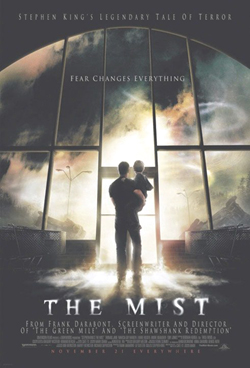
 There is something in the mist, but it really doesn't matter because this film is more about the people trapped by the mysterious mist in a small town grocery store. The Mist is pure social commentary masquerading as a half-way decent horror flick.
When I learned Frank Darabont, director of The Shawshank Redemption and The Green Mile, was adapting Stephen King's story and directing this film, I knew I had to see it. Shawshank is one of my favorite films. A near perfect picture that never ceases to move me with its profound message of hope and redemption.
The Mist is not nearly as hopeful. In fact, it's nihilistic. It's a social commentary that beats you about the head until you are left bloody and whimpering for mercy. I'm not a huge fan of nihilism and was put off by this aspect of the film.
But the movie is interesting; you might say it's a thinking man's horror flick. The premise is bare-bones simple: a strange mist rolls into a small coastal village after a night of raging storms. It doesn't take long to discover that something malevolent is lurking in the mist and it's not averse to snacking on humans for breakfast, lunch, or dinner. A couple dozen villagers manage to barricade themselves into the local grocery store with the mist just on the other side of the glass doors.
I knew going into this film that it was a social commentary of sorts so I spent a great deal of time playing spot-the-metaphor. That game soon deteriorated into a game of spot-the-stereotype. Darabont is anything but subtle in this film. The film's tagline - fear changes everything - essentially tells us The Mist is a comment on how fear changes us. This mist is fear - ambiguous, amorphous, menacing, mysterious and ubiquitous. Thus, the most compelling quality of this film is witnessing how the characters react to the menace and realizing that their reactions are a microcosm of the human condition. Hat tip to Darabont for making the effort.
But, he's guilty of employing offensive stereotypes to make the point. Fear of the mist begins to drive some of the villagers to faith, and, of course, these otherwise reasonable people decide to adopt of brand of faith being advocated by an insane woman (Marcia Gay Harden) that quickly descends into bloodlust and human sacrifice. Of course, she's an insane Christian. This annoys me, but I do understand the point Darabont is making - fear of the unknown drives people to religion (some would argue fear led humans to invent religion) and all too often religion has been a catalyst for violence. In our present world, it is Muslims who are using faith to justify horrific acts of violence. So, why did the character in this film have to be a knife-wielding, wild-eyed Christian? Just wondering.
The crazy religious woman provided some of the more dramatic moments in this film, but she did not upstage in any way the strange creatures that inhabit the mist. While the creature CGI may have been somewhat below my expectations, they proved to be sufficiently creepy and provided some excellent classic horror moments. The were squirm-inducing to say the least.
In spite of its nihilistic theme, I was for the most part entertained by this movie. The script is intelligent, the acting is engaging, and the social commentary is legitimately thought provoking. Who would have thought blood-sucking spiders from another dimension could be part of a compelling lesson on human nature?
Movie Review - The Mist
By Dadman
There is something in the mist, but it really doesn't matter because this film is more about the people trapped by the mysterious mist in a small town grocery store. The Mist is pure social commentary masquerading as a half-way decent horror flick.
When I learned Frank Darabont, director of The Shawshank Redemption and The Green Mile, was adapting Stephen King's story and directing this film, I knew I had to see it. Shawshank is one of my favorite films. A near perfect picture that never ceases to move me with its profound message of hope and redemption.
The Mist is not nearly as hopeful. In fact, it's nihilistic. It's a social commentary that beats you about the head until you are left bloody and whimpering for mercy. I'm not a huge fan of nihilism and was put off by this aspect of the film.
But the movie is interesting; you might say it's a thinking man's horror flick. The premise is bare-bones simple: a strange mist rolls into a small coastal village after a night of raging storms. It doesn't take long to discover that something malevolent is lurking in the mist and it's not averse to snacking on humans for breakfast, lunch, or dinner. A couple dozen villagers manage to barricade themselves into the local grocery store with the mist just on the other side of the glass doors.
I knew going into this film that it was a social commentary of sorts so I spent a great deal of time playing spot-the-metaphor. That game soon deteriorated into a game of spot-the-stereotype. Darabont is anything but subtle in this film. The film's tagline - fear changes everything - essentially tells us The Mist is a comment on how fear changes us. This mist is fear - ambiguous, amorphous, menacing, mysterious and ubiquitous. Thus, the most compelling quality of this film is witnessing how the characters react to the menace and realizing that their reactions are a microcosm of the human condition. Hat tip to Darabont for making the effort.
But, he's guilty of employing offensive stereotypes to make the point. Fear of the mist begins to drive some of the villagers to faith, and, of course, these otherwise reasonable people decide to adopt of brand of faith being advocated by an insane woman (Marcia Gay Harden) that quickly descends into bloodlust and human sacrifice. Of course, she's an insane Christian. This annoys me, but I do understand the point Darabont is making - fear of the unknown drives people to religion (some would argue fear led humans to invent religion) and all too often religion has been a catalyst for violence. In our present world, it is Muslims who are using faith to justify horrific acts of violence. So, why did the character in this film have to be a knife-wielding, wild-eyed Christian? Just wondering.
The crazy religious woman provided some of the more dramatic moments in this film, but she did not upstage in any way the strange creatures that inhabit the mist. While the creature CGI may have been somewhat below my expectations, they proved to be sufficiently creepy and provided some excellent classic horror moments. The were squirm-inducing to say the least.
In spite of its nihilistic theme, I was for the most part entertained by this movie. The script is intelligent, the acting is engaging, and the social commentary is legitimately thought provoking. Who would have thought blood-sucking spiders from another dimension could be part of a compelling lesson on human nature?
Comments (14)