Study: Single massive asteroid wiped out dinosaurs - CNN.com
WASHINGTON (Reuters) -- A single, gigantic asteroid slammed into Earth 65 million years ago, dooming the dinosaurs and many other species, scientists said on Thursday in a new study rebutting theories that multiple impacts did the deed.
An examination of rock sediments drilled from five sites at the bottom of the Atlantic Ocean strongly supports the notion that one massive hunk of space rock caused the mass extinction, a research team led by University of Missouri-Columbia geology professor Ken MacLeod found.
"It's a completely straightforward, single-impact scenario," MacLeod, whose findings appear in the Geological Society of America Bulletin, said in an interview. "It was a haymaker that nobody saw coming. One shot, and that's all you need to explain it."
Scientists believe that an asteroid about 6 miles wide hurtled to Earth 65.5 million years ago at the end of the Cretaceous Period, plunging into what is now Mexico's Yucatan Peninsula to carve out the Chicxulub crater measuring about 110 miles across.
OK, first of all a 6 mile wide asteroid is not "gigantic" by asteroid standards. An asteroid 60 miles wide could perhaps be called "big" but the largest asteroids in the asteroid belt are hundreds of miles wide. Ceres, the largest is about 580 miles wide. There are dozens bigger than 100 miles wide, and thousands, larger than 50 miles wide. So a six mile wide asteroid is no big deal in astronomical terms.
Besides my constant issues with CNN's science "reporting" the reason I bring this up is precisely because a six mile wide asteroid is so commonplace. This story makes it seem like something on the order of Ceres or Pallas hit the earth, instead of a mere run-of-the-mill asteroid that is so nondescript that a similar asteroid today probably wouldn't even have a name, if it even had a number. This was a SMALL asteroid folks. A "big" asteroid would be something the size of, oh, Hawaii perhaps. A "gigantic" asteroid would be something the size of Texas. Something that big hitting the earth would probably have melted the entire surface of the earth, and could potentially create a second moon.
The story would have been MORE compelling, not less, had they been factually correct.
The end of this story is also very revealing, demonstrating how two competing scientists can have completely different opinions of the same facts and what they mean. Somehow I don't think you will see similar "opposing views" expressed in equally fact-challenged stories on Global Warming.
Here's their artist conception of a "six mile wide" asteroid hitting the earth:
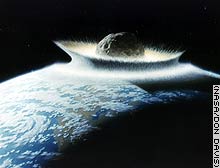
Based on that perspective I'm guessing they think the earth is roughly 50 miles in diameter.
Comments (0)
No comments on this post.