I love the Astronomy Pic of the day.
Look at this photo.
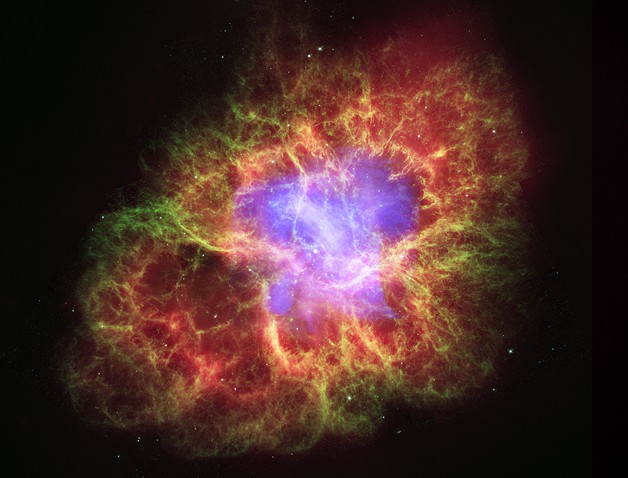
APOD: 2006 October 26 - Composite Crab
Explanation: The Crab Nebula is cataloged as M1, the first object on Charles Messier's famous list of things which are not comets. In fact, the Crab is now known to be a supernova remnant, expanding debris from the death explosion of a massive star. This intriguing false-color image combines data from space-based observatories, Chandra, Hubble, and Spitzer, to explore the cosmic debris cloud in x-rays (blue-purple), optical (green), and infrared (red) light. One of the most exotic objects known to modern astronomers, the Crab Pulsar, a neutron star spinning 30 times a second, is the bright spot near picture center. Like a cosmic dynamo, this collapsed remnant of the stellar core powers the Crab's emission across the electromagnetic spectrum. Spanning about 12 light-years, the Crab Nebula is 6,500 light-years away in the constellation Taurus.
A neutron star is a star that is essentially made up of nothing but neutrons. The supernova that created the neutron star crushed the core of the star so powerfully that it literally pushed the electrons and protons together, forming neutrons. The entire star is really nothing but a huge atomic nucleus. What is fascinating to me is that neutron stars have powerful magnetic fields, which means that current flows through the neutrons in the same way that current flows through the wires of a dynamo. I've always thought that there's something really interesting about that fact that hasn't really gotten the attention it deserves. But I'm so out of touch with physics these days, I'm probably just not aware of several published papers on the subject.
Lately astrophysicists have suggested that there is one more step between neutron star and black hole. They suggest that a star could be crushed so that the neutrons themselve are broken into quarks, which then bind together into a quark star, which is made entirely of quarks. Theoretically it could be possible. But remember, I'm still not convinced entirely in the existence of black holes.
Comments (0)
No comments on this post.