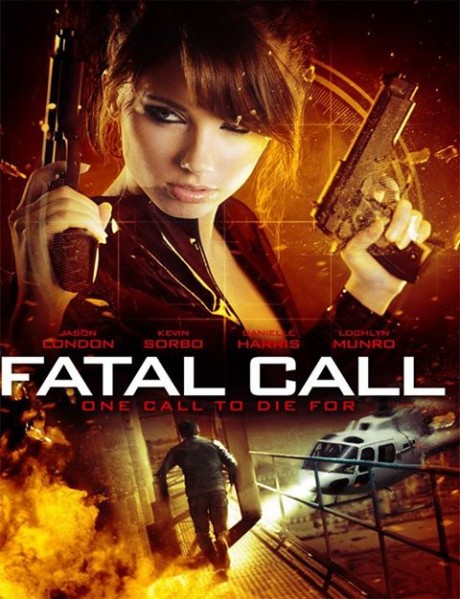
 ... is a really egregious misrepresentation of the movie itself. Jack apologized for this up front indicating that he had no input into the cover. I find that very interesting and wonder how common it is for there to be that level of disconnect between the creator of a film and the marketing posters created. I suppose that would account for other posters I've seen that seem sort of off compared to the movie. In this case the poster seems to be deliberately exaggerating an action scene and the "femme fatale" nature of the movie. If I were Jack I would be quite incensed at the end result.
OK, I've got that out of my system. On to the movie itself.
My basic reaction to the movie is that it struck me as being fairly representative of the writing, acting and production qualities of a Hollywood movie. For what I suppose was a fairly low budget Indie movie, I was impressed with the final result. With a couple of exceptions, but then that's generally true of most movies I watch.
The main character, Mitch, portrayed by Jason London, did a fair job overall, with some compelling moments. Amy, the femme fatale portrayed by Danielle Harris, was, I thought, the most compelling actor in the movie, even though her first scene in the bar was not her best. Kevin Sorbo, best known as the star of the "Hercules" TV show, showed moments of talent, but some scenes he seemed to be mailing it in. The two actors who portrayed Mitch's friends, Joel Lewis as Ted and Jimmy Chung as Simon were outclassed and sometimes painful to watch.
The camera work and general cinematography were generally solid. Several scenes were well crafted, well framed, well lit and provided the proper tone for the scene. The editing itself was mostly unnoticeable, which is about the best thing you can say about editing.
Which brings us to the story.
Generally I judge how well a story is written according to at least the following things:
1. How easily I can predict the events.
2. How well the key plot elements are foreshadowed, woven into the story and, finally, revealed.
3. How plausible key events are.
4. How consistent the actions of characters are based on their personalities as portrayed.
So here's how I react in each of these areas:
1. I'm afraid that I found the plot to be entirely predictable, and was not surprised by any of the "reveals". Not even the "big" reveal at the end. This was in part because the story had a fairly bad case of "wow, what a coincidence" going on pretty much all the time. That didn't ruin the story, I'm rarely surprised by the plots of Hollywood movies, so I can usually appreciate the story even when it seems to be clipping along the exact trail I expected.
2. This is probably the part of the writing that I think was done the best. It appeared to me that the writer (Jack, I assume) spent a lot of time working on exactly how to provide the clues that would eventually be used to justify the final reveals. For the most part I think this was done as well as, or even better than, many Hollywood movies, most of which resort to final second twists to justify their final reveals. At least that wasn't the case here.
3. Hmmm.... plausibility issues were unfortunately fairly common. Maybe no more common than most Hollywood movies, but I have a very poor opinion of most Hollywood writing, so that's not much to grab onto. The most bothersome issues to me from a plausibility perspective were the following:
a) Mitch's reaction to the initial discussion to deal with an unwanted marriage were not consistent with the persona we had been presented with. This could have been managed better if this scene had been moved several minutes further into the movie, and we had seen Amy use her feminine wiles more deliberately to break down Mitch's supposed "good guy" tendencies. As it was, they went to bed and almost immediately Mitch was accepting the premise of Amy being willing to commit murder and even asking Mitch to do it.
b) Virtually none of the detective, DA or police station scenes struck me as plausible. Pretty much every character in any role of law enforcement was not fleshed out enough to be believable as anything but a means to advance the plot. The actors in the detective roles attempted to inject personalities into their portrayals, but ended up mostly just providing personality quirks that were sometimes incongruous and even unprofessional. Considering what their role was in the plot, they should have been more menacing, gritty, hard-bitten, even bitter or resentful, but the most important aspect of their role in order to be meaningful to the plot is that they should have been competent and they were not.
c) The entire sub-plot with the ruffians pursuing Mitch was unnecessary and distracting. If I were editing the work I would have suggested cutting that entire bit out of the script. It added nothing important to the story and demonstrated nothing new about Mitch's character.
d) Mitch spent much of the first half of the movie running around in public with obvious and potentially serious wounds, and interacted with people in a strange and disturbing manner, and it never seemed to occur to anyone to call the police.
4. I already touched on this with Mitch implausibly accepting the idea that Amy was a murderous bitch and being OK with it after nothing more than an evening of rather tame and conventional sex. I know from my own experience that writing sex scenes is quite difficult, especially if there is any deviation from what people consider "normal." But Amy needed to be more forceful and unconventional in her approach to sex for Mitch to have fallen so quickly to her wiles. Amy needed to be a beast in bed, a vixen with a mission. She should have left Mitch exhausted, astonished and overwhelmed by this sudden realization of his wildest fantasies. Then I would have believed that Mitch could have fallen prey to the temptations of his repressed sexual urges. Amy was too tame and conventional and Mitch was too decent for me to believe that the story would have developed the way it did.
I know this probably all sounds harsh, but as I said above, the movie struck me as being pretty well in line with the quality and standards of Hollywood movies, which is probably quite an achievement on the budget and with the resources the movie was made with. Overall it hung together and there was a story to watch with some interesting characters, some surprisingly good production qualities (particularly the film editing) and a couple of acting performances that would have stood out in many big-budget Hollywood films.
I give it three lanyard-flash drives out of five. You could do worse than check this out.
Movie Review: Fatal Call
By CosmicConservativeThis is an unusual situation. I write a lot of reviews of movies, books and even the occasional television show. But up until now, other than having a friend of my daughter work on some of the computer graphics for a movie, I've had no connection to the item being reviewed.
This movie is the creation of one of the regular posters on this blog who goes by "Jack". And one of the very few liberals who hasn't been driven away by the anti-liberal commentary that is rather frequently expressed here. Or at least not yet permanently. So I don't feel quite the level of objectivity that I normally have when doing one of my reviews.
With that caveat out of the way, here we go:
First, the poster, reproduced here:
... is a really egregious misrepresentation of the movie itself. Jack apologized for this up front indicating that he had no input into the cover. I find that very interesting and wonder how common it is for there to be that level of disconnect between the creator of a film and the marketing posters created. I suppose that would account for other posters I've seen that seem sort of off compared to the movie. In this case the poster seems to be deliberately exaggerating an action scene and the "femme fatale" nature of the movie. If I were Jack I would be quite incensed at the end result.
OK, I've got that out of my system. On to the movie itself.
My basic reaction to the movie is that it struck me as being fairly representative of the writing, acting and production qualities of a Hollywood movie. For what I suppose was a fairly low budget Indie movie, I was impressed with the final result. With a couple of exceptions, but then that's generally true of most movies I watch.
The main character, Mitch, portrayed by Jason London, did a fair job overall, with some compelling moments. Amy, the femme fatale portrayed by Danielle Harris, was, I thought, the most compelling actor in the movie, even though her first scene in the bar was not her best. Kevin Sorbo, best known as the star of the "Hercules" TV show, showed moments of talent, but some scenes he seemed to be mailing it in. The two actors who portrayed Mitch's friends, Joel Lewis as Ted and Jimmy Chung as Simon were outclassed and sometimes painful to watch.
The camera work and general cinematography were generally solid. Several scenes were well crafted, well framed, well lit and provided the proper tone for the scene. The editing itself was mostly unnoticeable, which is about the best thing you can say about editing.
Which brings us to the story.
Generally I judge how well a story is written according to at least the following things:
1. How easily I can predict the events.
2. How well the key plot elements are foreshadowed, woven into the story and, finally, revealed.
3. How plausible key events are.
4. How consistent the actions of characters are based on their personalities as portrayed.
So here's how I react in each of these areas:
1. I'm afraid that I found the plot to be entirely predictable, and was not surprised by any of the "reveals". Not even the "big" reveal at the end. This was in part because the story had a fairly bad case of "wow, what a coincidence" going on pretty much all the time. That didn't ruin the story, I'm rarely surprised by the plots of Hollywood movies, so I can usually appreciate the story even when it seems to be clipping along the exact trail I expected.
2. This is probably the part of the writing that I think was done the best. It appeared to me that the writer (Jack, I assume) spent a lot of time working on exactly how to provide the clues that would eventually be used to justify the final reveals. For the most part I think this was done as well as, or even better than, many Hollywood movies, most of which resort to final second twists to justify their final reveals. At least that wasn't the case here.
3. Hmmm.... plausibility issues were unfortunately fairly common. Maybe no more common than most Hollywood movies, but I have a very poor opinion of most Hollywood writing, so that's not much to grab onto. The most bothersome issues to me from a plausibility perspective were the following:
a) Mitch's reaction to the initial discussion to deal with an unwanted marriage were not consistent with the persona we had been presented with. This could have been managed better if this scene had been moved several minutes further into the movie, and we had seen Amy use her feminine wiles more deliberately to break down Mitch's supposed "good guy" tendencies. As it was, they went to bed and almost immediately Mitch was accepting the premise of Amy being willing to commit murder and even asking Mitch to do it.
b) Virtually none of the detective, DA or police station scenes struck me as plausible. Pretty much every character in any role of law enforcement was not fleshed out enough to be believable as anything but a means to advance the plot. The actors in the detective roles attempted to inject personalities into their portrayals, but ended up mostly just providing personality quirks that were sometimes incongruous and even unprofessional. Considering what their role was in the plot, they should have been more menacing, gritty, hard-bitten, even bitter or resentful, but the most important aspect of their role in order to be meaningful to the plot is that they should have been competent and they were not.
c) The entire sub-plot with the ruffians pursuing Mitch was unnecessary and distracting. If I were editing the work I would have suggested cutting that entire bit out of the script. It added nothing important to the story and demonstrated nothing new about Mitch's character.
d) Mitch spent much of the first half of the movie running around in public with obvious and potentially serious wounds, and interacted with people in a strange and disturbing manner, and it never seemed to occur to anyone to call the police.
4. I already touched on this with Mitch implausibly accepting the idea that Amy was a murderous bitch and being OK with it after nothing more than an evening of rather tame and conventional sex. I know from my own experience that writing sex scenes is quite difficult, especially if there is any deviation from what people consider "normal." But Amy needed to be more forceful and unconventional in her approach to sex for Mitch to have fallen so quickly to her wiles. Amy needed to be a beast in bed, a vixen with a mission. She should have left Mitch exhausted, astonished and overwhelmed by this sudden realization of his wildest fantasies. Then I would have believed that Mitch could have fallen prey to the temptations of his repressed sexual urges. Amy was too tame and conventional and Mitch was too decent for me to believe that the story would have developed the way it did.
I know this probably all sounds harsh, but as I said above, the movie struck me as being pretty well in line with the quality and standards of Hollywood movies, which is probably quite an achievement on the budget and with the resources the movie was made with. Overall it hung together and there was a story to watch with some interesting characters, some surprisingly good production qualities (particularly the film editing) and a couple of acting performances that would have stood out in many big-budget Hollywood films.
I give it three lanyard-flash drives out of five. You could do worse than check this out.
Comments (16)