I've never sailed a ship. I've never even been on a sailing ship while it is moving under sail. I've been on sailing ships at port and was once on a "sailboat" that had its sails "shipped" and was moving under the power of a small outboard motor.
But I've never sailed.
Which is sort of a shame since I find sailing ships to be one of the most amazing, elegant and earth-changing developments ever created by the human race.
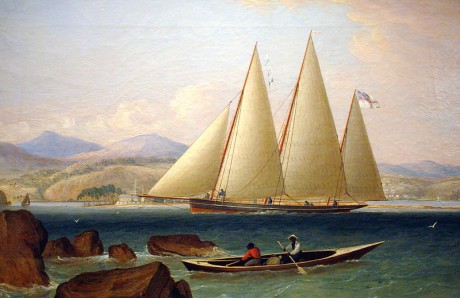
There is an amazing depth and breadth of knowledge required to understand how to sail a ship. That includes knowledge of the different aerodynamic properties of a bewildering number of different types of sails and how these different types of sails work together or work against each other. It also requires an understanding of the complex and dynamic needs of deploying, manipulating, retrieving and storing the sails, which is usually done through a series of ropes, pulleys, grommets, masts and rigging. And all of that requires an encyclopedic knowledge of different kinds of knots and when, where and how to tie them.
The painting above depicts a naval vessel in the "bermuda rig" configuration. This has become probably the most common configuration of sailing ships large and small today. That can be compared to the "full-rigged" painting of the USS Constitution below:
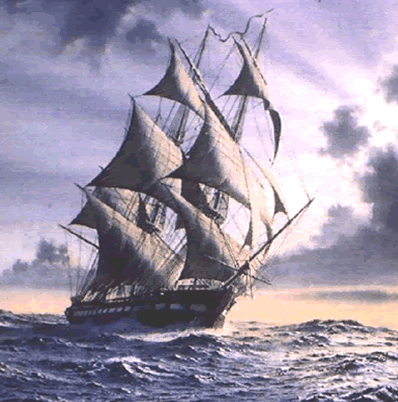
Contrary to what you see in movies, the process of changing the direction of a sailing ship was not done by turning the wheel which turned the rudder. The rudder can only redirect a moving ship and if the new direction is incompatible with the sail rigging, the ship will lose momentum and may even expose the sails and masts to stress from the wind that could damage them. So changing direction in full sail meant changing the configuration of the sails to redirect the forces of the wind and the keel to provide a new direction of movement that could be maintained over time. And to do that a ship captain had to be able to bellow out the commands necessary to manipulate every sail necessary to achieve the new configuration. In some cases that meant reconfiguring dozens of individual sails.
Being a sailing ship captain was not easy.
Comments (4)