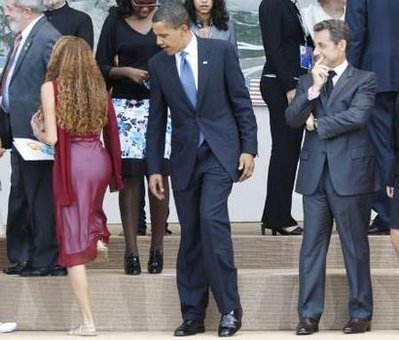
Remember how the Left used to howl in embarrassment every time Bush went anywhere? Well, it's good to see that we now have a President who is so willing to demonstrate his good taste in things.
Hard to argue with this one.
I do have to say though, that Obama sure has an awkward, uncomfortable looking pose in this picture. He normally looks much more athletic and composed than this. She must have really been hot. :)
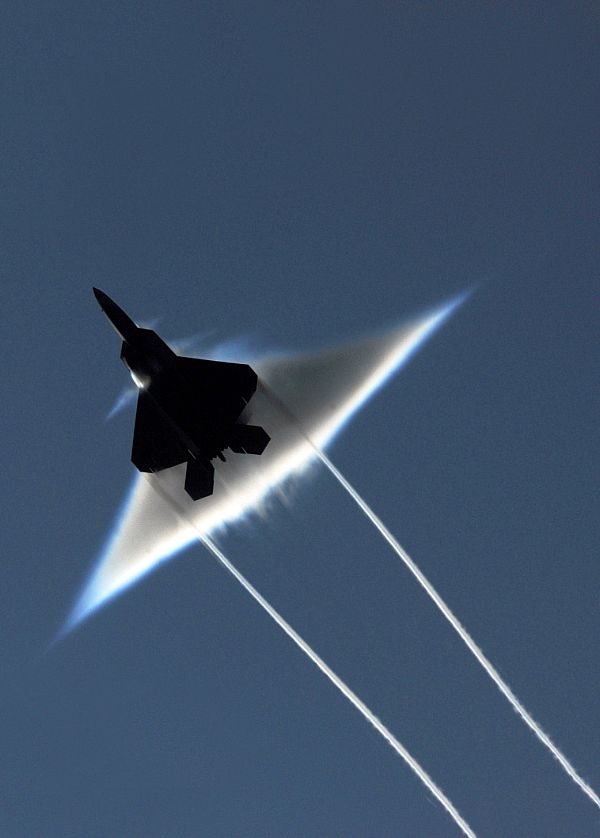
This photo was taken by the International Space Station. It's an eruption on June 12 of an active volcano near Japan.
Note how the eruption's shock wave has pushed the clouds back in a near-perfect circle.
+18 to AWESOMENESS MAN!!!!
So, now that I'm working on my novel again (geez, that sounds so sophomore English Lit pretentious, doesn't it?), and I can see the light at the end of the tunnel, I've started to investigate the minor detail of "How the heck do you get a novel published?"
Back in the dark ages, when I was first trying to get published, it was pretty simple. You really had two options. You either sent your manuscript off to a publishing house and hoped for the best, or you engaged a "Vanity Press" outfit who printed them for you at your expense. And when I say "expense" I'm not kidding. Vanity Press printings of a self-published book could run into the tens of thousands of dollars.
As with so much else in the world, things have changed. There are now several options if you want to become a "published author" and actually SELL your finished result.
Obviously you can still go the traditional route. There is a lot to say about that route, the most important of which is that if your manuscript gets chosen out of the thousands their editors review every day, you may well be on your way to fame and fortune. If they like it they will assign an editor, arrange for cover art, help with copy editing, and perhaps even pay you an advance on the sales they anticipate. That's still the way cool way to go.
But that is becoming less and less common these days. Publishing houses are suffering in much the same way that traditional newspapers and other media are suffering. Technology has taken the keys to the printing press and distributed them to people with the time, skill and equipment to do the same thing on a much smaller scale. The end result is that traditional publishers are publishing fewer and fewer new authors as they seek to maximize their profit margins by pushing book after book from their stable of best-selling authors. From what I read on the web, right now is perhaps the worst time EVER for a struggling new author to try to break into the ranks of best-selling authors whose first book is published by a traditional publishing house.
But that's because there are options. The question is whether the options are better for a new author or not.
Of course the Vanity Press approach is still there too, but Vanity Press outfits are no doubt being harder hit even than traditional publishers since the new means to publish really play in the same limited printing space as Vanity Press outfits have always done. But they are still around if you want to go that way.
Probably the fastest growing new publishing technique is the "Publish on Demand" technology that has sprouted up as computers, printers and computer aided binding techniques have become cheaper and cheaper every year. "Publish on Demand" or "POD" businesses typically charge an up-front fee to format and load your manuscript files into their system, and then when someone orders a book, they print it "on demand" using their high-tech publishing tools. Amazon.com has entered this in a big way lately with their "Booksurge" product. There is very little up-front cost to POD, and that means that the author generally gets a higher royalty for each book they sell compared to a traditional publishing house. It's really pretty simple to do this, all you have to do is generate your manuscript in the proper file formats, upload them to the POD website, and pay them the money they want to put your book in their catalog. Once that is done the author can create a link from an e-commerce site and when an order is placed, the book is printed, bound and shipped.
Another option is to "self-publish" your book. This means you have to do all the things the POD company does. Believe it or not, you can actually do this. Or if not, you can find other people who have figured out how to self-publish and work with them. Self-publishing is exactly that. You do the printing, binding and shipping yourself. Like this guy:
Or you can just create an eBook and forget the whole paper part of the process.
Or you can do eBook downloads and have the paper book for folks who prefer paper.
So, my last post about Facebook got me thinking. And that's not always a good thing, my thoughts frequently take me places that most other people seem to not want to go.
I think that a hundred years from now my generation will be looked upon as the last pre-computer generation. Which doesn't just mean "internet", it means all of the things that are associated with computer technology.
Here's what I mean:
I learned to type on a manual typewriter. I still have my manual typewriter on which I wrote virtually every significant research paper in high school and college. I used that typewriter to write two books and to create the rulebooks for two games. I never purchased an electric typewriter because I eventually moved directly to computer word processing instead.
I used to write letters. I have a box full of old letters I received in my closet. Letters from friends, family, girfriends, etc. I used to write a lot of letters. Most of the letters I wrote were hand-written, not typewritten, as are most of the letters I received.
My first "calculator" was a slide rule. I still love slide rules.
In fact I love writing by hand, and I love manual typewriters too, even though I rarely do any of those things any longer, and when I do, it's mostly simply for nostalgic reasons.
But habits linger. Writing by hand, and using a typewriter force the writer to think about what they are saying. There is no "delete" key on a manual typewriter. You can use whiteout to correct a letter or two, but if you have written an entire paragraph and decide that isn't what you really meant to write, your only realistic option is to put in a new blank sheet of paper and retype everything.
The major habit this situation reinforces is the habit of self-editing. It teaches you to organize your thoughts before you type, either by writing them down, or else by working through what you want to say and how you want to say it in your mind. It also teaches you to learn to spell, because retyping a page because of spelling errors is no fun at all. Similarly, it reinforces learning grammar and organization. In general I would either have a hand-written first draft, or at least a hand-written outline that I worked from when I began typing.
I used to hear all the time about how important it is to "live in the moment". "Living in the moment" was considered to be more "authentic," more "organic" and more "real."
Well, in the internet age it seems that "living in the moment" is all we do anymore. We've raised a couple of generations of people who have never had to self-edit a thought in their lives. They think it, and they say it. Internet chat rooms, email, message boards, blogs... all of those things allow people to have a thought and publish that thought seconds later. The result, in my mind, has been a dramatic coarsening of our culture. Misspelled words are so common now that it is considered rude to ask people to learn to spell before they publish their thoughts. Spelling is not important. Grammar is archaic. An entire culture has grown around the deliberate mangling of the English language with "L33T SP33K". Bad spelling and grammar went well beyond "acceptable" and became "cool".
But worse than that is that a similar approach has overcome the CONTENT of our messages. All you have to do is visit a prominent blog and read the comments to see how little thought people give to whether their thoughts SHOULD be published. Living in the moment has come to mean that the moment someone THINKS something, they have no problem PUBLISHING it.
Our culture has become a culture of stimulus-response, with very little governance of the responses. Back in the days when I had to physically write a thought on paper, the fundamental question that was always the first to ask was "is this worth writing down or typing out?"
That fundamental governance of our interactions has disappeared, so it should be no surprise that "is it spelled right?" is rarely even considered at all.
I'm sure I'm just an old fogey, but I feel that the world has lost something when it lost this sort of self-governance. We need to get back to "stimulus-THINK-response."
I see this on Facebook a lot. I've even participated in it. Why in the world would I think it is a thought worth publishing that I have decided to take my dog for a walk? Or that I am microwaving a burger?
Wired has the story.
I have to admit, I was surprised how easy it seems to be to crack locks once you know the details of the locks themselves.
I had always thought that picking a safe deposit lock would be a time-consuming effort with long skinny lockpicking tools. To learn that many of them can be opened with a filed down key and a quick thump on the filed down key while it is in the lock is somewhat disconcerting. I suppose I should have known this for years, the technique is clearly well-known in lockpicking circles.
And using a bic pen to open a bicycle lock?
There's a whole 'nother world out there, isn't there?
Drax, in another post, presented is skepticism that human culture could have suddenly "Exploded" from stone-age neanderthal-like beginnings, into complex societies which exhibit a full range of language, art, tools and culture. This was in response to a documentary he watched on TV about how neanderthal and "cro-magnon" cultures co-existed at more or less the same level for thousands of years, but neanderthals disappeared and "cro-magnon" developed the cultures we see as human civilization. The documentary explained this by asserting that the explosion of culture was driven by the development of complex languages. (Drax, if I'm misrepresenting, let me know).
I don't have time at the moment to give this due attention, so I'll add to this later today when I get a chance.
A victory for copyrights and intellectual property? Or a digital persecution of a couple of entrerpeneurs?
Pirate Bay four jailed for breaking copyright in Swedish file-sharing trial - Telegraph
Founders Peter Sunde and Gottfrid Svartholm Warg, along with two other employees Fredrik Neij and Carl Lundström, were sentenced to a year in jail after being found guilty in a Swedish court of making 33 copyright-protected files accessible for illegal downloading on the website Piratebay.org.
The four were also ordered to pay $3.6 m (£2.4m) in damages to copyright holders, including Warner Brothers, MGM, Columbia Pictures, 20th Century Fox Films, Sony and Universal, according to Swedish media reports.
So, 2009 is the 400th anniversary of the year Galileo Galilei first turned his hand-made telescope to the heavens and was the first to see the moons of Jupiter and craters on the moon.
400 years may seem like a long time, but it's really not. The average life of a modern human in an industrialized nation is approaching 80 years, which is 1/5 of that period. In that time human knowledge has exponentially increased, in large part due to the scientific use of the telescope itself.
For that reason I feel like waxing philosophic on telescopes. (So you can safely move on to other subjects if you don't want to get bored out of your gourd.)
What is a telescope? Well, that's a fairly philosophical statement in itself. To most people a telescope is a tube with glass elements on both ends. You look through the "little" end and point the "big" end at something and, magically, the "something" looks bigger.
Of course in reality it gets a lot more complicated than that. Telescope technology, like all technology, has changed and improved dramatically since Galileo pointed his freshly ground glass lenses at the moon. These days "telescopes" range from common optical telescopes you can buy at Wal-Mart to highly sophisticated electro-magnetic field manipulators like radio telescope arrays and x-ray telescopes (which look about as different from a "telescope" as you can imagine).
Anything which gathers electro-magnetic radiation for the purpose of analyzing what it reveals is technically a "telescope." Even if the resulting device doesn't even magnify the image. In fact one of the most profound discoveries made in the 20th century, that of the distribution of the cosmic background radiation, was made with a "telescope" that actually REDUCES the size of the image of the whole sky into a viewable map of the entire sky you can put on a manageable piece of paper or computer screen. So not all "telescopes" are "far see-ers" which is what "telescope" translates directly into.
In the history of the telescope there have been major improvements which have directly led to tremendous increases in the rate of discovery of the nature of the universe. Those improvements have been largely in two areas. First are improvements in the ability of the telescope to form a magnified image. Second are improvements in the abiltiy to image different areas of the electro-magnetic spectrum.
Galileo's original telescope used normal glass of the same sort that was being used at the time for early eyeglass grinding. Early opticians realized that a ground lens could adjust for nearsightedness or farsightedness. In the late sixteenth century Hans Lipperhey, a spectacle maker by trade, was essentially fiddling around with different ground lenses and noticed that a certain arrangement of differently ground lenses formed an image which could be larger or smaller than the real thing depending on the arrangement of lenses. Recognizing the potential benefits of a device based on this property, Hans filed for a patent on the device.
Soon people all over the world were grinding lenses to see if they could duplicate Hans' results. One of those people was Galileo Galilei, an already noted and accomplished physicist. What made Galileo famous was not that he invented the telescope, but that he recognized its value in examining the heavens.
The prevailing wisdom at the time of Galileo was that the heavens were the realm of perfection. The sun was thought to be a perfect sphere. As was the moon. Planets and stars were thought to be perfect points of light. In fact it was significantly important to certain religious dogma of the day that the EARTH was unique in NOT BEING PERFECT. So when Galileo focused his primitive hand-ground telescope on the moon and saw the face of the moon covered with craters, this was a shattering moment for him and for Western Civilization itself. As if that was not enough, another key tenet of dogma was that the earth was the center of the universe and all heavenly bodies revolved around the earth, but when Galileo turned his eyes on Jupiter, he saw NOT ONLY that Jupiter also was an imperfect sphere (banded and visibly not spherical) but it had OTHER BODIES that REVOLVED AROUND JUPITER, immediately challenging the notion of the earth-centric cosmological model. As it turns out this was just the first paradigm-shattering moment telescopes have brought to humanity.
I was going to go into the history of the technological improvements that have taken our ability to "see" the universe to the point it is now, and where I'd like to see it go in the future, but I've done some of that before and don't want to bore folks more than I already have.
Enjoy the International Astronomical Year by getting out to a star party some night this summer. You won't regret it.
 Remember how the Left used to howl in embarrassment every time Bush went anywhere? Well, it's good to see that we now have a President who is so willing to demonstrate his good taste in things.
Hard to argue with this one.
I do have to say though, that Obama sure has an awkward, uncomfortable looking pose in this picture. He normally looks much more athletic and composed than this. She must have really been hot. :)