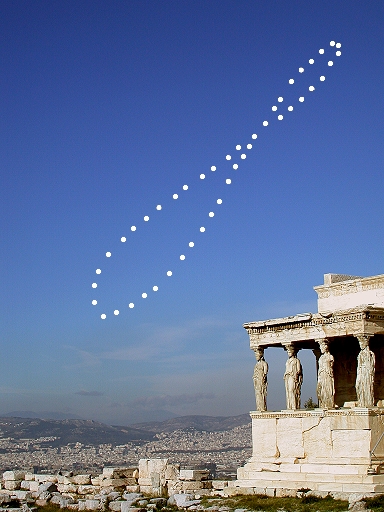
I love these sorts of photos. This is a fairly typical example of a photo of the sun's progressive position in the sky at the same time of day over the course of a year. This is one of those things that most members of ancient cultures would recognize immediately, and most modern people would say "Huh? What's that?"
The novel I put down almost two years ago is a fantasy story which involves extensive use of magic as part of the plot. This is true of most fantasy novels. But it is usually the way that magic is described and used in a story that I find to be the weakest part of any fantasy story.
In most fantasy stories magic is simply so arbitrary and situational that it is indistinguishable from divine intervention. Harry Potter is probably the worst example of this. I like the Harry Potter books but every time Harry gets in a tight spot, I know that Rowlings will get him out of it with some new, yet-undiscovered magical ability that just happens to be exactly what he needs at exactly the right moment to keep the story going. There's no reason or rationale whatsoever behind it. If he needs to be able to cast a stronger, faster spell than the acknowledged most powerful wizard of all time, then that's what Harry does. If the spell needs to come from out of nowhere and do something no spell has ever done before, then that is what the spell does.
By the way, Star Wars is a fantasy story, set in a sci-fi universe. The "Force" is just magic. Jedis are just warlocks.
In other fantasy stories the author goes to great lengths to explain the rules behind the magic system and shows how the "wizards" have to study and learn to utilize the magic. Eregon is like that. The "magic" is all in the "true language" words that hold all the power in the universe. Usually those books try to keep some sense of limitation to what magic can do, but usually the author finds ways around their own built-in limitations to advance the story line. Again the Eregon series is a classic example of this with the reader first being told that magic is limited to the physical power that a person can generate from their own body, but as the story develops and more and more powerful magical spells are needed to advance the story and enhance the crises, suddenly tools, techniques and artifacts appear which get around this limitation, and we are back to magic having arbitrary limits and capabilities as needed for the author to get their hero out of a jam.
I hate that.
The Lord of the Rings had a unique perspective on magic, and a unique means of describing the use of magic to the reader. We are told that Gandalf is a wizard early on, and he demonstrates his wizardness at first through the use of fireworks, a specialty of Gandalf's. The fireworks show at the long awaited party is very skillfully done for a modern reader because the fireworks are just magical enough to tantalize, but described as recognizable chemical-powered rockets and devices. The reader is left to wonder how much "magic" is actually in play with Gandalf's wizardry.
In fact in the entire book Gandalf's first-hand descriptions of magic are quite rare, and when done, are quite subtle. Gandalf uses his staff and a burst of his magic to start a fire in a snow-sodden pile of wood. And as he does so he complains "There, I have said 'Gandalf is here!' to anyone who cares to see." This was wonderfully done because it was a life-saving use of magic beyond the ability of any mortal present, yet was nothing more than lighting a fire in the cold, and yet the use of it was fraught with danger because of the recognizable signature his magic carried with it. This conflict betwen Gandalf's well-known magical powers and the danger inherent in their use is almost unique in literature. His most blatant uses of his power are described only as remote events at the time, as in the unusual flashes of light on Weathertop, or as after-the-fact descriptions of the results, again as on Weathertop where Aragorn and the hobbits find the hill scorched and burned from the terrible energies weilded between Gandalf and the Nazgul king. Now we have EVIDENCE of Gandalf's power, but we still don't SEE it. It's left almost entirely to the imagination. Perhaps the most overt use of magic in the entire book was when Gandalf went to save Farimer from the Orcs at Osgiliath and we see then that he raised his HAND to direct white bolts of energy at the Nazgul. But even then Gandalf was only able to fend them off, his bolts did not reduce the Nazgul to cinders upon contact.
One of the reasons I love the Lord of the Rings books is precisely because Tolkien managed to deal with magic in such a way that the reader is left with the IMPRESSION that Gandalf is a supremely powerful magician, but virtually all of Gandalf's magic is hidden, subtle, or of a seemingly minor nature when compared to other wizards in literature. But Gandalf's magic was BELIEVABLE. I never had any problem suspending my disbelief with Gandalf. I was convinced of his power, and awed by his self-control. Magic was something to be used responsibly and sparingly precisely BECAUSE of its power. There are subcurrents that Saruman's fall was, at least in part, due to his pride in using his own magical abilities, and a major sub-theme of the book was the temptation to abuse power, especially magical power.
OK, so I probably went on too long about Gandalf and his use of magic....
The point is that in the novel I was writing, I wanted magic to be more like LOTR magic than most fantasy novels. I wanted it to be powerful, subtle and mostly hidden, but lurking like a tiger in the weeds, ready to pounce on the unwary.
So as I started working on the book, I tried to create a set of rules for magic that I felt would allow me to create such an experience for the reader.
And you know what? It's hard. And what I found is that it's even harder to stick to it once you get the story going. In fact, in rereading it, I find the magic system to be annoying to me now. I don't like it at all. So now I'm figuring I'll have to rewrite all the parts where the protagonist or anyone else in the story is using magic.
And I know that the desire to rewrite a story is one of the great threats to completion of a novel...
But still, even I don't "believe" the magic in my story. It must be fixed....
So back to the drawing board.
Bill Maher and his sidekick, Larry Charles, have a new movie opening in theaters this Friday - 'Religulous'. I view it as just another salvo in the secular Left's war against faith. It's a common meme in today's world and I really wouldn't have an issue with it (atheists are entitled to their point-of-view) were it not for the ad hominem nature of Maher's attacks. In his mind, anyone who professes a religious faith is simply 'crazy'. Not being content to simply criticize organized religion, he revels in mocking and ridiculing religion and its adherents.
Religion is an easy target and the criticism it receives is often justified. Whether you're talking about the Catholic Inquistion, the Mountain Meadow Massacre, or modern-day Islamo-fascism, God and faith have often been used to justify the worst examples of human behavior. What seems to be missing in the indictment of religion, however, is a fair reckoning of the horror secular atheism has brought to this world (e.g. Stalin's Soviet Union and China's Cultural Revolution for example).
Ultimately, it is not religion behaving badly that explains The Inquisition, for example, it is bad people behaving in ways that corrupt and contradict the fundamental tenets of their faith. As a Christian, I am taught to love my neighbor as myself, to be charitable, to serve others, etc. Anything short of that, I believe, is an indictment of human nature not the faith that encourages a higher standard...
...that's my take on it anyway...
I'm not much of a numerologist. I know some people who are, and who ascribe mystical powers to numerical coincidences. There are a lot of reasons I don't get into such things, but the most compelling reason I don't is because dates and times are purely arbitrary things that humans have overlaid on the uncaring backdrop of natural events. There is no reason that today is "08/08/08" instead of any other combination of numbers other than that an arbitrary "beginning" calendar date was set by some religious academics some thousand years ago or so.
I might be more interested in such numerical coincidences if calendars were tied to some sort of astronomical events or even human events. But since they aren't, I pretty much find such arbitrary arrangements of numbers to be interesting, but not compelling.
One of the things I ponder about when I decide to ponder is the nature of nothingness. For a long time humans thought "nothing" was that which existed apart from matter and energy. In other words, in the deepest, coldest, most remote corner of the universe, in a place where the nearest galaxies are millions of light years distant, there might be a random particle or two, but otherwise what you found there was "nothing". Similarly the space (as tiny as it might be) between the electron cloud and the nucleus of an atom was also thought to be "nothing."
But this very thought troubled many philosophers and scientists alike. From a philosophical perspective the concept of "nothingness" belied common sense at every turn. If "nothing" exists, they speculated, it at the very least had to contain some means of holding "something". That implied a capacity at least, and if something has a capacity, how can it be "nothing?" Similarly every position in the universe IS somewhere, and if something has an address, how can it be "nothing?"
In the nineteenth century this culminated in the concept of the "aether" which supposedly was the foundation upon which all the universe's matter and energy lived, propagated and interacted. In other words, "nothing" was anything BUT "nothing" it was actually the very stage that the great theater of reality played out.
When quantum mechanics came along scientists began to speculate that "nothingness" was actually a seething sea of "virtual particles" which boiled and bubbled eternally, providing a sort of foaminess to the foundation of the universe. In time scientists were forced to conclude if quantum mechanics were correct, that "nothingness" must actually have a calculatable rest-energy, an attribute they dubbed the "zero-point energy" of the universe. In fact some speculated that this zero-point energy might be exploitable as an energy source, quite a promotion for "nothingness" really.
Today there is a huge debate taking place on the nature of dark matter, dark energy and "nothingness". There are those who believe that the next Einstein-level breakthrough in physics will involve the experimental exploration into the nature of "nothingness" itself.
If I were a religious person, which I am not, I would probably make some sort of comparison between what we think of as "nothingness" and what the Bible refers to as "the Firmament."
To put it plainly, "nothing" is the raw material out of which everything we know is created. It is my personal opinion, and has been for many years, that matter and energy are simply "rolled up balls" of "nothingness" that have certain attributes based on how they are rolled up. I put "rolled up balls" in quotes because I think the reality is much more interesting than just little rolled up balls of nothingness, but I don't have a better way to describe it. In essence, EVERYTHING is nothing. And nothing is everything. There is nothing BUT nothing, and all of our incredibly vast and complex universe needs no other explanation than that. In that sense you could argue that everything is just a sort of illusion, but I don't think that. I think the reality is that there really IS no such thing as "nothing" at least not within the boundaries of our universe, and that when we understand what the "firmament" really is, we will see how it is the clay, the raw material, from which the vast array of particles and energy have been created, and into which they will someday return.
See, a lot of you were right. I really can pontificate at great length about nothing at all, can't I?
Bueller...Bueller...? Ben Stein of 'Ferris Bueller's Day Off' fame has produced a film documenting the suppression of 'intelligent design' concepts in academic circles by what he calls 'Big Science'. The film, Expelled, is scheduled to open in 1000 theaters nationwide on April 18th. From WorldNetDaily:
“Expelled†calls attention to the plight of highly credentialed scholars who have been forced out of prestigious academic positions because they proposed Intelligent Design as a possible alternative to Charles Darwin’s 150-year-old theories about the origins of life. Instead of entertaining a debate on the merits of competing theories, the scientific establishment has moved to suppress the ID movement in a “systematic and ruthless†way at odds with America’s founding principles, the film asserts.
I have mixed feelings about the so-called Intelligent Design movement. Personally, I believe an intelligent designer was the catalyst behind the organization of the universe and the origins of life. I do not believe faith and science are mutually exclusive, but I do believe they tend to ask and answer completely different questions. Religion will tell us God is the creator of the universe and all life in it. Science will attempt to identify and explain the natural processes we can observe. Science, if you will, attempts to explain HOW God does what He does. At least that's how I view it.
I believe the gaps and weaknesses of the evolutionary theory should be examined openly as part of a science curriculum without risk of suppression, ridicule, or worse. Where science fails to offers answers, such as how life itself got its start, then the open discussion of intelligent design should be permitted without retribution. The problem is intelligent design is not testable and therefore not really within the scientific domain so some realistic limits need to be placed on how far you take such a discussion in a traditional science course. And no one deserves to be punished for facilitating such a discussion in a context of academic freedom.
The bigger issue seems to be the utter lack of respect, even disdain, many scientists have for the idea of God. Too many are dogmatic secularists that ooze contempt for anything outside the scientific domain. And, of course, too many people of faith are overly skeptical and critical of what science has given us.
Can't we all just get along?
OK, so I see that I'm getting a significant bump in traffic from Dadman's UFO posting. I'm hoping some of those folks actually look at the site instead of just reading that one post. In case they do, I thought I'd post my opinion of UFO sightings.
First of all let me start off by saying that I think the chance that the human race is the only group of self-aware, intelligent beings in the universe is so ridiculously low that it stretches all bounds of credulity to believe that we are "alone" in the universe. As I have said in other posts, the main thought that pops into my head when I consider such a possibility is "man, what a waste of space."
So my position on UFOs starts with the basic powerful belief, which I would call as much a certainty as I am certain of anything, that we are NOT alone in this universe, and in fact if I had to bet on it I would say that there are likely billions of other planets with intelligent beings on them. I am very pro-alien life and always have been.
But does that mean that the earth is "likely" to have been visited by any of those alien races at all? Well, that's when things get a little more difficult to work out. And here's why.
The universe is big. I sometimes think that there are very, very few people on this planet who have any real conception at all about how big this universe is, how big the galaxy we live in is, and how intimidating the distances are between even the closest stars we can see.
Factor in the fact that I am pretty much a skeptic when it comes to supernatural capabilities, and I think that we may not know everything about physics, but we know quite a bit about it, and you might start to see how unlikely I think it is that there are spaceships zipping around the galaxy like an L.A. freeway at rush hour.
And then add to that the complete lack of credible evidence of alien encounters and the flood of hoaxes and fakes we have seen over the years, and I have to admit that my skepticism of alien encounters is at least as high as my skepticism of the neighborhood "psychic" being able to tell me who my soul-mate is. Much less simply predicting the next lottery drawing.
To put it as succinctly as I can, the space between stars is so daunting that it defies easy description to people who may not have any real concept of what "the nearest star to earth is 4.5 light-years away" means.
What it means is that unless there is some magical way to get around the most fundamental things we know about physics, things like the laws of thermodynamics, the laws of conservation of mass and energy, the amount of energy it takes to accelerate physical objects to anything like the speed of light, etc... and the realization eventually sets in that making a trip to another star is a BIG DEAL. And I don't just mean for our current level of technology. I mean a BIG DEAL period. And that's not even taking into account such minor details as what happens in space when a gamma ray burst irradiates everything with life-snuffing radiation.
It is highly likely, in my view, that there are some star-spanning civilizations in the universe. It is somewhat likely that there are some in our galaxy. But unless we discover some way to overcome the most basic physical limitations our physics tells us exist, then it is unlikely that there are any galaxy-wide spanning civilizations or even any civilizations that occupy major star clouds. Much less civilizations that are roaming around the galaxy looking for random places to stop and have a picnic.
The energy cost is simply too high to waste it on random chance of encountering a suitable planet or system for colonization or trade partners. It is far more likely that star-spanning civilizations grow in carefully planned steps from one system to another after using extreme technology such as mile-wide telescopes and million-mile long antennae to search the sky for the most likely candidates for the next step. And even then the effort to build and launch a colonization attempt, or even a scouting effort is such a staggering investment of economic resources that it cannot be something that is done on a whim.
I would not be surprised to learn that there are civilizations who have sent long-distance probes on low-energy flights to nearby stars, but such flights would take centuries and would likely have a fairly high rate of failure. But there could be millions of such probes roaming the galaxy as I type this, and still the odds of a single one of those stumbling into our solar system wuold likely be in the range of one in a million or more.
Then there's the whole issue of what I expect would happen if one of those probes did enter our system. What would the likely result be? At best it would send a signal back to the home planet or the nearest outpost. Such a signal would likely take decades or centuries to reach home. And it would take much, much longer for that civilization to react to the signal with anything like a scout ship or fleet of ships.
But if they did, again the massive investment of time and energy into the effort makes it inconceivable to me that once they reached here, they would simply play hide and seek with us for decades. I just can't see any benefit to them to do so. Most likely they would simply announce their presence and seek to contact us, or else they would simply watch us from a safe distance (say the orbit of Neptune, perhaps) and call for the troops to come and clear off this nice juicy planet from the current infestation of potential competitors.
The LEAST likely of all scenarios is the one that most UFO devotees usually claim to be happening. The idea that some civilization has been secretly watching us, experimenting on us, and sending ships down into our atmosphere to be seen by lucky humans and blow their cover is patently absurd.
Basically I find the arguments that our skies are full of alien ships, and our world is infested with alien visitors hiding among us to be essentially the same level of wishful thinking as those who believe in ghosts, the Loch Ness monster or inter-dimensional gateways that pop into and out of existence. Basically I think the whole thing is fundamentally an atavistic need for people to believe in some sort of magical, supernatural connection that humans have with the universe. It used to be the Gods of Olympus, satyrs and fairies. Now it's galactic overlords, robots and "grey aliens."
So expect me to view all reports of UFOs with complete skepticism. Such claims require extraordinary evidence, and any photo that could have easily been photoshopped by a high school freshman is certainly not going to get me to say anything but "sheesh, here we go again."
When they arrive, there will be no doubt. I just hope they don't come guns a-blazin'.
Very sad news, and potentially very destructive to any peace process that Bush is wanting to get done before he leaves office.
I've already seen terrorist organizations such as Hamas calling the murderous zealot behind this a "hero."
Yes, the same people who demand that cartoonists be beheaded for "insulting Islam" call a man who guns down 17 defenseless religious students a "hero."
This is a perfect example of what non-Muslims mean when they say "where is the outrage from Islam?" I've seen nothing from any Islamic authority condemning this act. Yet if an artist draws a cartoon with Mohammed in it, the outrage spreads like wildfire throughout the Islamic world.
As long as that is how that culture works, they will never be at peace with the rest of the world.
BBC NEWS | Middle East | Eight killed at Jerusalem school
Eight people have been killed and nine wounded by a Palestinian gunman who infiltrated a Jewish seminary in West Jerusalem, Israeli officials say.
Witnesses said the gunman went into a crowded hall during dinner at the Mercaz Harav seminary in the city's Kiryat Moshe quarter and opened fire.
The assailant, who Israeli police said was a resident of East Jerusalem, was shot dead by an Israeli army officer.
The attack is the worst of its kind in Israel for a number of years.
But then "peace" isn't what they are after, is it?
Well, that's what the media and liberals say about Bush if he even hints at some of the things Hillary says in this old interview with the NY Times. "Felt the presence of the holy spirit, eh?" Do we really want someone in the white house who communes with spirits!?!!? Oh no!
Hillary: “I Have Felt the Presence of the Holy Spirit†- The Brody File: David Brody Blog - CBN News
In July of last year, Hillary Clinton gave an interview to New York Times reporter Michael Luo about her faith. It’s a fairly in depth interview.
Well, for your listening pleasure, The Brody File found the actual audio from the interview and it’s really interesting. Reading the transcription of the interview is one thing, but hearing Hillary Clinton talk about her faith is very different. Listen here. You can read the transcription here.
At the time, the article got significant play but some of the quotes from the whole interview never got used in the article. Here are some key quotes that I thought you might be interested to look at:
Hillary Clinton: I believe in the father, son, and Holy Spirit, and I have felt the presence of the Holy Spirit on many occasions in my years on this earth.
Reporter: Can I ask you theologically, do you believe that the resurrection of Jesus actually happened, that it actually historically did happen?
Senator Clinton: Yes, I do.
 I liked this guy, so it's not the religion thing.
 I just don't like Benedict.