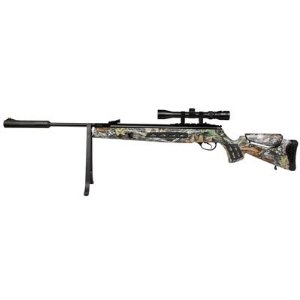
Yeah, I've sort of deliberately not posted anything on my Hatsan pellet gun situation.
As you probably know, I returned two of these guns for problems and finally received a third that I thought was working properly. I was working on sighting it in and was making progress.
Here's the deal. I have shot and retrieved several pellets and it is clear that the pellets are rifling properly and are tracking properly once they are in the air. That means they should be accurate once they leave the barrel.
The problem is "leaving the barrel." The recoil on this gun is so violent that it blows my mind. It literally broke a cast iron retaining bolt that was holding the scope in place. It shook loose the bracket that holds the sling on, and I lost the pin that holds the bracket to the stock (it fell between the boards on my deck when it came apart).
The worst thing though is that I screwed up. Just as I was feeling like I was figuring out how to hold the gun for repeatably accurate shooting, I went to cock it and the barrel slipped out of my hand, whipping back up so violently that it appears to have bent either the barrel or the joint holding the barrel slightly.
You can't see it visually, or maybe you can just barely see that it is angled a bit up, but it is enough that I can no longer get the scope to sight in on the new trajectory of the pellet. So I've been trying a variety of ways to shim up the front of the scope so that it can sight in the new pellet location.
I don't feel comfortable returning the gun now since I was the one who messed it up.
Also, the reason the gun has such problems with recoil is because of its power. It is still the most powerful break barrel gun out there, and if I can ever get the sighting thing worked out, I think it still will be an awesome gun.
Just to give you an idea, the best results I've had with repeatable shooting so far has been to hold the gun so lightly that it is almost floating in my hands. I lay it at its balance point in front of the trigger on my left palm, and I very lightly rest it against my shoulder, just enough to keep it from shaking, and then I put the ball of my thumb directly behind the trigger. Then I pull the trigger as straight back as I possibly can.
When I feel I have accomplished this successfully, I get pretty nice groups. But it is very, very hard to do this. I find that even when I try very hard to hold it this way, I still have a tendency to pull the gun slightly to the right and up when I pull the trigger. Because the gun is essentially floating, the slightest pull off-line will move the barrel, messing up the shot.
The experts seem to feel this sort of hold requires thousands of shots to truly master. It's that hard. But the results should be to have a very accurate gun with awesome power.
Anyway, that's where I am. This weekend I hope to get some time to figure out how to shim up the scope so that it sights in again and I will practice again with the "artillery hold". I think the gun is accurate, it just has to be held right.
So... I think I have finally found the pellet gun I really want. This is the Maserati of pellet guns.
It's called the "Condor" and it's made in America by an American manufacturer called "Air Force." (Clever, eh?)
Why is this such an awesome pellet gun? Lots of reasons.
It's a dual power source design. You can either use compressed natural air at up to 3,000 psi, or you can use CO2 "cartridges." The "cartridges" is in quotes because we're not talking about the sort of cartridges you put in a typical pellet gun, the CO2 cartridges are huge, and are used normally to recharge paint ball guns. Obviously there is a huge power difference between CO2 cartridges and the compressed natural air, but CO2 is a nice power source for plinking. Compressed natural air is more for serious shooting.
I love this basic design. The air tank doubles as a shoulder stock, which reduces the weight of the gun by a pound or more. The air flows directly into the breech in the direction of the barrel, doing away with any recoil or airflow turbulence problems. It's got weaver scope mounts and a loooong barrel, which is ideal for accuracy.
But there's more. The "gun" here is really more of a "gun platform" than a "gun." You can swap out the barrel, use alternate power sources and add all sorts of tactical accessories (laser sights, flashlights, scope levels, etc.) easily.
You can purchase all of the common pellet caliber barrels, from .177 to .25. And at 3,000 psi it will send a .25 caliber pellet at over 800fps, delivering over 30 foot pounds of energy at the target as much as 50 yards downfield.
The huge air reservoir allows you to get up to 100 shots in the "sweet zone" of the power curve. Most PCP airguns get 20 or so shots before you have to top it off again. Plus you can "dial down" the power which still provides more power than most airguns but can then last up to 200 shots before falling off the bottom edge of the power curve.
The gun itself costs about $650. Additional barrels and accessories would push that up to $1,000 or so. But man, oh man, what a pellet gun you would end up with...
Yeah, the Maserati of pellet guns. I really want one. :)
The U.S. Anti-Doping Agency brought formal doping charges against former cyclist Lance Armstrong in an action that could cost him his seven Tour de France titles, according to a letter sent to Armstrong and several others Tuesday.
As a result of the charges, Armstrong has been immediately banned from competition in triathlons, a sport he took up after his retirement from cycling in 2011.
In the 15-page charging letter obtained by The Post, USADA made previously unpublicized allegations against Armstrong, alleging it collected blood samples from Armstrong in 2009 and 2010 that were “fully consistent with blood manipulation including EPO use and/or blood transfusions.” Armstrong has never tested positive.
At some point I think there should be a statute of limitations on doping charges. If they can't prove you were doping for a race wtihin, say, six months... then move on. If six months isn't reasonable, then say two years... going back 20 years to rewrite history just strikes me as crazy.
Well, I'm pretty much calling the 2012 Colorado Rockies baseball team done.
They are, at best, a team that struggles to be mediocre. They have not been able to hold a lead in the late innings and their closer has not shown the ability to shut down teams in a final decisive inning.
I guess it's time to start thinking about next year.
If I were the front office, I'd start bringing up players from AAA now so they get as much exposure in the big leagues as possible for next year.
I suspect this will be Jim Tracy's last year as coach too.
OCEANSIDE (CBS) — NFL and USC Trojan Junior Seau was found dead Wednesday morning in his Oceanside home from an apparent suicide.
Seau’s girlfriend discovered the body of the 43-year-old NFL standout around 10 a.m. in a bedroom, Oceanside Police Chief Frank McCoy said.
Paramedics attempted to revive Seau, but they were unsuccessful. He died from a self-inflicted gunshot wound to the chest, according to McCoy . A handgun was recovered from the home.
Police are investigating Seau’s death as a suicide.
Two years ago Junior Seau drove his car off a cliff in California. He claimed to have fallen asleep at the wheel, but the whole incident seemed awful sketchy to me. Now this.
I'm sure this will be tied to Seau's NFL career and blamed at least in part on concussions.
Seau was a great player in the NFL for a long time. He made millions of dollars both on and off the field.
You gotta wonder what could possibly drive a person who had a life filled with so much adulation and success to suicide.
You know, I think at this time even I am ready to say just stop this Clemens trial nonsense.
WASHINGTON -- Roger Clemens stood and uttered "Morning" to the 90 potential jurors who had gathered in the ornate, sixth-floor ceremonial courtroom, the one deemed big enough to hold them all. After he sat down, he swiveled his chair, as if trying to make eye contact with as many as possible.
Some of those looking back had no idea who he was. Others, including two who survived the first cut, wondered if it was a waste of taxpayer time and money that got him to this point.
Yeah, hard for me to say. Roger Clemens is an ass. Worse, he's an ass that I am 100% convinced was a cheater, and was the only real competition for Greg Maddux as "best pitcher of his generation". Cheater. Ass.
But enough with spending taxpayer money on this nonsense.
As I mentioned in the below couple of posts on pellet guns, I've been looking at dozens of Youtube video reviews of pellet guns. Pellet rifles mostly, but on occasion I've checked reviews of some interesting pellet pistols as well.
In general the reviews will do target shooting as part of the review. It is quite interesting to me how consistent the target shooting "standards" seem to be. In other words, regardless of the source of the review, the standard shooting distances seem to be the same.
The bulk of the reviews I have been watching are done by one of two air gun providers, or are done by independent reviewers on their behalf. Those are "Pyramyd Air" (where I bought my gun) or "Airgun something-or-other" (I forget their name). Besides those there are a couple of guys who do reviews just because they seem to be airgun devotees.
All of the reviewers I've been watching use almost exactly the same equipment. There's this thing called a "Chrony" which measures the speed of a projectile, and all of them have one. The Chrony is a small box with two sets of "antennae" that look like nothing more than old portable TV "rabbit ear" antennae. You shoot through them and it calculates the speed by how fast it passes each set of antennae. Or that's what it seems anyway.
They also have ammunition scales that measure things in 'grains'. Pellets for pellet guns seem to range from about 4 grains to well over 20 grains for the largest pellets.
They also use a webcam set up to align their sights so that you are looking through the gun's scope as it is shooting. Although sometimes the reviewer will instead set the webcam up to record the target as the pellets hit instead.
What surprised me was not that they all had the same equipment, nor that they all recorded results from the same distances. No, what surprised me were the ACTUAL DISTANCES that they all used.
Generally speaking these rifles were tested at 10 and 20 yards. Every now and then, if the reviewer was interested enough, they might do a 50 yard test. Once, and only once, I saw a review that covered 100 yards.
TEN YARDS!? Really? Using a scope on a bench-mounted RIFLE? Thirty FEET? I guess I can see testing a PISTOL at ten yards, but what's the point of doing a rifle test at 10 yards? Jeeze, if you are 10 yards from your target, using a rifle scope starts to introduce parallax effects. I sure as heck wouldn't sight my scope in at ten yards.
Twenty yards is at least somewhat reasonable. Sixty feet. Still seems like a crazy close distance for a scope. I would think a scope would become useful more at about fifty yards. And required at more like a hundred yards. But the testing is all done at 10 and 20 yards.
At that range these pellet rifles were generally putting groups together that were no more than a few inches, and the best rifles were putting groups the size of a dime. Considering that you can't just keep a pellet gun clamped in place on the bench (because of the cocking or pumping needed to fire another shot), that's still probably more impressive in terms of the reviewer being able to repeatedly sight the gun than how the gun itself might actually perform.
Virtually all of the pellet rifles I have been looking at are of a design called "break barrel." The term is derived from the pumping design which uses the barrel itself as the pumping/cocking mechanism. The barrel "breaks" just in front of the breech and is levered downwards to compress a powerful spring in the body of the gun.
This is a totally different mechanism than the old standard multi-pump mechanism, such as my Crosman 1377 pistol uses. Multi-pump designs use a compression valve to drive compressed air into a receptacle which holds the air until you fire the gun. Multiple pumps drive more and more air into the receptacle, up to a point where a release valve bleeds off any excess air you pump in. When you pull the trigger on a multi-pump, all that really happens is that the air is released from the receptacle and expands into the barrel behind the BB or pellet, pushing it out the barrel. So there is virtually no recoil. But multi-pump designs are self-limited by the amount of air you can force into the receptacle, as well as how much pressure those compression valves can withstand. The result is that most multi-pump pellet guns top out at about 750 feet per second for a standard .177 caliber pellet. Which is respectable, and more than adequate for target shooting, plinking and very small game (birds, rats, small snakes..) but they don't really work well for larger small game (rabbits, squirrels, large birds, possums, etc.)
A "break barrel" design is totally different. Instead of pumping air into a compression valve, break barrel designs work much more like the old Daisy Red Ryder BB gun. They compress a spring. When you pull the trigger, the spring releases and drives a piston forward at high speed and great force so that a single massive blast of compressed air is forced into the barrel, expelling the projectile.
This sort of design can drive much more powerful bursts of air into the barrel, and can do so with only one cock of the gun (although it's a pretty good pull, usually around thirty pounds to do the cocking).
But there are drawbacks to the break barrel design. The most immediate drawback is that the release of the spring is a violent physical act, which jars the entire gun. Some of these break barrel designs kick more than a .22 rifle. But because the projectile is moving much slower than a .22 bullet, the violent motion imparted from the spring is acting on the gun while the pellet is still in the barrel. That means the barrel is moving slightly as the pellet leaves the gun.
So, how can such a gun be accurate at all? You might ask.
Well, some of them aren't. If you get sloppy with your spring alignment and the tolerances of your internal moving parts aren't tight, you get all sorts of three dimensional chaotic movement, and the result is that it's quite literally impossible to produce a decent grouping since each pellet leaves the gun with random lateral or vertical momentum. So the best guns are the ones which have the tightest tolerances and the best damping of the internal forces.
But even then, there is still some movement of the barrel. So how can you shoot straight?
The answer is that the spring's impact on the gun may be violent and may be impossible to stop just by holding the gun tightly, but it is repeatable. in other words, the spring reacts the same way every time.
So if you hold the gun lightly and let it do its little dance as the pellet is traveling through the barrel, then the final result on the pellet itself is very close to identical. But you have to let the forces flow through the gun, you can't fight it.
Most rifle hunters have been taught to hold their rifle tightly to their shoulder and to prepare for and overcome the gun's recoil. Trying that with a break barrel pellet gun will do nothing but guarantee poor accuracy. To shoot one right requires what they call the "artillery hold." They call it that because the problem that the internal spring introduces for weapon stability during fire is very similar to the same problem that artillery pieces have always had (and still have today). In fact if you watch a slow-motion video of a 4" battleship gun firing, you'll see exactly what I'm talking about. Those guns actually move a few FEET when they fire. But they can be fired accurately because that movement of the barrel is understood and planned for in the firing of the gun. It's predictable, so it is just factored into the aiming of the gun.
So, the bottom line is that shooting a break barrel pellet gun means having to learn an entirely new means of shooting the weapon. The technique is usually taught as using one hand to balance the gun, usually right past the breech, letting it rest freely on your flat palm, then using the other hand to pull the trigger, without gripping the stock any more than you have to, and just letting the gun jerk when you pull the trigger.
It's going to be interesting to see if I can master the technique, since my whole life shooting rifles I've been taught to do it almost exactly the opposite.
I have a problem at my house. We have skunks. We've had to clean our dog from skunk spray once, and our new dog is sure to get sprayed soon the way things are going. We've tried a number of things to get the skunk(s) to leave our property, including mothballs, human urine, harassment...
None of it has worked. It has gotten to the point that we have skunk smell on our property pretty much every day.
Which isn't going to help sell the house. As if it's going to sell anyway.
But I'm sick of the skunk.
I could legally use my .22 to shoot the skunk, but I don't want to for a variety of reasons. Mostly I don't want to have the noise of a gun going off in my backyard because I don't want to alarm the neighbors.
So I've been researching skunk-killing air rifles. I went through about two dozen reviews of different guns and I finally settled on this one:
It's the "Hatsan Sniper 125". It shoots .25 caliber pellets at up to 750 fps, theoretically delivering about 25 foot-pounds of impact force. Killing something like a skunk supposedly takes at least 15 foot-pounds of force, meaning a typical air rifle or pistol simply doesn't have the power needed. This thing is powerful enough to compare with a .22 small rifle shell. It is also supposed to be the most accurate pellet rifle on the market. I've seen reviews of people putting five shots within a quarter-sized circle at 20 yards.
Not sure I can duplicate that sort of performance, but I think I can get close.
I should be getting it Friday or Saturday. I will probably be up all night Saturday since the stupid things are nocturnal.
Wish me luck.
Wow. I have been exploring an entirely new and unknown culture. Unknown to me anyway.
So, I was at Walmart a few months ago and saw a cheap Crosman BB gun scope. Well, BB gun or .22 it said. It's only 4x and has no coatings, it's cheap, light and probably doesn't even work well.
But it was only eight bucks.
I mean how can you go wrong with eight bucks for a pellet gun scope?
So, we were in Walmart last night and I just couldn't stop myself. I bought the last one they had. I figured I'd come home, put it on my pellet gun and see if I could improve my accuracy on longer shots.
But it turns out that it won't fit on my pellet gun.
What I have is the Crosman 1377 pump-action .177 caliber pellet gun. I think mine is the 1377C model. Which is sort of a bummer now that I am looking into this stuff because the "B" model apparently had a magnetized bolt which would hold a steel BB so that you could shoot down. The model I have has a brass bolt and if you put a standard BB in it and point downward, it just rolls out the barrel. Which is very annoying. Of course it's actually designed for pellets anyway, and pellets don't roll out the barrel, so it's hard to call that a design flaw or anything. It's just that BBs are a whole lot cheaper than pellets and I'd prefer to do my plinking with the cheaper ammo if I could.
Anyway, I'm getting off track.
So, I get the scope home, pull out the pellet pistol, and ... uh oh. No way to mount the scope. I mean I can't imagine how I could have thought that a Crosman pellet gun scope might fit on a Crosman pellet gun... But it doesn't.
So last night, after my fourth night on a midnight deployment call in the past two weeks, I went to bed trying to figure out ways to mount the scope to the pistol. But I couldn't come up with anything that I thought would be worth trying, at least with the materials I have at home.
So this morning I decided to do a google search on "mount scope on Crosman 1377 pellet gun."
Oh. My. God.
It turns out there are two "standard" ways to do that. Both involve buying a product from Crosman. Huh. What a shock that is. You can either buy some mounting brackets that fit on the upper barrel of the pistol, or you can buy an entirely new breech which comes with scope mounts. The brackets were a bout $10 while the new breech was about $30, so you can guess which one I bought. (Luckily I had a $25 Amazon gift certificate sitting on my desk since Christmas, so I actually didn't even have to spend anything out of my pocket.)
In anticipation of the mounting brackets arriving next week, I decided to check out one of the google links that came up from my search showing how to attach the scope to the pistol.
That's when I discovered the wild and wacky world of pellet gun enthusiasts...
Some things I have learned.
My pellet pistol turns out to have quite a cult following. It is regarded as one of the most accurate and reliable pellet pistols ever made. In fact it is so highly regarded, and has such a wide following, that you can buy an amazing variety of after-market accessories for the gun. Besides the steel breech replacement made and sold by Crosman, you can buy all of the following, and much, much more:
Custom wood grips and pump handles (to replace the cheap plastic ones)
Grip extensions (which make it more like a short rifle than a pistol)
Replacement piston and valve (which supposedly pump more air into the chamber)
Silencer
Trigger replacement
Replacement springs (to reduce trigger pull)
A wide variety of different sights
Some of the modified pellet pistols look like anything from a carbine to Han Solo's blaster from Star Wars.
But that was only the half of it.
One of the Youtube referred videos was on making "explosive pellets."
Yes. You read that right. "Explosive pellets."
Made in your own kitchen.
It turns out that there are several ways to make explosive pellets. The easiest and most common is to pick up some of those red circles of plastic "caps" for the typical cap gun which are sold right there at the same store as the pellets. Then you can just scrape the gunpowder (or whatever it is) out of the caps and pack it tightly into a hollow point pellet and there you go. Instant exploding pellet.
If that's not impressive enough for you, you can make tracer pellets which burn through the air on their way to the target. Or poison pellets. Or you can snip the head off a thumbtack and stick the pointed pin part through a pellet to make a nasty pellet-arrow.
There are dozens and dozens of videos showing how to make your pellet gun more lethal. I'm tempted to send some of the videos to "Mythbusters" to see if the will do an episode on them.
Also, as if all that wasn't enough, I also discovered that Crosman has a .22 caliber version of my existing pellet pistol, and that one is much more lethal and even more accurate than mine.... So now I'm wondering if I should get that one...
So... I watch the show "Top Shot" every week. It's one of the shows the Cosmic Wife and I enjoy watching together. (The others are "Once Upon a Time", "American Pickers" and, on occasion, "Pawn Stars".)
I mostly watch Top Shot because I am fascinated with firearms, bows, etc. This season they actually had an atlatl, which is one of my favorite pre-historic weapons.
The contestants on the show are supposedly the top shooting performers in the country, or even the world (The season 2 winner was a British Special Forces veteran). The current crop of contestants includes the reigning US Army pistol and rifle champ, a Brazilian Olympic pistol shooter, the current professional competition pistol shooter, a US special forces sniper and a US Border Agent, among others. (There is also an IT guy who has no history of competitive shooting but who is kicking butt in the show... go figure).
Anyway, I like to think of myself as a decent shot. I should do some "True Life Stories" about my shooting exploits. I once made a shot while hunting quail that literally had my shooting partner's jaws hanging open. As a youngster, when I had two good eyes, I used to be able to put a bullet in the little earth globe on Pearl beer cans from 70 yards, with no scope on my .22.
For most of my life with guns my general attitude has been "if I can see it, I can hit it."
Of course I'm an old man now. Fifty-two years old. FIFTY-TWO YEARS OLD!? How did that happen?
But I still have quite the ego when it comes to shooting sports... (OK, I have quite the ego quite apart from the shooting sports... but in that area my ego is particularly pronounced).
My shooting these days is mostly confined to my pump action BB pistol and my wrist-braced slingshot.
Watching the Top Shot show they had a challenge two weeks ago where they were shooting 1911 model semi-automatic pistols at targets the size of a cantaloupe at a distance of about 50 feet.
That's a respectable shot. The targets were about the size of a human head, and if centered on the human heart would certainly be a fatal shot if successful.
But it's not a really hard shot. In fact it's the sort of shot that most recreational shooters could expect to make pretty regularly. I know amateur, even casual, shooters who can put a group of six bullets in an area the size of the palm of my hand within 50 feet. In fact I can do that with my BB gun. I can ALMOST do that with my slingshot.
Yesterday afternoon I set up one of my paper targets at 75 feet and using a sitting position with my forearms braced on my knees I was able to put seven of ten shots within an inch of the center of the target, and the remaining shots all fell within three inches. That's with a BB gun on a windy day. With a .22 on a calm day I'd expect to put every single shot within an inch of the center from 75 feet from a braced position.
Yet many of these world-class shooters missed that cantaloupe sized target repeatedly.
I see that a lot on this show. Last week they had a "precision shooting" challenge using a scope on a highly accurate long rifle. They were shooting gumdrops at a distance of 50 feet. With a SCOPE! And one guy missed EVERY TIME THREE out of FOUR times.
I have to assume it's the pressure of performing in competition in front of a camera for a lot of money. Because I can't help but think that shooting a gumdrop with a scoped rifle that has been sighted in at that range is non-trivial, but it's not HARD. Not for a serious shooter.
I should try out for that show...
Yesterday I was out in the backyard with my slingshot and was able to hit a fist-sized target at 30 yards on my third try.
Maybe I should be trying out for a career in the shooting sciences...
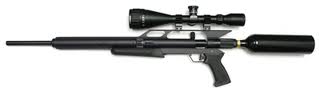 It's called the "Condor" and it's made in America by an American manufacturer called "Air Force." (Clever, eh?)
Why is this such an awesome pellet gun? Lots of reasons.
It's a dual power source design. You can either use compressed natural air at up to 3,000 psi, or you can use CO2 "cartridges." The "cartridges" is in quotes because we're not talking about the sort of cartridges you put in a typical pellet gun, the CO2 cartridges are huge, and are used normally to recharge paint ball guns. Obviously there is a huge power difference between CO2 cartridges and the compressed natural air, but CO2 is a nice power source for plinking. Compressed natural air is more for serious shooting.
I love this basic design. The air tank doubles as a shoulder stock, which reduces the weight of the gun by a pound or more. The air flows directly into the breech in the direction of the barrel, doing away with any recoil or airflow turbulence problems. It's got weaver scope mounts and a loooong barrel, which is ideal for accuracy.
But there's more. The "gun" here is really more of a "gun platform" than a "gun." You can swap out the barrel, use alternate power sources and add all sorts of tactical accessories (laser sights, flashlights, scope levels, etc.) easily.
You can purchase all of the common pellet caliber barrels, from .177 to .25. And at 3,000 psi it will send a .25 caliber pellet at over 800fps, delivering over 30 foot pounds of energy at the target as much as 50 yards downfield.
The huge air reservoir allows you to get up to 100 shots in the "sweet zone" of the power curve. Most PCP airguns get 20 or so shots before you have to top it off again. Plus you can "dial down" the power which still provides more power than most airguns but can then last up to 200 shots before falling off the bottom edge of the power curve.
The gun itself costs about $650. Additional barrels and accessories would push that up to $1,000 or so. But man, oh man, what a pellet gun you would end up with...
Yeah, the Maserati of pellet guns. I really want one. :)