Cosmic Conservative

Rational Conservatism from the heart of America

Living

Movie Review: Jobs

By CosmicConservative
When I first saw the trailer for this movie, my immediate reaction was "Ashton Kutcher? Seriously?" jobs-movie Having seen the movie now, I don't think Kutcher was a bad choice to play Jobs. Physically he bears a strong resemblance to Jobs and he does a fair job with makeup pulling off the illusion of being Jobs. Except for one thing I'll mention here and try to overlook for the rest of this review. Starting about 1/3 into the movie, Kutcher adopts a very awkward gait while walking. He sort of hunches his shoulders over, leans forward and splays his legs out as he walks. The result is decidedly uncomfortable looking, and on several occasions it feels like Kutcher is focused more on achieving this strange gait than on the scene around him. I was mostly curious about this movie because of my close association with Apple back in the 80s. I was, back then, a certified Macintosh developer and attended multiple Apple Developer conferences and other Apple events including some of the events where Steve Jobs was the keynote speaker. I had even met some of the people in the movie, albeit very briefly and only in the context of being part of a group attending a workshop or mingling during meals, between sessions or during some of the "get to know Apple" activities. People who knew me at that time will remember that I did not have a high opinion of Steve Jobs, and my opinion of him has not really changed that much since then, although I give him more credit for his marketing savvy and ability to spot a trend-setting market opportunity than I did then. Back then I more or less considered Steve Wozniak to be the real genius behind the creation and success of Apple Computer, and meeting Woz was much higher on my "want to do" list than meeting Jobs. Although I never actually met either of them in spite of being in several sessions where one or the other (or both) spoke. My main curiosity in watching the movie was how well the movie would match my own memories of the time, particularly around the creation and production of the Lisa and the Macintosh computers. As it turns out the movie was much more of a character portrait than any sort of historically meaningful life story. What historically relevant information there was, and there was very little, was mostly focused on the iconic imagery of Jobs, Woz and Apple. The humble beginnings in Jobs parent's garage, the production of the first kit computer (now known as the Apple I), the creation of the Apple II, etc. There was virtually no meaningful technological history. For example, there was no mention of Jobs visiting Xerox's Palo Alto Research Corporation (which is where most of the technology that made the Mac so visionary had been produced) or any real exploration whatsoever of what made the Apple II any better than the dozens of competing computers set up in booths beside Apple's introduction of the Apple II. Anyway, the movie was all about what sort of person Jobs was, and how he grew, or didn't grow. I suppose the point was to try to show how visionaries are different than normal people. But what emerged was not so much a comparison of visionaries vs normal folks as a comparison of assholes vs geeks vs corporate greedheads. Unfortunately the characters other than Jobs mostly fit some one-dimensional caricature, including, amazingly, major figures like Steve Wozniak who came across as a fairly typical overweight, socially awkward, business ignorant engineer. I've never met Woz personally, but I've been present in the room several times when he was presenting and I've seen tons of interviews with him and that is a seriously unfair representation of a pretty complex and interesting individual. There is a certain amount of irony in a movie that portrays the single greatest failing of Steve Jobs to have been his singular focus on his own needs, desires and goals to the detriment of everyone around him, and then treats every other character in the movie as a cardboard, meaningless drone who exists for no other purpose than to be a cog in the Steve Jobs machine. In fact the depiction of the other characters is so limited that there's really no point in critiquing them. Sure I could snark about how awful the members of the Board of Directors were portrayed, particularly the Farmers Insurance guy playing the "bad guy" board member with the subtlety of a careening Mack truck, but that's the sort of depiction that was needed to allow the movie to be all about Steve Jobs. Which begs the question of how does the Steve Jobs of the movie actually come out? Well, the Cosmic Wife's reaction was "what a total jerk!" Which is pretty accurate as far as my understanding of Steve Jobs is. The movie is sometimes surprisingly unsympathetic to Jobs, especially in any scene where Jobs has to interact with anyone outside of creating a product for Apple. You end up wondering if Steve actually remembers his wife's name. Since the movie offered no real insight into what made Jobs successful, other than that he was a driven jerk, and it offered no real context for how Apple became the technology juggernaut it was in the early 80s and has become again with the iPhone and iPod, I really can't recommend the movie as a way to spend a few hours, especially at movie theater prices. I'd give it 1.5 misaligned circuit boards out of 5 and say wait until it's on the Lifetime channel on a rainy Sunday afternoon if you want to see it.


Progress in the basement

By CosmicConservative
Besides making substantial progress on my novel, since I stopped playing "Grepolis" I've also made a lot of progress in some home maintenance activities, including yard work, garage cleanup and, the subject of this post, cleaning up the basement. The main thing I've been doing in the basement is converting an entire wall (10 foot wide by 8 feet high) into shelves to hold all my cr.. er stuff. Here's what I'm using: shelves Basically I've mounted four vertical strips of wall mounting that holds brackets you can place at any height you want, and then you can put boards across the brackets to make the shelves. I spent most of yesterday cutting, drilling, screwing, re-drilling and re-screwing to get the wall-mounted strips on the wall. The wall is a bit unusual in three ways. First, there is a three inch ledge at 44 inches high due to accommodating the actual foundation of the house. Second, there is a section of the roof that holds the conduits for our air conditioning/heating vents. Third, the lower portion of the wall and the upper portion of the wall do not have matching stud layouts. That meant I had to basically create two different layouts for the strips to get them to fit as well as I could. Today I have to purchase the remaining brackets and all the shelves themselves. That's probably going to be $150 or so. The vertical mounts and the brackets I've already purchased was $100, so in the end this will end up costing about $250. Once I have the shelves up, it should be a simple matter of just stacking all the stuff in my boxes into the shelves. I'll post a photo when it's all done.

Memorable story moments in fiction

By CosmicConservative
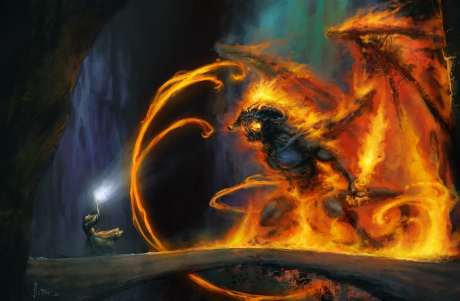
As I have noted in a few other posts lately, I've finally gotten my motivation back to finish the novel I've been working on for eight years now. Yeah, eight years. No kidding. Seriously. Since 2005. My very first files on this book date back to a basic plot outline I put together on an airplane in 2005. My first rough attempts to create the opening scenes of the book were written a few days later. A few days after that I created the basic character portraits of the main characters. Eight years ago. Wow. Up to this point I have been focused entirely on creating a cohesive, comprehensible and compelling story with interesting and believable characters. Of course I don't know how well I've done that, but I've done the best I can, and as I read through the book myself, it feels pretty natural and seems to hold together well. If I make the final change I discussed in my previous post, then technically I can call the story finished. But there's something that I really, really want to do. And that is to not merely create a believable, cohesive and compelling story, but to create a story that provides the reader with truly memorable moments that they will savor and perhaps even come to identify with the story. Here are some examples of what I'm talking about. I suspect that most of my readers will immediately recognize every single one of these moments and it will evoke mostly positive memories of the stories they came from: balrog "You cannot pass!" "Please sir, I want some more." "Frankly my dear, I don't give a damn!" "Big Brother is watching you." "It is a far, far better thing I do than I have ever done..." "Are you trying to seduce me, Mrs. Robinson?" I'm not sure how to do this though. I know what I WANT to do, I want to have the story build up to a crescendo of tension and conflict, then capture that tension and conflict in either a memorable statement from a character, or else some equally memorable descriptive text. I want that moment to be seared into the reader's mind such that if they repeat that quotation or descriptive item, anyone who has read the book will immediately be drawn back to that moment and relive it in their mind. I really don't know if other authors deliberately attempt that, or if it "just happens." I am worried that trying to MAKE it happen might actually be counter-productive, sort of like trying to make a date successful with just the right line, and then sounding like a total ass. Still, that's what I want. I want there to be at least half a dozen moments in this book that are so compelling and have been so firmly embedded in the minds of the reader, that twenty years after reading the book, one sentence will pull them back to a moment that had enthralled them.

The novel

By CosmicConservative
obsidian_knife OK, I have begun writing again. I managed to squeeze out roughly 3,000 words over the weekend. In essence I have completely restructured the ending of the first book, allowing the protagonist (Lirak) and his allies to secure a major victory against the evil world-conquering forces arrayed against them. Previously I had the first book focused almost entirely on the internal personal growth of Lirak, with the key "victory" in the book being his final unlocking of his own ability to manipulate the forces that the enemy had been using so effectively against the "good guys". I had thought that this was dramatic and fulfilling enough to overcome the fact that the book ended with a huge army knocking on the door of the main city defending against the invading hordes. My thought was that this cliffhanger approach would encourage people to buy the next book so that they could see the resolution of that battle with Lirak's new abilities being used as part of the defense. Two things changed my mind. First, I just never really felt a sense of closure myself as the author of the story, even knowing the ultimate outcome. Second, I have been deliberately attempting to paint visual images in the scenes of the book so that the reader experiences epic events that will stick in their mind for the rest of their lives, and the internal struggle of Lirak to master his birthright just didn't provide that sort of epic cinematic opoprtunity, while the destruction of an entire army does so in spades. In order to still have that hook in the book though, I now intend to foreshadow an even BIGGER battle as the good guys discover that the evil forces are sending a massive invasion fleet directly at the defending forces. Anyway, for better or worse, I have written the first half of that final battle, and I now have to weave that scene together with the existing final scenes which are all about Lirak leaving his homeland and entering the next phase of his life as a major player in the world stage opposing the seemingly inevitable conquering of the world by the evil forces arrayed against him. I figure another couple of hours is all I need to wrap up that final battle, then a couple more hours to weave it into the narrative, and finally I'll have nothing left but some final edits and tweaks here and there. This is, for those counting, the third time I've totally rewritten the ending of the book. It better be the last time.

Movie Review: Fatal Call

By CosmicConservative
This is an unusual situation. I write a lot of reviews of movies, books and even the occasional television show. But up until now, other than having a friend of my daughter work on some of the computer graphics for a movie, I've had no connection to the item being reviewed. This movie is the creation of one of the regular posters on this blog who goes by "Jack". And one of the very few liberals who hasn't been driven away by the anti-liberal commentary that is rather frequently expressed here. Or at least not yet permanently. So I don't feel quite the level of objectivity that I normally have when doing one of my reviews. With that caveat out of the way, here we go: First, the poster, reproduced here: fatal_call ... is a really egregious misrepresentation of the movie itself. Jack apologized for this up front indicating that he had no input into the cover. I find that very interesting and wonder how common it is for there to be that level of disconnect between the creator of a film and the marketing posters created. I suppose that would account for other posters I've seen that seem sort of off compared to the movie. In this case the poster seems to be deliberately exaggerating an action scene and the "femme fatale" nature of the movie. If I were Jack I would be quite incensed at the end result. OK, I've got that out of my system. On to the movie itself. My basic reaction to the movie is that it struck me as being fairly representative of the writing, acting and production qualities of a Hollywood movie. For what I suppose was a fairly low budget Indie movie, I was impressed with the final result. With a couple of exceptions, but then that's generally true of most movies I watch. The main character, Mitch, portrayed by Jason London, did a fair job overall, with some compelling moments. Amy, the femme fatale portrayed by Danielle Harris, was, I thought, the most compelling actor in the movie, even though her first scene in the bar was not her best. Kevin Sorbo, best known as the star of the "Hercules" TV show, showed moments of talent, but some scenes he seemed to be mailing it in. The two actors who portrayed Mitch's friends, Joel Lewis as Ted and Jimmy Chung as Simon were outclassed and sometimes painful to watch. The camera work and general cinematography were generally solid. Several scenes were well crafted, well framed, well lit and provided the proper tone for the scene. The editing itself was mostly unnoticeable, which is about the best thing you can say about editing. Which brings us to the story. Generally I judge how well a story is written according to at least the following things: 1. How easily I can predict the events. 2. How well the key plot elements are foreshadowed, woven into the story and, finally, revealed. 3. How plausible key events are. 4. How consistent the actions of characters are based on their personalities as portrayed. So here's how I react in each of these areas: 1. I'm afraid that I found the plot to be entirely predictable, and was not surprised by any of the "reveals". Not even the "big" reveal at the end. This was in part because the story had a fairly bad case of "wow, what a coincidence" going on pretty much all the time. That didn't ruin the story, I'm rarely surprised by the plots of Hollywood movies, so I can usually appreciate the story even when it seems to be clipping along the exact trail I expected. 2. This is probably the part of the writing that I think was done the best. It appeared to me that the writer (Jack, I assume) spent a lot of time working on exactly how to provide the clues that would eventually be used to justify the final reveals. For the most part I think this was done as well as, or even better than, many Hollywood movies, most of which resort to final second twists to justify their final reveals. At least that wasn't the case here. 3. Hmmm.... plausibility issues were unfortunately fairly common. Maybe no more common than most Hollywood movies, but I have a very poor opinion of most Hollywood writing, so that's not much to grab onto. The most bothersome issues to me from a plausibility perspective were the following: a) Mitch's reaction to the initial discussion to deal with an unwanted marriage were not consistent with the persona we had been presented with. This could have been managed better if this scene had been moved several minutes further into the movie, and we had seen Amy use her feminine wiles more deliberately to break down Mitch's supposed "good guy" tendencies. As it was, they went to bed and almost immediately Mitch was accepting the premise of Amy being willing to commit murder and even asking Mitch to do it. b) Virtually none of the detective, DA or police station scenes struck me as plausible. Pretty much every character in any role of law enforcement was not fleshed out enough to be believable as anything but a means to advance the plot. The actors in the detective roles attempted to inject personalities into their portrayals, but ended up mostly just providing personality quirks that were sometimes incongruous and even unprofessional. Considering what their role was in the plot, they should have been more menacing, gritty, hard-bitten, even bitter or resentful, but the most important aspect of their role in order to be meaningful to the plot is that they should have been competent and they were not. c) The entire sub-plot with the ruffians pursuing Mitch was unnecessary and distracting. If I were editing the work I would have suggested cutting that entire bit out of the script. It added nothing important to the story and demonstrated nothing new about Mitch's character. d) Mitch spent much of the first half of the movie running around in public with obvious and potentially serious wounds, and interacted with people in a strange and disturbing manner, and it never seemed to occur to anyone to call the police. 4. I already touched on this with Mitch implausibly accepting the idea that Amy was a murderous bitch and being OK with it after nothing more than an evening of rather tame and conventional sex. I know from my own experience that writing sex scenes is quite difficult, especially if there is any deviation from what people consider "normal." But Amy needed to be more forceful and unconventional in her approach to sex for Mitch to have fallen so quickly to her wiles. Amy needed to be a beast in bed, a vixen with a mission. She should have left Mitch exhausted, astonished and overwhelmed by this sudden realization of his wildest fantasies. Then I would have believed that Mitch could have fallen prey to the temptations of his repressed sexual urges. Amy was too tame and conventional and Mitch was too decent for me to believe that the story would have developed the way it did. I know this probably all sounds harsh, but as I said above, the movie struck me as being pretty well in line with the quality and standards of Hollywood movies, which is probably quite an achievement on the budget and with the resources the movie was made with. Overall it hung together and there was a story to watch with some interesting characters, some surprisingly good production qualities (particularly the film editing) and a couple of acting performances that would have stood out in many big-budget Hollywood films. I give it three lanyard-flash drives out of five. You could do worse than check this out.

The sad state of television entertainment

By CosmicConservative
I admit it, over the past few months I have developed a very sad tendency to sit on the couch in front of the television. There are reasons for that, the primary reason being that I still haven't gotten my basement set up as a home office/hobby room like I intended. But regardless, because I have been spending so much time on the couch in front of the TV, I've been picking up the remote and looking for things to watch that are not just as annoying as hell. And not having much success. It's not like television was some sort of brilliantly conceived, life-fulfilling experience when I was younger. I mean I watched a whole lot of this: gilligans_island More of this than I'd probably like to admit: hillbillies ... and way too much of this: onedayatatime ... so I probably don't have much room to talk. But still, back then I didn't have over 1,000 channels to choose from. I had, like, four. Now I've got over 1,000 channels and 90% of the time when I sit down and flip through the channel guide there's friggin' nothing on! How can that be? OK, that's not entirely fair. Here's a random sampling of the stuff that tends to be on when I check out the guide: Lots of network garbage that more or less is a poor ripoff of the same shows I watched when I was younger, and almost all of which involve jokes about how stupid and horny men are, how clever and precocious kids are and how exasperated women get with their husbands and kids. With loads and loads of sexual innuendos and invitations to sexual activities, 90% of which are initiated by the female stars. Sports shows, either shows about sports, actual games, or replays of games from years gone by. Channel after channel of these. Every now and then I actually care about a sporting event, but that's rare. I tend not to like to watch baseball games, I prefer listening to the radio, and while I do enjoy football on TV, I only follow a couple of teams and they only play once a week during the NFL season. Hyped up reality TV shows. Except none of the shows I've seen seems to have any connection with any sort of reality I've ever experienced. Seriously? "Keeping up with the Kardashians" is listed as "Reality TV?" That's darn near criminal misrepresentation as far as I'm concerned. Actual reality TV shows. These are shows that follow actual almost normal people as they go about their daily jobs. These range from shows about cooking in a bakery to people who make their living from purchasing storage lockers from auction. I admit that some of these have actually suckered me into watching them. Particularly "Storage Wars" and "Swamp People". Who knew a show about families that hunt 'gators in southern Louisiana could be entertaining? Still, there aren't many of these that I find worth watching, so that leaves the vast majority of my time unfilled. Movies. Probably 1/3 of the channels on my TV at any given time are showing movies. But only a tiny fraction do so in HD without commercials, which is pretty much the only way I want to watch a movie. And those few that do show movies in HD without commercials seem to show the exact same movies at the same time as every other channel doing the same thing. And 90% of the time even then they are movies I have the blue-ray, or at least the DVD sitting in my shelf. Why would I watch it on TV when I can watch it in higher quality with more control from my blue-ray player? Science shows. This is a small fraction of shows, but there are still quite a few of them. This constitutes the bulk of my TV watching interest these days. Shows like "Nova" or "Through the Wormhole" or shows that explore ancient technologies or modern marvels. I love shows that can express the importance of major breakthroughs like the development of the arch, or how the first true domes were created. But the general response to my turning on the TV is to stumble blindly around page after page of offered entertainment while saying "Really? People actually watch shows about Botox injections?" How can there be so much content, and so little worth seeing?

Online multiplayer space conquest game

By CosmicConservative
So, while we were playing "Grepolis" for the past few months, Drax and I had a number of phone calls to coordinate activities and discuss strategy. As part of that we discussed what we liked and didn't like about the Grepolis game. As that sort of thing goes in our conversations, that led us to what sort of combat/conquest strategy game we'd like to play. And that led us to the idea of a galactic conquest game. spaceship A long time ago, in a previous life, I used to play a game called "Reach For The Stars", which was a game that was published on a variety of PC platforms, including Commodore, PC and Macintosh. It was actually a pretty good game, but it wasn't massively multi-player. It did allow up to six players I think, but it was turn-based and everyone had to take their turns at the computer to make their moves and watch the outcome. At the highest level what I'd like to see is a massively multiplayer online game similar in concept to "Reach For The Stars." So Drax said "why don't you write one." Hmmm... well, I USED to be a programmer. I USED to write games. I USED to build enterprise wide systems capable of running a massively multiplayer game... But that was a long time ago... Still, it's an intriguing idea. If I were to pursue this, here are some things I would want to do:
  1. Most games that are a mix of resource development, military buildup, travel and combat require a huge investment of time in what are, to me, the less interesting aspects of the game like configuring resource management and shuffling resources around. I know that this is a major factor in actual wartime, but I also know that by and large generals leave those details up to subordinates. Generals say "Build me a bunch of tanks and deliver them to this location" and move on to the next agenda item. They don't worry about where to mine the iron, how to smelt it and produce steel, how much steel is needed vs rubber, glass, etc. If someone WANTS to deal with their resources at that level, that's fine, but I'd rather not spend hours per day micro-managing the mines. What I WOULD like is the ability to choose between different subordinates and assign to THEM these details and then monitor status and perhaps tweak the approach of the subordinates by issuing directives to them.
  2. Games that I've played treat all military units as interchangeable cogs. One ship is exactly the same as another. In fact, from a programming perspective, each military unit is frequently nothing more than a number in a list. There is no actual ship, when a ship is added the number of "ships" is increased by 1. In a game I would create I would have each individual unit be a unique object with a history and several attributes which are tracked separately, some of which might be modified based on the ship's history. (For example two identical ships might have significantly different combat effectiveness due entirely to the number of battles they have survived.) Yes, this means the process of conducting an actual battle will be quite complex, but hey, that's what programmers are supposed to deal with, right?
  3. The main issue I have with games like Grepolis is that the game requires constant monitoring and this is just not possible for me, or many other people, to do because we have actual LIVES that take precedence over playing a dang game. So the game needs to have some way to allow the player to play when they can play, and to deal with real life when they need to, without constant fear of losing a key military base just because they happened to be asleep at the time. At the same time, the game can't simply go on "pause" mode anytime any single player is unable to play or the game would NEVER move forward. It is my opinion that the game that best resolves this issue is the game that will become the "killer app" of online military strategy games. My initial cut at how to deal with this is to allow the game to create and execute plans. That way the player can set up a series of events and/or triggers with responses and log off secure in the expectation that their plans will be executed and that their pre-planned response will kick in if certain events occur. (For example, if a particularly military asset is under attack, a specific response plan can be triggered and executed.)
  4. It is a rare game that allows for any re-distribution of forces. I don't know if that is due to a lack of awareness of how wars actually happen, if it is due to lazy programming, or if it is some misguided effort to enforce "game balance." But I personally see no reason that entire armies or fleets could not be delivered to another player, according to whatever exchange the two players agree to. The caveat to this is in the next bullet, which is "support and supply lines"
  5. It is perhaps the oldest adage in military history, but it is just as true today as it was when Sun Tzu cautioned military leaders about it, and that is that armies "march on their stomachs." In today's terms that means more than just biological stomachs. A military operation is only as successful as the supply lines allow it to be. A command chain that cannot provide support for their armies and fleets is a command chain that will lose wars. While this can be abstracted to some degree, a truly accurate wargame should have military units that use up resources and those resources should need a supply chain to keep the units combat ready. Disrupting these supply chains has always been a major combat strategy. If a command somehow gains units that they cannot support, those units will either disband, mutiny or join another player's fleet/army. Of course that means the game has to have an element that allows for the creation, management and disruption of supply chains.
  6. Most wargames have completely arbitrary means of providing "game balance", most frequently in the area of defense vs offense. Many games just arbitrarily make defense stronger than offense so that you get the result of needing something like 3x the number of offensive units being needed to overcome defenses. I would like to think that there are ways to make actual tactics more meaningful. In other words, defensive troops should only be "more effective" because they have employed specific tactics that make it harder to overcome them. They shouldn't be harder to kill just because someone clicked the "defend" button instead of the "attack" button.
  7. In a strategy game, strategy should actually, you know, matter. Right now most wargames I've played are called "strategy" games because they fit some commercially derived genre, not because they actually encourage or even promote strategic gaming. Grepolis is about as "strategic" as checkers. And that might be an insult to checkers. In order to make strategy matter, there have to be actual strategic options and goals for the players to engage. And good strategies should be rewarded while poor strategies should be punished. Again, picking on Grepolis, there is virtually no actual strategic impact in the game. The game boils down to pure brute strength and the ability to build enough cities to out produce your enemies. And that boils down mostly to who is willing to invest more of their personal time into the game, not who is actually BETTER at planning and executing strategies.
Anyway, I could (as usual) go on (and on and on). The bottom line is that I am intrigued by the possibility of re-entering the gaming world by working on a massively multi-player real-time galactic conquest strategy game. But there's this little novel I've been trying to finish...

Greppling

By CosmicConservative
Hi, my name is Cosmic and I have been a Grepolis addict. grepolis What is Grepolis? It's an online wargame that is (very, very) loosely based on ancient Greek warfare. The name appears to be a portmanteau of the English word "Greek" and the Greek word "polis" meaning "city-state." First of all, it is only fair to point out that the ads you may have seen on TV imply that the game looks something like this: grepolis ad It doesn't. The most action you will see on the screen in the game looks like this: actual grepolis battle There is no interactive, simulationist graphics element to the game at all, unless you consider a static image of your city being built, all exactly the same, to be so. I don't. But that doesn't mean the game isn't addictive. The basic premise of the game is that you are some sort of king in the Grepolis world, and as such you reign over a city or cities. Following the rules of the game properly every player begins as the king of a single city, and then through colonization and conquest you can take more cities. The game attempts to provide some limitation to growth by having a point-buy system to allow players to found new cities (either by colonization or conquest). You can only have as many cities as you have "culture points" to spend. Culture points can be obtained four ways:
  1. Battle (an ever-growing number of 'battle points' can be converted into culture points by holding city "victory celebrations" which take 4 hours each.
  2. City festivals, which cost resources (see below) and require a certain level of research in the "Academy" to hold. City festivals take 12 hours each.
  3. Theater plays, which are like city festivals in that they take resources (but significantly less) and time (3 days) but you have to build a Theater to hold them.
  4. Olympic games, which require spending "gold". More on "gold" below.
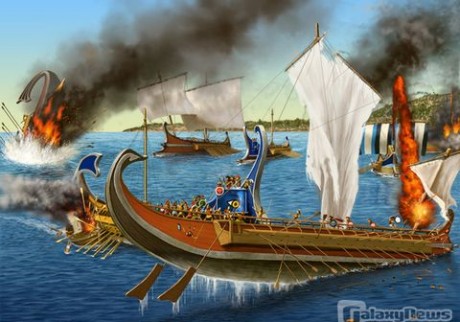
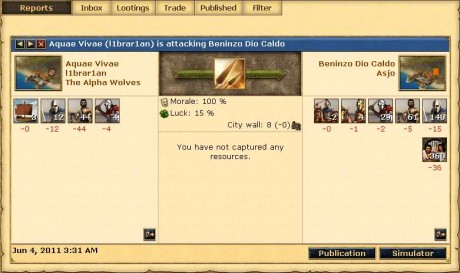
Obviously the more cities you hold, the more powerful you are. Well, back in early April my brother, Drax here on CC, invited me to play the game. I sorta like wargames, and this invitation predated the TV commercials so I had no actual knowledge of how the game was played so I went online and checked it out. It looked interesting from a strategy wargame perspective, so I agreed to play and soon received the invitation and found myself the king of a tiny little city next to one of his sprawling metropolises on a small island in a huge ocean. So I looked around. The game "board" is a series of literally tens of thousands of essentially identical islands separated by a world sea. Basically for all practical purposes your cities are located on small islands and there are colonizable islands in every direction as far as you can plausibly sail. Which brings me to sailing. The game is deliberately slow-paced. On an island it might take 10 - 40 minutes for infantry troops to walk from one city to another. A catapult might take hours to move from one city to another. Horses move faster and flying troops (more on that below) move faster still. Ships move faster than land troops, but they still take hours to travel between islands. To sail from one island to another nearby island can take an hour. To sail to islands far away can take days. When I talk about minutes, hours, and days here, I'm not talking about some arbitrary game-clock. I'm talking real, honest to god clock-based minutes, hours and days in the REAL WORLD. Just wanted to make that clear. In other words if you want to attack a city on an island a couple islands away from your starting island, you launch your ships and it might take three hours of real world time for your ships to get there. While the game gives an allegorical nod to actual historical military technology, the actual game mechanics themselves are highly abstracted and simplified. Boiling the game down to its essence, there are four types of attack, and four types of defense. Each military unit, be it ship, soldier or mythological creature (more on that below) has an attack and defensive rating. Land units have an attack type (blunt, sharp or distance) and a defensive value against each of the three attack types. Sea units have a sea attack and sea defense rating. Battles are resolved by calculating the attacking armies damage done against the defending army's defensive values. Most units, land or sea, are primarily attack or defense, meaning that attack units have virtually no defensive abilty, and defensive units have virtually no attack capability. There are a very few units that can do both, but they obviously tend not to be the best at either. The strategy of the game is to win battles by utilizing units with higher attack values in an area where defensive units have lower defense values. Well, that's the theory. In practice players tend to just build huge "bombs" of a single unit and simply overwhelm the enemy with numbers. Sea battles lack even the pretense of any sort of strategy, there is simply a sea attack and sea defense value and that's it. A typical battle goes like this: Attacking cities join together to target a single city. That city's owner will call for help from his allies and those allies will send support to the targeted city. While you can attack cities with normal forces and gain battle points and resources, to conquer another city requires sending a "colony ship" which is a special battle unit that allows an attacker to take over the defending city if their attacks are successful. The thing is that colony ships are excruciatingly slow. They are basically about 1/7 as fast as a battle ship. That means a trip that takes 10 minutes for a bireme can take over an hour for a colony ship. Attacks from islands even just a few islands distant can take seven or eight hours. Colony ship attacks of 24+ hours are not uncommon. The targeted player is notified of any incoming attack. There are no "surprise attacks" in the game, unless the player simply isn't paying attention. This includes colony ship attacks. So that means any attempt to take over a city generally gives the defending player a lot of time to get support into their city from their other cities or from allied players. Which means that the attacking city has to pull in support from other cities or allies of their own to boost the attacking forces to the point that they can overcome the combined defensive forces. Land troops only fight land troops. Sea forces only fight sea forces. To get land troops onto the targeted island, you either have to destroy all the defending ships, or you have to use a special attack type (which you have to research) which allows you to sacrifice a huge amount of your attacking ships attack value in order to land a percentage of your troops onshore. This can be a very useful tactic, but it is very costly, meaning to use it requires having even more ships doing regular attacks. The "proper" approach to taking a city is to send "clearing waves" of pure sea attack ships to "clear the harbor" of defending ships, and then to land land troops to clear out any troops in the city. Only when the target city's harbor is empty AND the city is clear of land troops can a colony ship begin the process of conquest, which is called a "siege." A siege takes 12 hours to complete, so once the siege begins, the defending player has 12 hours to send whatever they can gather together to break the siege. If they can destroy the colony ship, then they retain control of their city. The main strategically limiting factor of the game is that while defending fleets and armies stack together, attacking fleets and armies do not. An "attack" is accomplished by sending a fleet or army or combination of the two at a city, and the attack takes place in a split second, the results are tabulated, and any remaining attacking ships or troops return immediately home. That means that if you send two attacks and they land one second apart, by the time the second attack lands, the first fleet/army is already headed home. Of course in the meantime, in between the two attacks, a defending force can arrive from another city and be in place for the second attack to have to deal with. To visualize this I tend to think of fleets and armies moving through wormholes. You send them off somewhere, and they then disappear from the world while in transit (you cannot "intercept" a moving fleet or army, they simply are not on the board at all), and then pop out of the wormhole at their destination, the battle is resolved in an instant, and then they are whisked away back through the wormhole to their originating city. You cannot stack multiple cities worth of troops in one city and launch an attack or defense with the combined forces either. Each city has its own wormholes they send their troops through. So, battles are settled by these fleets and armies popping into the battlefield. Supporting fleets and armies stay in place once they land, but attacking fleets and armies do their damage, and if any survive, flit away again in an instant. The battle impact of this game design is that defending cities don't have to defend against all of the incoming troops. If they want to, they can dodge the incoming attacks and wait for the colony ship attack and try to time their defense so that all the incoming attacks have nothing to attack and the colony ship finds an instantly materialized massive fleet and army in the harbor and city when they get there. To further complicate matters, the wormholes themselves have a ten second random jump built into them. So you send your troops to a destination, and they can arrive anywhere from ten seconds before or ten seconds after your targeted time. So basically you end up with a crap shoot at the key moment of the battle and whoever "rolls the dice" best can win the battle even if their troops are far less than the other side. The purpose of this is to allow players with fewer cities to have some hope of defending themselves against players with lots of cities. I personally hate it. OK, I mentioned "gold" and "mythological units". So I'll cover them here. Building anything in the game, troops, ships, buildings, research, etc. requires "resources." There are three types of resources: wood, stone and silver. Everything you build has a cost based on these three resources as well as a "population" cost. The population cost is the most important since each city has a maximum population count based on the number of farms the city has built and there is a maximum number of farms a city can build. This means that no city can become more powerful than other cities. Each city reaches a maximum size pretty quickly and can only produce buildings or troops equal to the free population. When the population limit has been reached, the city can't build anything else. This drives major players to build as many cities as possible and to tailor each city to a particular purpose. Some cities build nothing but offensive ship fleets, some build nothing but "sharp" land units, some build nothing but mythological units. But "gold" is different. Gold isn't really part of the game mechanic, gold is something that you gain from outside the game. While there are some ways to attain gold through player activities, the main way to get gold is to spend actual real world money on it. If you do buy gold you can use the gold to do things like accelerate the build speed of units or buildings, hold Olympic games (meaning you can essentially "buy" new cities) and purchase the services of "helpers" which provide advantages to the player such as a 30% improvement in troop strength for land troops. Buying gold is the profit means of the game. I admit that I purchased gold when I first started playing the game and used it to help get up to speed more quickly so that I could be a meaningful player. But I haven't used gold for a while once I got to a reasonable number of cities and no longer needed it to grow. "Mythical units" are military "troops" based on Greek mythology. Minotaurs, harpies, medusae, manticores, etc. These are very costly units but they provide abilities and power far beyond "normal" troops. The main benefit they can provide from a purely strategic perspective though is that some can fly. Also the best defensive unit in the game is a mythical unit, so if you are hunkering down in a city, filling it with cerberuses (I want to say "cerberi") is a great idea. Manticores, harpies and pegasi can fly, meaning they can get to battles or defend cities faster than any other forces and can completely ignore fleets in doing so. Well, to make a long story short (HAH!) I just quit the game last night. While it's a generally fun game with some nice strategic elements, the bottom line is that the game is a massively multiplayer, international, 24x7 endeavor and that means you have to constantly monitor your cities to avoid being "indisposed" when some enemy player decides to take one of your cities. Plus the whole game is based around resource management and the more time you spend clicking on buttons, the more resources you gain, so you find yourself in the position of either constantly getting online to build resources, or falling behind in the resource management battle. (There are some "illegal" ways to build resources, such as "farming bots" but those will get you banned from the game). I was literally waking up half an hour early every day to check on my cities and gather some resources, then checking on break and at lunch to see if I was getting attacked, and then spending a good chunk of my evenings and weekends doing resource management, moving troops around and otherwise just making sure my cities were smoothly functioning. And that doesn't even begin to address the effort involved in planning and executing a battle. A "good" battle will take hours to execute, and if you are managing a couple dozen cities, that may mean that you have as many as 30 or 40 individual fleet/army launches to initiate at very specific times so that they arrive in the battle as precisely as possible. Running a battle for me meant creating a list of all of the troop movements I needed to initiate with the proper time listed for each one, and then pulling up the battle screen in Grepolis and selecting the appropriate troops and then hitting the "attack" or "support" button at the proper time for the troops to get there when they were needed. That meant for the course of four or five hours I might need to be sending troops every ten minutes or so. Anyway, it was too much. So I am now an ex Greppaholic.

Renter's rights?

By CosmicConservative
no_guns There is a story today in the news about a Colorado rental company that is telling their renters that they cannot have guns on the premises. The story seems to imply that this is a sudden ultimatum issued by the renting manager, but I suspect the actual message is that when a renter's current lease is up, they will have to sign a new lease that does not allow them to have guns on the premises. This, to me, raises a couple of legal questions. The first is related to the Civil Rights Act, which says that renters can't enforce rules that violate an individual's civil rights. Usually that is interpreted as renters can't refuse to rent to people based on gender, sexual orientation, race or age. But unless I am badly mistaken, the Second Amendment is a "civil right" and as such a renter cannot set rules that disallow the "right to keep and bear arms." I suppose that if this goes to court, that will be the primary argument made by the plaintiffs. But to me this opens the door to another, perhaps more fundamental, question about the renter/rentee relationship. Can the renter tell me that I cannot own legal products? I suppose this has been tested in the area of renters who disallow pets, or perhaps even children. But pets or children are living things. A gun is an object. What if a renter decided that they would not allow skis or kayaks on their property? Could they legally do that?

The Dick Pic

By CosmicConservative
So, I am going to deliberately break my rule about having a photo or illustration in every post for, I think, rather obvious reasons. For the last few years I have found myself perplexed by what is clearly a social phenomenon that I find to be utterly baffling. The phenomenon I am speaking of is the prevalence in the past few years of prominent male public figures sending photos of their genitalia to females they barely know, in the hope (or expectation) of luring their targets into bed. So what is it that I find so perplexing about this phenomenon? Is it that well-known public people (politicians, sports heroes, actors...) are willing to risk their reputation in the pursuit of women in this manner when they presumably have no problem getting plenty of women in more traditional ways? No. Is it that there is an expectation that sending a photo of their "junk" would entice a woman to respond favorably? Well, I suppose that I do find this to be totally inexplicable based on what the women I have known in my life say about their own reaction to such behavior. I have never met a single woman who would admit to finding such behavior anything but creepy and abhorrent. But as bizarre as that is, that is not the main thing that makes me shake my head about this behavior. Is it that there is apparently an entire section of the internet reserved for men and women to send each other photos of their gender bits? No, not really. I suppose that is something I personally can't imagine doing or receiving, but I can't say I'm terribly surprised that people use the internet for such things. I would think that most people would understand that once you initiate anything with an IP address you pretty much have given up any sense of privacy. But then I don't expect people to think much. About anything. So I figure there are a lot of people who are foolish enough to engage in such sexcapades. And for the most part, if it is between two people who have entered into such an intimate relationship, sending each other groin shots might even be understandable in a titillating, break down the barriers sort of way. Forbidden fruit and all that. So what is it that totally blows my mind about this whole thing? It is this. Apparently, it works. Which either means that I have somehow, throughout my life, encountered females who are all in the particular subset of females who find such behavior unacceptable and creepy.... Or else I've been lied to about what turns a lot of women on. Dick Pics. Seriously?