What else is there to say:
I had such a crush on Mary Poppins ... er.. Julie Andrews...
What a beautiful set of pipes she had.
I just love when she says it backwards...
I am sure you have seen the recent Geico commercial with 70's rocker Peter Frampton. Â Still skinny minus the long hair. Â Frampton was at the Bossier Centurytel Arena a few years ago. Â One of my favorites:Â Â
John Ritter's family is looking for $67 million dollars from a radiologist and cardiologist because they did not save John Ritter's life when his aorta tore on the set of "8 Simple Rules."
Part of the story points out that they have already won some settlements worth millions, but they aren't done suing yet.
Beach plans to drop charges against Abercrombie store | HamptonRoads.com | PilotOnline.com
City officials said Monday that they plan to drop obscenity charges filed against an Abercrombie & Fitch store manager at Lynnhaven Mall, where police confiscated two large posters of partially dressed models over the weekend.
The Abercrombie & Fitch promotional photographs appear in the fashion retailer’s stores throughout the country, including at MacArthur Center in Norfolk. One photo depicts the backs of three shirtless men, including one holding jeans that hover well below his waistline and reveal the top of his buttocks. The other, as described by a Virginia Beach police spokesman, shows a topless woman with her hand covering a portion of her breast.
Near the dawn of MTV when women in giant chicken suits still roamed the earth, a band called The Breakfast Club released this catchy tune. Madonna was the drummer in this band in the early 80s and is rumored to have dated both the lead singer and the drummer. Music is such an incestuous business...
I think if I were the lead singer in a band I would insist on wearing a fedora too. Do any of you remember this song?
This provocative tune by Tommy James and the Shondells was the #1 hit in 1969 and one of the biggest hits in the 1960s. I've always liked this song. It's strangely evocative in ways that were no doubt perturbing to the heavily starched parents of the 60s...
What do you think? Could you dance to it? Did you dance to it?
How does a ship sail upwind? At first blush this would seem to be impossible, but it is not impossible. In fact well-designed and well-crewed sailboats can sail upwind at surprisingly respectable speeds. How do they do it?
Basically the answer has to do with the fact that a ship experiences two forces while in a steady wind. The wind itself provides a force, and the water provides another force. The wind force is called aerodynamic force and the water force is called hydrodynamic force.
But the main reason a ship can sail into the wind is that sails act as true airfoils. In other words, they act like airplane wings. They exploit Bernoulli's principle which says that the force on an object in a fluid is dependent on the speed at which the fluid flows over the surface of the object. For a sail (or an airplane wing) that force is different on the leading and traling edge of the sail. The net force is what provides the thrust the ship feels.
But, in the absence of hydrodynamic forces, a ship could not maintain a particular heading to exploit the properties of an airfoil. Drag forces would quickly orient the sail such that it no longer had a different air pressure on one side than the other, and the wind would simply blow the sail along.
What allows the sail to maintain an orientation to exploit the differential aerodynamic forces is the ship's hull, keel or other object which takes advantage of the hydrodynamic forces in the water to offset the forces of the wind which want to reorient the sail so that it only blows downwind.
Because these two forces can be set to oppose each other, the resulting total force on the boat is an additive vector derived from adding the aerodynamic force to the hydrodynamic force, and that resulting vector can point in virtually any direction except directly upwind.
Since a ship cannot sail directly upwind, they have to zig-zag along an optimal angle into the wind. This zig-zagging is called "tacking into the wind" and a really well designed sailboat can tack about 35 degrees from straight into the wind.
Now, if there is a strong current in the water, that can also be exploited to improve the angle of movement into the wind.
It is the real-time evaluation of all of these forces, and the ability to plot an optimal course into and downwind that separates average sailors from great ones. The zig-zagging of the ship requires a complex set of adjustments to the ship's rudder, angle of attack in the water and sail settings that has to be redone every time the ship zigs or zags. This has to be choreographed like a fine ballet in order for the optimal results to be achieved.
The realization that a ship could be made to sail upwind in this manner is one of the defining moments in all ancient seafaring cultures. The fact that such cultures were able to understand and exploit this is a testament to how clever human beings really are. Ancient Phoenicians, for example, had no idea of how Bernoulli's theorum explained fluid dynamics, but they intuitively understood how to exploit them anyway. It's almost a zen thing, they were able to figure this out by pure feel.
And people think that ancient humans were dumb. This stuff is not easy folks, and humans have been doing it for tens of thousands of years...
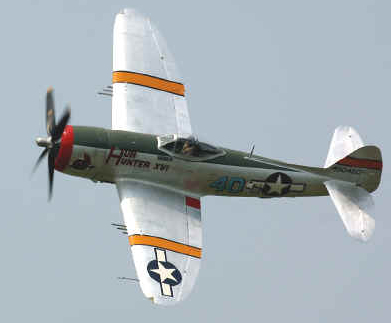 The largest and most powerful U.S. fighter of WWII. Also known as the "Jug."
Was it better than the P-51 Mustang?