So, I've indulged my own selfish pursuits the last few days and among the posts I've made are some about a book I started writing about two years ago, but which I have not touched for, well, almost two years.
I thought I'd reveal a bit of the work I've done, and maybe even give some clues about the story itself, just to see if anyone finds it interesting.
First, before I could start writing a book, I had to create a setting for it. In my case that meant creating an alternate universe, more or less from the ground up. Because this is a fantasy novel with magic as a key part of the story, I felt there needed to be some plausible background for magic to exist.
So to do that I followed the Tolkien model and actually wrote up a basic theology and creation story for the universe. I won't go into the details here, and I am not using this as an analogy for any specific earthly creation myth so there's no ulterior motive. To talk any more about the creation of the universe would give away too much of the story's intent, so I won't. Suffice it to say that the gods of this universe are real and actively concerned with what happens in it, but limited by their own design in what they can actually do to intervene. In general cosmic terms the universe is much like our own, there are galaxies, stars, planets, moons and the laws of physics are pretty much identical to our own, with a few rather critical exceptions. Next I created a solar system with planets and moons, and then created the main planet, it's continents, seas and basic political subdivisions.
From a comparison to earth perspective the planet is roughly comparable to earth around the tenth century. The most advanced societies have some basic technology and some knowledge of gunpowder, and there are large areas of the planet which are still very much in the stone age. It's a period of empire building by a few aggressive cultures who have no qualms with things like racial genocide. Some of the empires are worse than others though, and one in particular seems to deliberately project a palpable sense of evil. At least one other powerful empire is at war with the evil empire and has managed, so far, to battle them to a stalemate, leading to a years-long standoff between the two empires with constant skirmishes fought in remote areas, while major cities have been fortified in every possible way. Well-defended and maintained stone walls stretch for hundreds of miles through the countryside.
The story, however, does not begin in either of those empires, nor in any other "civilized" nation. Instead it begins in a "heart of darkness" area of the map populated by a stone-age culture which has long been ignored by the rest of the world, both for its general inaccessibility and for its perceived lack of valuable resources. However, all that is about to change.
The protagonist of the story is a young man (we would call him a "boy") who is apprenticed to the village stone-knapper, the man who makes the village's best knives, axes, arrowheads and other stone tools. His older brother is the village's most skilled hunter and his father disappeared years earlier on a trip to a faraway place on a mission even his own mother will not talk about.
In this culture as a boy reaches a certain age, he is sent on a spiritual journey chosen for him by the village shaman. In this case the journey chosen is to travel to a sacred cave far away over an imposing mountain range, to gather sacred stones which the village uses to protect itself from evil spirits, and sacred herbs which the village uses to perform certain rituals. It is a dangerous journey, and not all who have been sent on it have returned. Without the stones and herbs, the village suffers greatly, so the responsibility for a successful journey is not simply a personal mission, but is one that the village depends upon for its very existence. Or so he is told.
The first few chapters of the book are about this personal journey. Hopefully it's a compelling story in its own right. On the trip he has to contend with dangerous mountain passes, difficult to follow instructions, hungry wildlife and powerful storms.
Upon his return (I won't reveal if the journey is successful) he discovers that his entire village has been wiped out, the bodies of the villagers have been despoiled and the females have been viciously abused. There is virtually nothing left of his village except some half-burned out huts and a large number of corpses. Not knowing what else to do, he begins burying the corpses as well as he can according to the village customs. This takes more than a few days.
As he is doing this some survivors come trickling back to the village, among them are his older brother, who had been on an extended hunting trip, a young woman he had been developing a relationship with, but who had been viciously raped and left for dead by the attackers, and a ragtag collection of several stunned village survivors.
Wracked with grief and driven by revenge, our "hero" sets about to hunt down and exact his revenge on the people who destroyed his village. There is a lack of universal agreement on this course of action, and this leads to conflict and hard feelings between him, his brother and others in the group. Yet eventually he prevails and the group of villagers follows him as he pursues the raiders.
That's sort of the first "section" of the book. I don't recall how many chapters that is, but it's a chunk of story, and there is a lot going on. All of this is to set up the next portion of the story, which is a sort of grim version of Robin Hood where the ex-villagers become guerilla fighters harassing a far superior army as that army leaves a trail of destruction behind. All of the destruction of the army is simply a consequence of a larger goal, which is to attack and destroy a portion of the defensive wall surrounding the "good" empire, as part of a larger offensive which is intended to crush that empire for good.
As this part of the story develops, our hero's guerilla force grows as survivors of other villages join them. They quickly learn to appreciate and appropriate the technology of the invaders and eventually they become effective enough that they force the invaders to deal with them, creating delays that threaten the larger strategy itself. During this period the hero demonstrates a remarkable ability to lead tactically and strategically, so much so that eventually his own older brother accepts a subordinate position in their "army".
That's enough to talk about now. The story arc of the book takes this group and eventually has them join with the larger army of the "good" empire, where the hero (honestly I have been away so long, I've forgotten his name... sad) has become legend due to his actions as a guerilla fighter. He is offered a position in the empire's army and leads a climactic victory over the evil empire's general, effectively driving them back to their homeland, and freeing up the ancestral lands of the stone age cultures. However, our hero remains behind as he has become the favorite general of the emperor. That ends book 1.
Book 2, when I get to it, will be called "Warlord" and will be about the battle between the two empires from the perspective of our hero, who eventually becomes the supreme commander of all the "good" empire's troops, and whose popularity and skill eventually becomes a threat to the emperor himself.
Book 3, when I get to it, will be called "Warlock" and will reveal that the whole empire vs. empire battle was part of a larger spiritual struggle where supernatural forces square off against each other in an ultimate battle of good vs. evil with the future of the universe on the line.
Throughout all three books I intend to incrementally increase the use of magic. At first our hero seems to have no magical abilities, but it is revealed over time that he actually does, as do others in the book. The discovery and mastery of magical abilities is a key part of the character growth and development, and by the time the reader is in the third book, magic is more important than non-magical abilities. (Thus the "Warlock" title).
So far I've gotten about 2/3 of the way through Book 1.
The novel I put down almost two years ago is a fantasy story which involves extensive use of magic as part of the plot. This is true of most fantasy novels. But it is usually the way that magic is described and used in a story that I find to be the weakest part of any fantasy story.
In most fantasy stories magic is simply so arbitrary and situational that it is indistinguishable from divine intervention. Harry Potter is probably the worst example of this. I like the Harry Potter books but every time Harry gets in a tight spot, I know that Rowlings will get him out of it with some new, yet-undiscovered magical ability that just happens to be exactly what he needs at exactly the right moment to keep the story going. There's no reason or rationale whatsoever behind it. If he needs to be able to cast a stronger, faster spell than the acknowledged most powerful wizard of all time, then that's what Harry does. If the spell needs to come from out of nowhere and do something no spell has ever done before, then that is what the spell does.
By the way, Star Wars is a fantasy story, set in a sci-fi universe. The "Force" is just magic. Jedis are just warlocks.
In other fantasy stories the author goes to great lengths to explain the rules behind the magic system and shows how the "wizards" have to study and learn to utilize the magic. Eregon is like that. The "magic" is all in the "true language" words that hold all the power in the universe. Usually those books try to keep some sense of limitation to what magic can do, but usually the author finds ways around their own built-in limitations to advance the story line. Again the Eregon series is a classic example of this with the reader first being told that magic is limited to the physical power that a person can generate from their own body, but as the story develops and more and more powerful magical spells are needed to advance the story and enhance the crises, suddenly tools, techniques and artifacts appear which get around this limitation, and we are back to magic having arbitrary limits and capabilities as needed for the author to get their hero out of a jam.
I hate that.
The Lord of the Rings had a unique perspective on magic, and a unique means of describing the use of magic to the reader. We are told that Gandalf is a wizard early on, and he demonstrates his wizardness at first through the use of fireworks, a specialty of Gandalf's. The fireworks show at the long awaited party is very skillfully done for a modern reader because the fireworks are just magical enough to tantalize, but described as recognizable chemical-powered rockets and devices. The reader is left to wonder how much "magic" is actually in play with Gandalf's wizardry.
In fact in the entire book Gandalf's first-hand descriptions of magic are quite rare, and when done, are quite subtle. Gandalf uses his staff and a burst of his magic to start a fire in a snow-sodden pile of wood. And as he does so he complains "There, I have said 'Gandalf is here!' to anyone who cares to see." This was wonderfully done because it was a life-saving use of magic beyond the ability of any mortal present, yet was nothing more than lighting a fire in the cold, and yet the use of it was fraught with danger because of the recognizable signature his magic carried with it. This conflict betwen Gandalf's well-known magical powers and the danger inherent in their use is almost unique in literature. His most blatant uses of his power are described only as remote events at the time, as in the unusual flashes of light on Weathertop, or as after-the-fact descriptions of the results, again as on Weathertop where Aragorn and the hobbits find the hill scorched and burned from the terrible energies weilded between Gandalf and the Nazgul king. Now we have EVIDENCE of Gandalf's power, but we still don't SEE it. It's left almost entirely to the imagination. Perhaps the most overt use of magic in the entire book was when Gandalf went to save Farimer from the Orcs at Osgiliath and we see then that he raised his HAND to direct white bolts of energy at the Nazgul. But even then Gandalf was only able to fend them off, his bolts did not reduce the Nazgul to cinders upon contact.
One of the reasons I love the Lord of the Rings books is precisely because Tolkien managed to deal with magic in such a way that the reader is left with the IMPRESSION that Gandalf is a supremely powerful magician, but virtually all of Gandalf's magic is hidden, subtle, or of a seemingly minor nature when compared to other wizards in literature. But Gandalf's magic was BELIEVABLE. I never had any problem suspending my disbelief with Gandalf. I was convinced of his power, and awed by his self-control. Magic was something to be used responsibly and sparingly precisely BECAUSE of its power. There are subcurrents that Saruman's fall was, at least in part, due to his pride in using his own magical abilities, and a major sub-theme of the book was the temptation to abuse power, especially magical power.
OK, so I probably went on too long about Gandalf and his use of magic....
The point is that in the novel I was writing, I wanted magic to be more like LOTR magic than most fantasy novels. I wanted it to be powerful, subtle and mostly hidden, but lurking like a tiger in the weeds, ready to pounce on the unwary.
So as I started working on the book, I tried to create a set of rules for magic that I felt would allow me to create such an experience for the reader.
And you know what? It's hard. And what I found is that it's even harder to stick to it once you get the story going. In fact, in rereading it, I find the magic system to be annoying to me now. I don't like it at all. So now I'm figuring I'll have to rewrite all the parts where the protagonist or anyone else in the story is using magic.
And I know that the desire to rewrite a story is one of the great threats to completion of a novel...
But still, even I don't "believe" the magic in my story. It must be fixed....
So back to the drawing board.
So... I've been contemplating writing again. I haven't attempted to write anything for almost two years now, in fact since my father passed away. But lately I've been thinking more often about getting back to the keyboard and putting words to paper.
As such I've been looking back over the craft part of writing, and reading up on successful techniques and the styles and practices of great writers, particularly of great fantasy or sci-fi writers.
This sort of thing inevitably leads to Joseph Campbell and his thoughts and teachings on the power of myth, the use of archetypes, and the human attraction to a particular epic story arc.
From memory the Campbellian epic myth arc goes something like this:
1. The protagonist of the story begins as a reluctant participant in their own story.
2. The protagonist carries some seed of prophetic greatness (usually genetic, but not always).
3. The antagonist (usually a demigod or even god) knows about the existence of the protagonist, but not specific enough to immediately locate them, and so seeks out the protagonist through minions or some supernatural (or technological) power.
4. The protagonist is identified and attacked, usually through his family, and barely escapes alive.
5. The protagonist is effectively forced through custom, anger or loyalty into pledging battle against the antagonist.
6. The protagonist joins forces with an aging, once-powerful source of wisdom and training who both warns the protagonist of his travails ahead, and provides wisdom and training to unlock the protagonist's prophesied abilities.
7. The protagonist joins forces with a small group of unusual, usually widely diverse allies whose abilities are not nearly as powerful as the protagonist, but whose activities serve to provide the stimulus in unlocking the protagonist's prophesied powers.
8. The protagonist meets a series of ever-more-challenging obstacles and eventually succeeds in unleashing his inner power, frequently in the process of saving one of his allies.
9. The protagonist almost succeeds in defeating the antagonist, but at the last second is betrayed by one of his supposed allies.
10. The protagonist is forced to escape, regroup and eventually engage in a final, climactic confrontation with the antagonist where the protagonist wins an overwhelming victory.
11. The protagonist is heaped with praise, adulation and acknowledgment of his fulfillment of prophesy.
Now, this particular formula has clearly been used very successfully for thousands of years. And for the most part I think Campbell gets this right. Done properly this story arc is probably the most compelling and universally engaging story arc that humans react to in a positive manner. Here is a short list of stories that follow this arc almost to the letter:
1. Gilgamesh
2. Beowulf
3. The Iliad
4. The Odyssey
5. The Lord of the Rings
6. Star Wars
7. Shane
8. The Chronicles of Narnia
9. Harry Potter
etc. etc...
And of course I love all of those stories. But there is something about that formula that has always sort of bugged me. I think I've finally sort of worked it out. The whole business of the elite superman who is born to rule, or born to excel is not very egalitarian.
I mean Harry Potter did not achieve his powers through study and practice, he was born to them. As was Luke Skywalker. Of all the stories above, probably the one that diverges most from the fundamental story arc is actually The Lord of the Rings, since Frodo and Sam represent the "everyman" and are the true heroes of the book. In most of the stories the only role the "everyman" has in the story is to serve as cannon fodder or comic relief. The stories are presented as battles between the opposing wills of the superman protagonist and the demigod antagonist. Entire villages, cities or planets can be wiped out and the reader is not led to care about their lives except as markers to prove how evil the antagonist is. In some cases even the hero lays about with abandon, creating his own mountain of innocent corpses (particularly Achilles). In fact the reader is usually presented with a choice between the personal dictates of the antagonist against that of the protagonist. There's not a lot of room for, say, democratic self-rule, involved in these stories.
So I'm wondering what that says about humans in general. Does it mean that humans truly yearn for the rule of a benevolent dictator who rules by right of divine decree?
George Lucas actually said that. One of the acknowledged themes of his Star Wars movies is that the best form of rule is a benevolent dictatorship of elites with divine powers. George actually is proud of that. I guess he doesn't care much for all the messy nonsense that surrounds a democratic society.
So now I'm trying to decide if I really should follow that story arc if I want to write a story. It's a fairly well-proven formula to attempt, and I don't deny that one of my main motivations to EVENTUALLY write a successful novel is to MAKE SOME MONEY.
But as I said, the more I think about that formula, the more I think it is a bit too elitist for my taste...
What do you think?
If the full moon tonight seems brighter and larger than usual, it's not entirely your imagination. It really is larger and brighter than usual. This morning when I took the Cosmic Dog out for her morning constitutional (which I do about 5:30 am) the moon was so bright I didn't need my flashlight at all.
Tonight the moon is at perigee almost at midnight, so the full moon tonight will be as much as 30% brighter than "normal." There is also a chance for the Geminids meteor shower to start tonight, although tomorrow night is probably a better night for them. Unfortunately the fuller and brighter the moon is, the harder it is to see meteors. So if you want to see the Geminids, you should look away from the moon.
Look up tonight for a spectacular treat in the sky - Times Online
If the full moon tonight looks unusually large, it is not your imagination – it is the biggest and brightest full moon to be seen for 15 years.
Each month the Moon makes a full orbit around the Earth in a slightly oval-shaped path, and tonight it will swing by the Earth at its closest distance, or perigee. It will pass by 356,613km (221,595 miles) away, which is about 28,000km closer than average.
I have gotten to the point that I have almost forgotten the "Cosmic" part of "Cosmic Conservative." Sigh.
When I was, oh, about 12 years old, I wanted to play in the school band. Back then we called it "Junior High School" today it's called "middle school" because I guess "junior" was too traumatic for some people.
For some reason I decided I wanted to play trombone. I don't know why, but that's the instrument that caught my attention. After a bit of playing on checked out school instruments, I decided I needed my own trombone, so I started saving up my money from mowing lawns and doing other odd jobs I could find. After a while I had saved up about $50 or so, which was a lot of money back then for a 12 year old kid.
Finally I found an ad in the classifieds for a used Elk Hart trombone (I think that's what it was called) for $40, as I recall. So I called them up and they still had it, so my dad drove me over to their house to pick it up.
Things were different then. When we got there the father told us the trombone was in the attic, and pulled down the ladder thing and told me to go up and get it. Can you imagine someone doing that today? But that's what he did. So up I went, and sure enough, there it was, so I opened the case, looked at it, it looked in real good shape, so I closed the case and headed back to the stairs.
But then something caught my eye. An old rusted up rifle lay beside the trombone. I mean seriously rusted, and the stock was pitted with age. I could tell it was a .22 rifle though, and I had been wanting one for a while, but my dad was holding out mostly because my mom thought I was too young to own a rifle. And of course I couldn't afford a new one. But there one was, looking tattered and beaten down by life and thrown up in an attic.... So I picked it up too.
Again, can you imagine that in today's world?
Bringing both of them down, I showed the rifle to the house owner and asked if it was for sale too. He asked me how much money I had, and I said "After the $40 on the trombone, I've got $10 left."
"Sold." He said. My dad gave me a "you are going to get me in serious trouble" look, but did not say anything. So I handed the guy my $50 and we headed to the car.
"That gun probably won't even work." My dad said. "You probably just wasted $10."
"Well, it was my $10 to waste." I said.
"You'll have to fix it up yourself, I'm not going to do it, and I'm certainly not going to pay a gun shop to fix it." he said with an exasperated sigh, probably trying to figure out how to explain to my mom how I ended up with a rifle.
When I got home, my mother was predictably upset, but my dad argued that as a 12 year old, I was old enough to be trusted with a .22, that he'd teach me to use it responsibly, that I had always been a responsible kid, and besides, the thing was so messed up it probably wouldn't shoot anyway. Finally my mother reluctantly agreed to let me own it at least long enough to see if I'd actually do the work required to clean it up.
And it did require some serious work. The barrel was pitted and rusted, the stock was covered in dirt and in general the thing had a disreputable look that you might expect to find in a gun left in a mud puddle over a winter. But putting my eye to the inside of the barrel, the rifling looked to be in good shape and the inside of the barrel was shiny and pure.
The bolt didn't even work though, it was so gummed up and rusty.
My recollection is that it took me weeks, maybe more than a month of daily sanding and polishing to get the gunk off of the gun. The barrel had to be sanded down by hand and it took a lot of elbow grease to get all the rust off the barrel. I had to take apart the bolt and individually clean, sand and oil all of the moving parts to get it working again. I had to carefully clean, sand and polish the breech to get it to hold a shell. The stock was the easiest part, and as such was the first thing I worked on. As it turned out the stock was actually in pretty good shape, it was just covered in mud and grit which sanded off pretty easily. Once I had sanded it down, polished an oiled it, the stock actually looked quite beautiful. It was looking at the stock that kept me motivated to keep on the tedious and difficult work of sanding, polishing and reassembling the barrel and bolt.
But finally it was "done." By done I mean I had removed all of the rust and had taken off all of the grit and had polished oiled and tested all the parts. The barrel still had clear signs of the abuse of the years of neglect, but I had managed to remove all the active decay. To try to sand down all of the pits and gouges in the barrel would take months of daily sanding. So I purchased a small bottle of chemical gun blueing and blued the shiny steel barrel, then I put it all back together again.
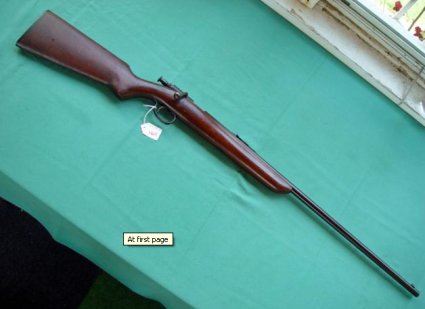
It looked like this:
I thought it was the most beautiful gun I'd ever seen.
So then came the day I actually loaded it up with .22 short (my dad insisted that I start with short before moving to long, and finally long rifle) cartridges. We had recently moved into the suburbs, but still had family who lived in the "woods" in a rural area, and my brothers frequently went to my aunt's house to target shoot. So I went with them and spent a wonderful day plinking at tin cans. Everyone was impressed with the little .22's accuracy. Soon I was hunting squirrels and rabbits with the little gun. And I treated it with respect, always cleaning it immediately upon returning from target shooting or hunting.
That was over 35 years ago. I've had that sweet little rifle ever since, and I have pumped a lot of .22 shells through it over the years. But it's been a decade at least since I've shot it. In my memory it is a highly accurate gun, but memories can be funny things. For example, my cousins had a favorite beer, I think it was called "Pearl" and the cans had a red circle in the middle of the front of the can about the size of a penny. My memory is that if I could see that red dot, I could put a bullet in it. And even if the can was so far away that the red circle wasn't actually visible, I could still put the bullet close or in it just from knowing where it was on the can.
I never put a scope on the rifle, and it took the life of a lot of innocent squirrels. But in all the years I owned it, all I ever knew about it was that it was a Remington single-shot .22. All of the model information had been sanded off with the corrosion on the outside of the barrel.
But thanks to the magic of the internet, today I was able to finally definitively identify the rifle as a Remington Model 41 "TargetMaster". In looking it up on the web I have found that it was made in the mid 1930s (for only 3 years) and that it had a reputation for being a highly accurate .22 rifle.
Somehow knowing the name and history of the gun actually gives me a sense of well-being. It turns out that it's not worth that much, a "good condition" version is worth about $150 or so. Mine is probably only worth about $50 or so since I foolishly took it to a gun shop and had it professionally blued since the chemical bluing I put on was wearing off after a decade or so. That no doubt ruined the collectible value of the gun. But I'm not much into collecting, and I have no intention of selling this thing anyway. I put way too much of myself into this gun, and I intend to keep it around as long as I'm around to keep it.
OK, so now that Obama has been elected, and before his administration can effectively raise the prices on guns so that only rich people or thieves can own guns, I have decided to buy a 9 mm handgun with my (hopefully) upcoming yearly bonus from work.
So I'm looking for recommendations.
I currently own a few guns, but only have a .22 pistol, which has about the stopping power of a spit-wad. As my dad used to say, I want a gun that picks up an attacker HERE and puts them back down again THERE. I also want it to be as accurate as possible, although I can't afford a precision target pistol...
Any thoughts?
In WoW the word "dungeon" is officially reserved for computer generated temporary environments that are sort of like "bubbles" of the world that are specially created for a group of five or fewer characters when they go through a specific "portal." In the game these portals are depicted as a sort of shiimmering surface in the air, usually stretching across a cave entrance or doorway. As the first group member goes across the portal, the server creates a complete sub-world which contains all the maps, mobs and loot of the dungeon. The reason for this is to allow multiple groups to adventure in a well-defined sub-world without worrying about colliding with other teams as they pursue the same goals. It's actually a pretty good system and not only works well mechanically, it also works well in terms of game design and continuity. A "Raid" is usually a "dungeon" designed for ten or more players, but it's basically the same concept.
Because these dungeons are sort of miniature WoW worlds all their own, they are usually designed by a small team of WoW game designers who are going after a specific user experience, and as such these dungeons vary wildly in terms of look, feel and content. For higher-level WoW players who have grown bored with the "real" world content after months or years of roaming up and down the same roads and mining the same nodes, etc. these dungeons are considered to be a major part of the WoW experience, and as such the portal entrances are usually crowded with characters waiting for groups to assemble or just hanging around before or after entering the dungeon itself. (I tend to still call these "instances" since that was the Everquest word for the same thing).
So of course one of the main areas of interest with a new release (such as "Wrath of the Lich King") is the execution of these dungeons. In a way these are the crown jewels of the game and as such are carefully evaluated by the long-time players of the game (which I still do not consider myself to be, although I'm at six months and counting now as a WoW player).
So yesterday and the day before I finally managed to get into a group that hung together and played well enough to actually complete a couple of dungeons. My opinion of them is that WOTLK looks like it will be considered to be a well-designed addition to the WoW world.
The two dungeons I've done are two of the easiest (since I'm still "low level" for the new area). The first was a standard castle dungeon crawl and was not terribly impressive, but it was decently challenging and required some good coordination from the group and provided some decent loot (I got a pretty nice piece of chest armor as my reward).
The other dungeon though was really well done. The dungeon was infested with giant insects and spiders. The spiders were particularly nasty and had two or three ways to incapacitate characters, including a quick web-wrapping that turns the character into a spider-web mummy until you fight your way out. Movement through the dungeon was both along normal cave paths and along gauzy spiderwebs that almost felt like walking in mid-air. The background music was creepy and included sounds meant to evoke giant bugs and spiders chittering and skulking around in the background, and the actual fights included creepy insect sounds along with the normal clash of weaponry and armor.
I thought it was very well done. The graphics and movement through the dungeon really felt like you were crawling through a creepy giant spiderweb. The gauzy, nearly invisible webs themselves created a real challenge for navigation, and we found ourselves having to search for the right path a couple of times. This is one great benefit of new content, normally if you do a dungeon there is someone there who has done the dungeon about fifty times already and so you tend to follow a standard script to complete the dungeon. With totally new content nobody knew the path, nobody knew the goal and nobody knew when to expect the inevitable sneak attacks.
As a result, of course, my character died three times, wich is costly since every death forces you to repair your armor, and high-level armor is not cheap to repair. But even so the newness and lack of knowledge of the intricacies of the dungeon really added a sense of foreboding to the endeavor, and when we did overcome the challenges, it was surprisingly satisfying to know that we, as a group, solved this dungeon on our own, without Google searches or the help of Joe the Ultimate Dungeon Sage.
I have to say that two hours of game play was worth the whole price of the game, and from what I hear, this is not one of the better dungeons.
So I have to give Blizzard credit on this. Well done!
Oh, and I got a real nice pair of boots!
Side note: After completing the dungeon I wandered around a bit in the far northern reaches of Northrend and suddenly came upon a giant steel gate set in a mountain pass. It looked a lot like the gate of Mordor. As I got closer and scouted around (it's good to be a rogue) I discovered that the place was infested with all sorts of super-powerful undead monsters, including these awesome bone dragons that rained coldness on the ground (hitting me once). It was a very impressive graphical accomplishment, with the giant metal gate, the outposts "manned" by giant flesh golems, hordes of undead minions swarming around, and the bone dragons making their ponderous way across an aurora-draped sky....
Was pretty cool. Seriously.
Then I left before something found me and killed me.
Dean's World has been having a fun discussion of the definition of "superhero", and that leads me to propose that "normal" humans who only have "powers" due to technology cannot be properly called "superheroes" while humans who have even nominal "super" powers, such as James Bond, ARE superheroes.
To elucidate:
There are a number of "superheroes" whose only "super" power is that they were in the right place at the right time when someone was handing out super suits. (To be fair, some created their own). Examples of this would be Green Lantern, Iron Man, Nova, The Atom, and even Venom.
On the other hand there are a number of literary figures not normally associated with "superheroes" whose physical or mental abilities are clearly beyond any actual human being's. James Bond is an example of a "normal" human who may never do anything that is actually "super" (such as flying or using x-ray vision) but whose ability to function at 100% human physical or mental capacity as long as he needs to is a super power all its own. Other examples would be Sherlock Holmes (super deductive reasoning), Cyrano De Bergerac (super swordplay), Rambo (super toughness) etc...
My proposal is that it is actually more accurate to call James Bond a "superhero" than to call Iron Man one.
OK, I've played WOTLK enough now that I've leveled up from 70 to 71, so that's a pretty good bit of game play. Here are my thoughts.
The new content is superb. The landscapes are beautiful. The new area is a northern continent near Azeroth's north pole (Northrend) so it is a landscape modeled after Sweden, Finland, Alaska and Greenland. There are great fjords, majestic mountains, island-sized icebergs and mile after mile of tundra. The land is populated with what seems to be a Pleistocene zoology, dominated by huge, hairy beasts and the predators which thrive on them. Woolly Mammoths, rhinoceros and giant elk-like beasts roam the area. A nice touch is watching the bull elk-like monsters duel with each other as their ranging around overlaps and they butt up against each other.
Because the new areas are all intended for what used to be called "epic level" characters, the land is populated with animals and monsters that are a serious challenge, including storm giants and dragons. Dragons in particular seem to play a large role in Northrend. There are many cities and towns in the new continent, most of which are modeled after ice-age Viking culture and mythology. There are lots of heavy fur wearing people with horned helmets, most of whom carry axes or (less common) swords. And all of whom are at least level 68, and most of whom are level 70+. The continent itself is larger than it looks on the map at first. I've roamed around a good bit and I've still only covered about a quarter of the total area, and most of that has been on the major roads, so even the areas I've mapped still have a lot left to discover.
The questing and level grinding is all too familar though. One of the things about MMORPGs that has always frustrated me is how little the actual game play varies as you get to higher and higher levels. At level 1 you might be killing young pigs to gain experience to level up, while at level 70 you are killing giant woolly mammoths, but there really isn't that much difference between the two in terms of game mechanics and game appreciation. Each new "monster" provides a short-term appreciation of the details of that individual creature (as with the rutting elk) but soon enough it just becomes a process of hacking and slashing your way through dozens of them to gather meat, gain XP or fulfill a quest (e.g. gather a dozen woolly mammoth tusks for the king's artist to carve). Of course there is a a valule to this repetitive genocide because you do have to learn how to use all your character's skills and items properly, but even so it can become boring when you are working on your 25th elk waiting for that last bit of pristine elk meat to drop...
But that's how these games are, and it seems a bit naive to whine too much about it. Still I do like to think that if I were a game designer at Blizzard, I'd come up with more original and clever ideas than just another, bigger, badder, more dangerous monster to have to go kill and loot.
And to be fair, they do try. They have a quest in the new expansion where you ride in a blimp and drop bombs on raiding pirates for example, and that's at least somewhat new and different.
Right now the challenge is in completing the quests with the wild mobs of players all desperately trying to be the first on their server, guild or play group to hit level 80. (Interesting note, the first official character to hit level 80 happened on Thursday night in Europe. That means someone advanced from level 70 to level 80 in about 48 hours. At least one person in our guild played for 36 hours straight, but only managed to get to level 74 before crashing.)
Still, I do really enjoy the work done on the landscapes and the cities and towns in Northrend. Very quality work, beautiful and imaginative, with just enough reality blended in to keep the game playable.
So far I've only found one magic item that was better than my previous gear, and that actually replaced my weakest magic item, so I've not really gained much in terms of power since the expansion came out, but that will come in time. I also have not yet done any of the "dungeons" (which is a WoW term meaning a dedicated computer generated "instance" where your group goes in and does not have to compete with other groups trying to do the same thing). Dungeons are really the most important part of the game at high levels since that's where you have to cooperate to complete them successfully and that's where the really good loot drops, so I need to work on getting into some dungeons soon.
There is only one new addtion to the character development part of the game, and that is the introduction of a class called the "Death Knight." A Death Knight is supposedly a powerful hero who died and was brought back to undeath (unlife?) by the Lich King himself to help him conquer the world. Death Knights begin play as level 55 characters and come equipped with standard gear that is robust enough to compete with other level 55 chars. I created one just to see what it was like but I haven't played him enough yet to really have an opinion on playablilty.
I do, however, have an opinion on the concept of the Death Knight, and I have to say I find the concept appalling. Basically you are evil incarnate and you are encouraged to slay the innocent, pillage, murder, steal etc... When you are murdering innocent (and frequently unarmed) villagers, they say things like "Please don't kill me, I'm all my grandmother has left") and stand there defenseless as you cut them down. I can't say I find that sort of thing very appealing, and I was frankly a little disturbed by the in-game comments other players were posting about how much fun it was to go on a murderous rampage where people pleaded vainly for their lives.
So I don't think I'll be playing my Death Knight much...
Also, I'm not sure I like the idea of new players being able to create characters that are already level 55. I had to work pretty hard to get to level 55 and the idea that a new player can come along, and within a few hours have a horse, have tons of magic gear, and can hit some of the most fun and rewarding dungeons in the game is a bit irritating to me. It feels like they are catering to the whole "I WANNA DO IT" mentality instead of the "I want to earn it" mentality that these games usually appeal to. (Note: WoW itself is usually considered to be the easiest of these sorts of games to level up and is for that reason already considered to be lame in comparison to, say, Everquest where you have to spend ten times as much effort for the same reward you get in WoW...)
Anyway, I'm not thrilled with the whole Death Knight thing. We'll see where it goes.
Overall I think the new expansion is clearly worth the $39 I paid for it. It's energizing to have your character climbing up the level tree again. Based on the fact that for the first time since I started playing WoW I now frequently find myself in line to get a login on the game server, clearly the WoW community is pleased with the release.
I'll let you all know when Rhlyssa reaches level 80. I guess it will likely take me until about Christmas to get there.
OMNIVORACIOUS: A Mind Swimming with Swords: An Interview with Swords artist and author Ben Boos
As you might guess from its subtitle, a lot of love went into Swords: An Artist's Devotion. The first book from former video-game artist Ben Boos, Swords is a gem, a lavishly illustrated and handsomely produced pictorial that celebrates (and satisfyingly geeks out on) this iconic piece of weaponry. Swords was released last month by Candlewick Press--a publisher that regularly puts out some very beautiful kids' books--but Boos definitely intended the book for all ages, including "anyone who likes swords in the context of history, fiction, fantasy, video games, pen and paper games, movies, comics, etc."