OK, so I've admitted here before that among my geeky activities is that I engage in tabletop role playing games. I've played Dungeons and Dragons off and on since the early 80s when my brother ("Drax" here) re-introduced me to it when he returned from doing a stint in the US Navy. (I had played a bit in the early days pre-second edition, but not much).
I love the game, pretty much unreservedly and unabashedly. It's a great game, and I'm a game aficionado of the first order. I love all kinds of games from card games to table top games to computer games. Of all the games I've played though, table-top role-playing games are the most challenging, complex and rewarding, when done well. It is unfortunately true though that they can be done badly.
My initial experiences in D&D were with the first "mainstream" release of the game, now called the "black box" version, if I recall. In those days the game was fairly limited and constrained, but still it was a new "thing" for me and the opportunity to create entire worlds and roam around in them was just too much fun. Soon after that came the "Advanced D&D" version, also known as "Second Edition" which was the first really comprehensive version of the game, and was published primarily as a set of books calld the "Dungeon Master's Guide" the "Player's Handbook" and the "Monster Manual." Every version since has been built around these three "core" books, usually referred to as the "DMG" the "PHB" and the "MM".
Up through the various modifications and add-ons to second edition, the game was fully human-centric, with only human characters being allowed to advance to the upper tiers of the game. This was by design, but it frustrated a lot of players who felt that it was a bit of species bigoting and there was no reason in a fantasy setting that an elf shouldn't be every bit as powerful as a human. Also the various rules around combat, dialog and traps had developed sort of organically and as such had completely different rules mechanics around them. This made the game somewhat challenging to master since in some cases you needed to roll a high result to do well, while in other, similar, situations, you need to roll a low result.
All of that led to the first really major rewrite of the rules when the "Third edition" for D&D came out. Gone were the "racial" limitations (the game uses "race" to mean "species" of intelligent beings. "Elf" is a "race" for example) which limited non-humans to second-class status. In fact the various racial options were embraced and blended into the overall game experience so that choosing a race became part of the overall "flavor" of the character you wanted to play. This was accomplished by having "racial attributes" defined for each race which provided benefits and deficits to make each race different, but still (mostly) balanced. (In my opinion dwarves are overpowered in third edition). Third edition also introduced several new character building concepts such as "feats" and "skills." This provided a means to custom build your character according to guidelines that were intended to allow for powerful, interesting characters, without arbitrary game-changing decisions being necessary. (In second edition there were no fundamental rules to deal with a player who decided his character could fight ambidextrously, which effectively made that character over-powered compared to traditional fighters).
Still, third edition was a bit clunky and had some major flaws, but those were mostly overcome with what is now regarded as the first fully fleshed out, flexible and comprehensive version of the game, the 3.5 version. The 3.5 version was incredibly diverse and allowed for the creation of wildly different characters, even allowing a player to play completely new and unique races and classes. It also introduced the concept of "epic" characters to deal with the game-changing aspect of higher level characters by providing new challenges and opportunities for characters which had essentially become superheroes or demigods.
I really enjoyed the 3.5 version of the game. That's the version I've mostly been playing for the past five years or so. Unfortunately I don't play enough to have any "epic" characters, but playing up to level 10 or so has been quite challenging and fun on its own. In fact I felt the game was pretty well complete and had no desire whatsoever for any new major changes in the rules. I invested in books and add-ons to the tune of a hundred bucks or so and expected to play that version pretty much from then on.
However, there was trouble in paradise. At levels nearing level 20 or above, characters became insanely overpowered by exploiting unintended synergies between different abilities of certain characters. There were ways to combine certain powers to effectively become omnipotent in game terms. Once people started figuring out how to create super-powerful characters, running high level dungeons became a frustrating exercise where individual game masters had to house rule spells and effects to keep higher level spell casters from simply overpowering everything in the game. In effect the game's greatest strength became it's greatest weakness. At the same time the role-playing genre exploded, with new games built around gamers playing vampires, or werewolves, or jedi knights or just about anything you can imagine started heavily intruding on the fundamental market that D&D had always owned. Add to that the explosion of online role playing games like World of Warcraft and Wizards of the Coast (which had purchased D&D to go along with their other fantasy games portfolio) decided that D&D was dying.
So they decided to completely revamp the game system, addressing the biggest concerns with the 3.5 version of the game.
The primary complaints in the 3.5 version of the game were around the spell-casters spell casting rules, and the unbalanced nature of the classes. The problem as it was perceived was that a wizard at low levels had very limited spell casting abiltities, and once his daily spells were cast, he became nothing but a very poor crossbow shooter wearing no armor. A fighter, on the other hand, could keep pounding away using his sword or bow with unlimited capacity to do damage. This situation reversed at higher levels where a fighter's melee combat became nearly irrelevent when compared to a wizard's ability to cast dozens of powerful spells, some of which could kill the most powerful monsters with nothing but a word. So at low levels the spell casters felt useless and bored while at high level the non spell casters felt like nothing but cannon fodder for the spell casters.
To "fix" that problem, in the 4e version of the game, all characters have roughly the same amount of combat potential in the form of at will, encounter and daily powers. Wizards no longer have a set of spells they gain each day and have to hoard to get through the day, they now had powers that were always usable, and other powers that would recharge after a fight (an "encounter" in D&D terms). Fighters gained special abilities that could be used in an encounter or daily which while not being "spells" were similar in effect. For example, a wizard might have a daily ability to cast "fireball" but the fighter would have some combat abilty to swing his weapon around in a circle hitting every enemy adjacent to him.
My first reaction to 4e was that it was too simplified when compared to 3.5e. The game mechanic was totally changed and it felt like there was no reason to play a spellcaster. In previous versions of the game, the dynamic forced a player to "suffer" with a spell-caster's low-level limitations to "earn" the high level benefits of being a spell-caster. It "felt" right to me that spell casters should dominate the upper levels of the game. The new fourth edition rules seemed to mimic the play of an online game like Everquest or WoW, which had gone to great lengths to keep different classes and races balanced from start to finish. In effect I pretty much decided that 4th edition was not my cup of tea.
But time goes on, and it turns out that it is hard to find a group that still plays 3.5 regularly. As with most things, people move on and adopt the new rules while older players stick with the old rules. (In D&D terminology, a player who adamantly refuses to play the new versions of the game is called a "grognard." There are grognards around who still insist on playing the first edition rules of the game, arguing that all subsequent editions have reduced the role-playing aspect of the game in favor of tactical battle simulations.) So a few weeks ago, I signed up for a 4e campaign just to see if I liked it. (OK, to be accurate, I had been running a 4e campaign for my regular group, but running a game is not the same thing as playing a character in the game. I wanted to experience the player side of things too).
Well, this past Sunday we had our first session. My biggest fear was that the game would feel too constrained and contrived, and that the role-playing would be subjugated entirely to the tactical battle simulations. I also thought the at-will, encounter and daily power thing would be confusing and also feel arbitrary.
I am pleased to say that I didn't feel that way at all during the game play. It was different, for sure, and there were things I missed from 3.5, but I was surprised to realize that there were some things I liked better in 4e. The main thing was the character balance was vastly improved compared to 3.5 games I've played. Every player is engaged in every round in every battle. In 3.5e my druid mostly hoards her spell-casting until there is a major battle because she has so few spells she can cast and they are so desperately needed in the major fights. In 4e you have your encounter and at will powers that you recharge anyway, so you may as well use them. This gives each battle more tactical options than in 3.5 where most of the real complex and interesting battles happen when you reach some final "boss" where everyone lets loose with all the spells and powers they've been saving all day. In 4e you get to use those even in minor random encounter battles. So there is much less of a "war of attrition" where the DM can coax a player into using up their major powers before the final encounter, or the players have a fight half an hour after waking up, and then decide that they can't go on before sleeping again.
I have to say I enjoyed it, but I was playing a melee ranger, a class that in 3.5e would have basically had just a few melee abilities that he would use over and over, while in 4e he has some interesting options to choose from. I'm still not sure how it would feel to play a spell-caster in 4e. But the ranger was a lot of fun. I can't say I'm "sold" on 4e, but I will say that most of my major concerns about the game have turned out to be overblown and in some cases, completely incorrect. I enjoyed it thoroughly and am looking forward to my next session in a few weeks.
So, did you know that you can buy blocks of raw obsidian on the open market? You don't even have to undergo a background check, you can just buy it from a rock peddler. "How much?" you ask? Well, I'm glad you asked. Raw obsidian on the open market costs roughly $3 per pound. "What is raw obsidian?" you ask? It's obsidian in its natural, uncut state. Usually in the form of large rocks in random shapes.
"What can you do with raw obsidian?" you ask? I notice that you ask a lot of questions.
Well, I made my first arrowheads yesterday, and my first spear point today. One arrowhead and one spearpoint look pretty authentic to me. The other two arrowheads are mostly good-intentioned, but probably less than deadly. The spear point in particular looks pretty nice. It's got a nice leaf shape to it, is fairly symmetrical and is sharp and thin enough to be effective.
"How sharp?" you ask? Enough with the questions! I say.
Well, sharp enough to cut the Cosmic son's finger when he picked up a bit of obsidian without asking. And sharp enough to slice a tomato like a hot knife through butter. Sharper than most knives anway.
And what else can you do with obsidian and a hammerstone? Well, do the words "nasty thumb contusion" mean anything to you?
So, it turns out that the Kaibab limestone which makes up the top fifty feet or so of the land around the Grand Canyon is laced with deposits of chert, which is perhaps the most common stone from which stone tools are made.
Unfortunately, the vast majority of the chert is not suitable for large tools. You can probably make arrowheads out of much of what you find, but finding a suitable piece of chert for axes, adzes, mauls or blades is much more difficult.
In fact I only found one potential piece while in the Grand Canyon National Park, a piece I put in my backpack and then put in the car when we left.
So, when we drove into the Painted Desert/Petrified Forest National Park, I was a bit surprised when I was asked to "declare" any stones I might have on me. So I gave the ranger the stone and he put it in a plastic bag. I guess it had to be quarantined so that the local chert would not get infected with some Grand Canyon chert virus or something. But he was serious, warning me about severe fines if I picked up any rocks from HIS National Park.
So I didn't. But I did pick up several pieces of nice chert from other areas. Now to see if I can make anything remotely useful....
So the weather there was unbelievable. We had temps in the mid 80s most of the time. Walking and hiking was pleasant. We hiked along the south rim for a couple of miles, and then hiked about a fourth of the way down into the canyon before coming back since we weren't really prepared for a long hike.
We got a bit of drizzle on us while hiking, which felt really nice. Incredible cool breezes blowing from the nearby thunderstorms... Could not have asked for a more pleasant day to be there, although that isn't always the best sort of light to do photography.
On the way back we decided to hit Meteor Crater and the Painted Desert/Petrified Forest, which were really beautiful, but we ended up blowing our schedule badly and that, coupled with road constrution and two actual DETOURS (one of several miles) on I-25 meant we didn't get home until 3:00 this morning, and I had to work today. So I'm pretty friggin exhausted right now.
SATURDAY AM UPDATE: With a big pricetag of $175 million, and bad buzz preceding it, G.I. Joe: The Rise Of Cobra seemed certain to tank. For months, Paramount's claims that the movie worked fell on deaf ears. Not until the Stephen Sommers' directed pic came on tracking with incredibly high awareness among males (with scores in the 90s). Now, despite all the sniping and snarking, it's the biggest opener ever in August for a non-sequel, and the 3rd biggest August opener ever.
OK, so we saw GI Joe last night.
You always hear the pseudo intelligentsia and wanna-be critics whine about how a popular movie is "stupid" and "has no plot" and "makes no sense" and "is just eye candy" etc...
Well, for once all that is true.
This movie is great eye candy, both in the sense of great special effects, and in the sense of some very sexy ladies dressed in very sexy clothes.
But it's stupid. It makes no sense. It is really just eye candy.
I suppose I could go on and on about the gaping plot holes and the obvious lack of any sense whatsoever in the movie, but instead I'll just use one example from the epic climactic scene of the movie.
In the GI Joe universe, ice sinks, and it sinks so fast and hard, that it crushes underwater military installations like boulders falling from a mountain.
I think that's really all you need to know about how much the makers of this movie attempted to have it make any sense whatsoever.
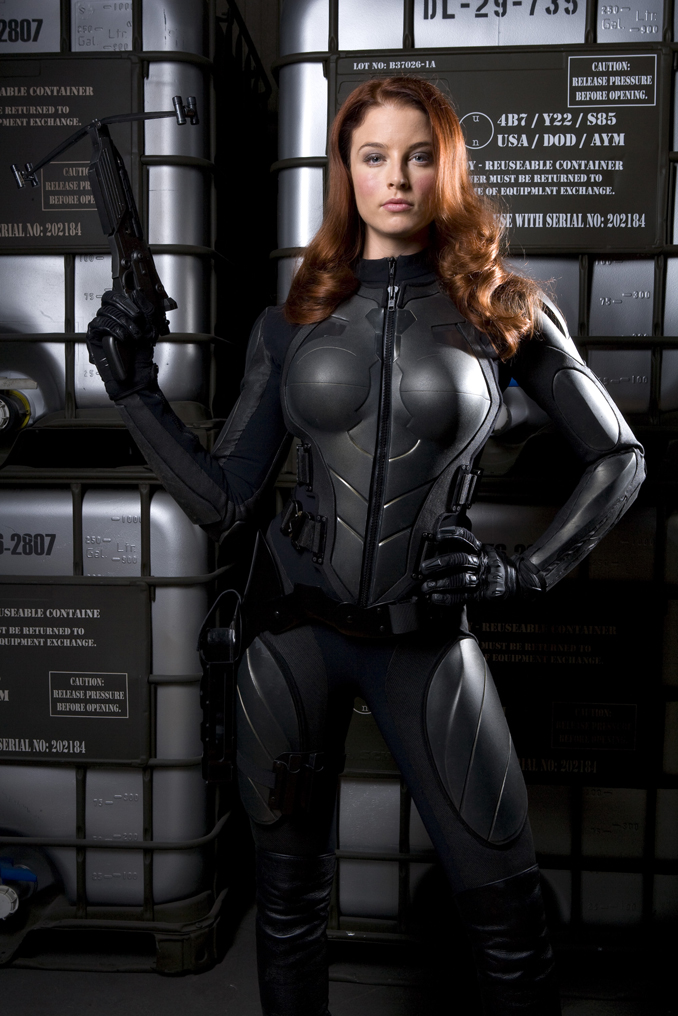
But it is great eye candy. Especially the red-haired eye candy.
(I was gonna say that I felt sorta bad for Dennis Quaid, but then I thought about what he got to look at for a few months making this movie and decided he did OK.)
It came in the mail today.
It's frickin' AWESOME dude. I mean I can't believe how awesome it is.
It's even better than I hoped. It's got a great balance and feel in the hand as well.
It's totally freaking awesome. I'm amazed at how freaking awesome it is.
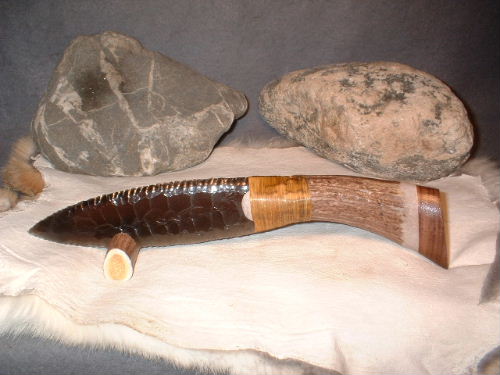
Lirak is the protagonist in the novel I have been not writing for the past week. Anyway, I've been looking for a month to find a knife that matches what I had in my head writing the story. This is by far the closest thing I've found, so I purchased it last night.
No, I won't tell you what I spent on it.
The size and shape are nearly perfect (well, according to the description the size is nearly perfect, I don't actually have the knife yet, it is being shipped here.) The obsidian blade, the sinew wrapping (although this is synthetic, which is fine with me) and the deer antler handle are all near perfect. The only thing is the walnut plug on the end of the handle, which I think looks really cool, but I didn't have such an end cap on the knife in the book. Now I have to decide whether to put that in the book. It definitely looks unique, and unique is what I want.
So, of course, what this means is that I've been researching Native American woodworking techniques. It turns out that wood working is a rather difficult subject to research because different tribes had vastly different techniques to carve or shape wood. Most used chert or obsidian knives, chisels and adzes to shape wood. But some used copper, some used seashells, and some used other materials. Copper was also used with some frequency as a flint knapping tool. That's a sort of interesting merging of stone and bronze ages which I never really thought about. I sort of thought that when copper became in common use, it replaced stone tools, but if native American examples are similar to other locations around the world, it was first used as a superior tool for MAKING stone tools. Very interesting.
I can imagine that carving with a stone knife was probably an extremely frustrating experience.
Anyway, here's his knife.
Astronomers Look for Clues in the Wake of the Jupiter Collision
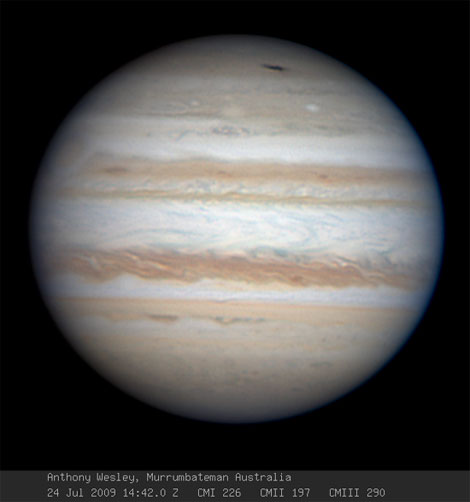
Something invaded our solar system and whacked Jupiter, but professional astronomers were looking the other way at the time. Now, as the shock wave slowly subsides, astronomers are working around the clock to find out exactly what hit Jupiter–and why they didn't see it coming.
I should have posted on this a while ago. I've been remiss in my posting duties. Pretty cool story though. The impact scar is roughly the size of the Pacific Ocean.
Interesting stuff, as the word count climbs... I'm over 90,000 words now.
Something interesting has happened to me while writing the last part of the book. I'm not sure if it is good or bad, but I do know it's going to mean a lot more work before I'm done with this book.
When I started writing the book, and through probably the first 70,000 words I wrote, I was really only interested in the protagonist and maybe one other character. Other than that I was mostly interested in telling the story, mostly as a series of events which either happened to them, or that they made happen.
As I got into the final quarter of the book, I started trying to wrap up some of the secondary plot lines in the book. Many of those plot lines involved minor climaxes in the relationship of some of the supporting characters. As I wrote those scenes, something really strange happened to some of those characters. I started to CARE about them. Suddenly they weren't just supporting characters anymore, they had somehow developed PERSONALITIES. What surprised me most is that they usually developed personalities that were quite different from what I had originally envisioned. But the personalities were compelling enough that I went with them and wrote the scenes weaving those new personalities into them.
But since the original scenes, way back through the first 70,000 words or so, have the original blande supporting caste feel to them, when you hit the climactic scenes it's a sort of Wizard of Oz moment. The characters kind of go from black and white to full color.
That ain't good. So I went back and reread most of the early scenes and realized that if I focused on them the same way, the protagonist's story would suffer.
So basically I concluded that I have to pull those characters out of the background one at a time during the main story, allowing them to become more like the final full color version in the climactic scenes, but not until the reader is fully immersed in the main plot line and has fully empathized with the main protagonist.
The implication is that I now have to go back through the entire book and weave some of that character development into the story.
For example, one character reached up and slapped me in the face and said "I'm a MUSICIAN!" In the scenes in the final chapters, he plays the flute, learns the lute and provides some (hopefully) humorous moments for the main characters. It turns out he's also a bit of a ladies man. Who knew? So now I've got to go back and weave all that in. This is important because he is basically the protagonist's main sidekick. Now I have to go back and show his interest in music, his development of his skills and his musical personality developing over time.
I find this to be very interesting.
OK, so my last post was on the Renaissance Festival. One of the reasons I went to the festival is because I was hoping to find somebody there who sold flint-knapped artifacts, particularly knives, and even more particularly, knives constructed out of obsidian with a deer-antler hilt.
Why?
Because the protagonist of the book I am writing is a flint-knapper, and one of the key elements in the book is his obsidian, antler-hilted knife. So I wanted to see if I could find something like that, both to check the authenticity of my description of the creation and use of the knife, but also to hold one in my hands.
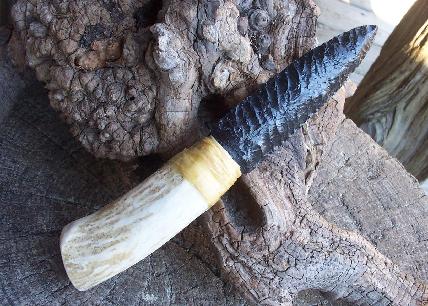
Well I did find a guy who makes them and who had two such knives that were almost exactly what I was looking for. Unfortunately both were already sold. However, he said he may still have a suitable obsidian blank that he could make into a knife for me. So I'm going to call him tomorrow and see if he found it. If not I may buy one of his smaller obsidian, antler-hilted knives which look an awful lot like this image I found online:
The knives he had like the photo were in the $70 - $100 range. The knife I wanted, but which he had already sold, is larger, with more of a dagger-style blade, and he said those were about $150.
The obsidian is translucent, so when you hold it up to a bright light, you can see through it. The knives were absolutely beautiful. I hope he has a blank left.