Cosmic Conservative

Rational Conservatism from the heart of America

We need a new post-galactic universal model measuring unit

By CosmicConservative
I'm tired of reading that such and so astronomical object is "only 34 million light years" away, or "300 million light years.." or whatever. Astronomers don't actually use light-years as the "official" astronomical measuring unit. They use the "parsec" which is a derived measurement based on the parallax of earth's orbital diameter. A parsec is about 3.25 light years. For longer distances they use "mega-parsec" which is a million parsecs or some other such variation. But you never see those used because "parsec" is such a weird word that most people don't recognize it as a distance measure anyway. That's why the original Star Wars movie used "parsec" as a unit of time in Han Solo's famous defense of the Millenium Falcon. Anytime you have to throw "kilo-" and "mega" and "tera" onto something to measure it, you've pretty much proven that the base measure is sort of meaningless. So, I propose that we define a new unit of measurement based on the size of our local group of galaxies. The average diameter of the volume of space containing the local group could be called one "cluster unit" or shortened to one "clunit". Therefore the distance to any astronomical object would be defined in terms that relate to the size of our local group. The nearest galactic cluster might then be 12 clunits away. The Andromeda galaxy might be .01 clunits. That would immediately show that the Andromeda galaxy is pretty friggin close in galactic terms. The farthest items in the universe would then be a few thousand clunits distant. I think anyway. I'm too lazy to do the actual math, but I think it would work out that way. This sort of things puts the units in an astronomical context, instantly giving the reader a sense of scale of the distance being discussed. Anything 1 clunit or less is clearly pretty close. Anything 100 clunits or farther is pretty far out there. 1,000 clunits and you're getting to the edge of the universe... Makes perfect sense to me...

On Wisconsin

By CosmicConservative
I have been uncharacteristically apolitical lately. It's not that my political views have changed, or that I've given up on the political process or anything, it's really just that I have been pretty focused on real life things lately instead of a political universe that I think has become so balkanized and entrenched that I just don't think my commentary adds much but additional noise level to an already chaotic and unhealthy environment. But having said that, I think what is happening now in Wisconsin may be the single best indicator we could have of what is likely to happen in November. Minnesota Governor Scott Walker is fighting for his political life in a recall election engineered by the most powerful forces on the Left. Unions, political action groups, lefty activists and filthy rich leftist moonbats have flooded Wisconsin with dollars to do everything they can to remove Walker from office. The Wisconsin media is wholly in the bag to defeat Walker and the state has become a proxy battleground for the fundamental battle between the statists on the left and the traditionalists on the right. If Walker loses the recall election, that will bode very ill for conservatism in this country. If Walker wins, it will fire a powerful warning shot across Obama's bow. This will be a good test to see how motivated the two sides are this year. I expect this to ramp up to a fever pitch by the end of May. The election itself will likely be punctuated by protests and civil unrest. I expect the Left to bus in thousands of agitators to make their side look better. And I expect massive voter fraud to occur. I consider this to be the real kickoff for the 2012 campaign season.

Say "ow"

By CosmicConservative

Former Charger Junior Seau Found Dead In Oceanside Home From Apparent Suicide « CBS Los Angeles.

OCEANSIDE (CBS) — NFL and USC Trojan Junior Seau was found dead Wednesday morning in his Oceanside home from an apparent suicide. Seau’s girlfriend discovered the body of the 43-year-old NFL standout around 10 a.m. in a bedroom, Oceanside Police Chief Frank McCoy said. Paramedics attempted to revive Seau, but they were unsuccessful. He died from a self-inflicted gunshot wound to the chest, according to McCoy . A handgun was recovered from the home. Police are investigating Seau’s death as a suicide.
Two years ago Junior Seau drove his car off a cliff in California. He claimed to have fallen asleep at the wheel, but the whole incident seemed awful sketchy to me. Now this. I'm sure this will be tied to Seau's NFL career and blamed at least in part on concussions. Seau was a great player in the NFL for a long time. He made millions of dollars both on and off the field. You gotta wonder what could possibly drive a person who had a life filled with so much adulation and success to suicide.

Season 4 of "Top Shot"

By CosmicConservative
I'm going to put this in the category of "reviews" just because it's sort of a review. But it's really more of a stream of consciousness reaction to the series. For those who may not know, "Top Shot" is one of those silly "reality shows" that have infected the television landscape like pustules on a plague victim. The host, named "Colby" something or other, is one of those deliberately-primped-to-be-rugged guys that irritate me to no end just by their preening, strutting affected hyper-masculinity. Everything about the guy annoys me, from the way he has a six-day growth of beard every day (the look initially made famous by Don Johnson in "Miami Vice" and I hated it just as much then), to the way he wears just slightly faded and worn jeans, to the way he stands to the way his blinding white teeth burst through his Clint Eastwood-esque squint when he spits his cliche phrases for the camera.... I've described the concept of the show before, so I'll just reiterate that it's based on the "Survivor" model except instead of voting someone off the island, there is a vote to determine two candidates in each show who have to face each other in an "elimination challenge" to see who goes and who stays. This gives Colby a chance to strut and preen as he says in his patented, clipped delivery, "you have fired your last shot" as he sends the hapless loser packing. But in spite of Colby's pervasive and irritating presence, the show itself has managed to do something that very few TV programs have done in the past decade. It has made me actually look forward to each episode. I do watch a couple of other shows right now ("Swamp People", "American Pickers", and "Pawn Stars") but I can take or leave those shows. I typically bring my laptop computer in and watch with the Cosmic Wife. They are engaging and I do enjoy them, particularly "American Pickers" but if I miss an episode or two, I don't sweat it. I make an effort to watch "Top Shot." Why? Because guns. So many guns. And bows, slingshots and atlatls. Not to mention rocket launchers, grenade launchers, sub-machine guns, gatling guns and twice now... Cannons. I mean, if you can't get a thrill out of watching a super slow-motion video of an artillery shell being fired directly at the camera... well, you might want to check your pulse. So anyway, this is the fourth season of the show. I've posted a couple of reactions to specific shows this year, including one where I was very disappointed with the overall accuracy that was demonstrated by these supposed "world-class shooters." But that was really an anomaly. In general the shooting is extremely good. But there is another dimension to the show, and that is the dimension that probably is intended to draw in viewers, although I admit that it doesn't really draw me in that much. Except in rare cases I almost never "root" for anyone. I have a few shooters that I like more than others, and I have to admit that I like seeing the hot chick shooters compete, even though they tend to get booted pretty early, but usually I don't get into the personalities of the shooters. I just like watching the shooting. This season though, I found myself getting drawn in. And as it happened the final two in the season finale who went up against each other were one of my favorites (Chris, the IT guy) vs one of my least favorites (Greg, the ex-soldier). From the start of the show it was clear that the military, police or competitive shooters were rather dismissive of Chris, who had never shot in any competition or been a member of any armed force. He was just a self-described IT geek who shot recreationally but who survived the auditions and ended up on the show. On I think the first episode, he and Greg both performed poorly on a specific team challenge, and Chris ended up being voted to do an elimination challenge, which he survived. The challenge involved using a pistol to shoot a series of plates where you had to shoot six plates in a row without a miss to move to the next row. Both Greg and Chris failed to complete a row of plates in that challenge. But after that, Chris steadily and quietly performed well in challenge after challenge. He showed a specific skill in being able to pick up a weapon he had never seen before and master it quickly. For example, using the atlatl, he nailed a perfect bullseye at the farthest distance, shutting out his opponent in the elimination challenge by scoring 9 points on one throw. Nobody else even got close to the bullseye on the farthest target. Greg, in the meantime, continued to spectacularly fail in challenge after challenge. Plus he demonstrated extremely poor interpersonal skills, repeatedly frustrating and angering both his teammates and the other team. He formed an early clique with three other shooters and they voted to protect each other instead of voting to send the worst performers to the elimination challenges. Even so Greg was sent to three elimination challenges during the season. And I have to give him credit. For whatever reason, while working as part of a team, Greg repeatedly choked badly in competition. in one competition he seemed to completely freeze up for an agonizingly long time trying to make difficult shots. In one case he took forever to make a shot, only to realize he still had the safety on, and then went through the whole agonizing process again, taking forever and missing his shot to boot. But in the elimination challenges, with him one on one vs another shooter, he was a totally different person. He survived all three elimination challenges, sending home shooters that I personally believed were far superior to him. So, in the end, both Chris and Greg survived the team challenges and entered the individual rounds. Both were considered to be the weakest remaining challengers, even though Chris had been perhaps the strongest shooter overall since that first episode. By now I was rooting for Chris and rooting against Greg. Well, in the end they ended up being the final two. And the final challenge was a series of seven individual shooting tests consisting of a flintlock pistol, an ancient British pistol, a Colt pistol, a crossbow, two different rifles and ending with a six-shot grenade launcher. Oh, did I mention that Greg's main credential for appearing on the show was that he was the military's champion grenade launcher in 2003? The second pistol challenge was a repeat of the "perfect series" test that both Chris and Greg had failed so spectacularly back in episode 1. Well... of the four season finales, this one was by far the closest. Chris took a small but significant early lead over Greg until they got to the crossbow, where Greg caught up. Both nailed the perfect series test shooting 12 plates in a row with a Colt revolver without a single miss. Good for them. Greg took the lead in the rifle challenges, ending up on the final challenge a good six seconds ahead of Chris. And the final challenge was the grenade launcher. They had to hit two targets with grenades one at 25 yards and one at 50 yards I think. Anyway, Greg hit his first target before Chris even got his grenade launcher loaded and into firing position. It looked very bad for Chris. When Chris missed his first shot, it looked like all was over, but Greg missed his shot at the farthest target. Then Chris nailed both targets with two successive shots in a stunning example of his uncanny ability to master unfamiliar weapons. His winning shot not only hit the target, it nailed the exact center of the bullseye, while Greg's final shot went just wide. I actually cheered.

Shooting accuracy

By CosmicConservative
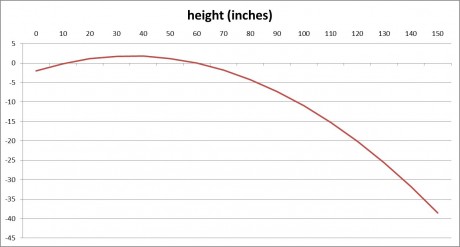
So I have bragged on here a few times about my shooting prowess. I've posted some of my results shooting my Crosman 1377 pump-action pellet pistol. I've posted about how I was unable to sight in my Hatsan 125 Striker pellet rifle, and how they agreed to replace it based on my description of it's accuracy problems. The replacement is supposed to arrive today. So I'll hopefully get a chance to do some shooting tonight to see if the new gun performs as advertised. In the meantime I have been doing some Youtube surfing for pellet gun shooting tips. In that surfing I stumbled across a couple of different guys who use pellet guns for pest control and hunting small game. They post videos of their shooting, meaning you get to see the raw footage of birds, squirrels, chipmunks, crows, etc. being blasted by pellets. Yeah, sorta gruesome, but in a fascinating sort of way. But the thing that has really interested me is in how they shoot. When I was a kid I used to hunt quite a bit. My hunting more or less stopped when I got married, and I haven't hunted now in over 25 years. Back when I did hunt, the only hunting I ever did with a scope was hunting for deer. All of my squirrel and rabbit hunting was done with barrel sights, and all of my bird hunting (mostly quail, duck, geese and dove) was done with a shotgun. Since I did very little deer hunting, and never took what I would call a "challenging" shot at a deer (by design, I always wanted a quick, clean kill when hunting) I never really learned much about scopes. But these guys use their scopes on everything. What they do is mount a digital camera onto their scope, attached directly where your eye would go, and they then look at the image on the camera back to sight in on their target. They record the whole thing, so you get to see the shot exactly as if you were looking through the scope when the shot is made. I have learned a lot from this. Because pellets travel much slower than .22 bullets, even relatively short shots have to factor in pellet drop and windage. And while each has their own unique way to set up and execute the shot, their basic process is very similar. Basically everything is done according to "mil-dots." What is a "mil-dot?" Well, when you look through a scope you obviously see the crosshairs (known as a "reticle" in the scope biz). But on the crosshairs going vertically and horizontally you should see a series of dots or hash lines regularly spaced across them. These are mil-dots. The standard mil-dot spacing is set to indicate 100mm of target size at 100 meters. Yeah, they are built in metric units. That converts to 3.6" at 100 yards. That means that if you are zeroed in on the exact center of a bullseye at 100 yards, the mil-dots will indicate 3.6" steps away from the bullseye. Now, scopes with variable magnification will sometimes have variable mil-dot distance, but for the sake of argument I'll stick with the "standard" mil-dot sizing. Now, how does this help you? Like most novices I assumed that it mostly was a way to do on-the-fly adjustments for windage and elevation. Meaning if your scope was sighted in at 60 yards, then at 40 yards you might need to sight in a mil-dot below the bullseye, or on a 100 yard shot you might need to sight in 3 mil-dots above the target. I figured it was a sort of "trial and error" thing until you got comfortable with the scope and gun. And that works OK, you can do that. But it turns out that there is an actual science that you can apply to this such that if you know your gun and scope (and your targets) well enough, you can do pretty amazing shots on your first shot. For example... anyone who has ever been trained to shoot a gun knows about "windage and elevation". For elevation, the idea is that you should know where your bullet/pellet will hit based on the range of the shot. Windage is trickier, but elevation is really almost pure ballistics. For target shooting this isn't all that much of a deal. You typically know what the distance is for your shot, and if you know your gun, based on that range, you know how high or low the gun will shoot. The problem most folks have is that when you are hunting, you have to estimate the range of your target. As anyone who has ever played golf will tell you, the difference between 120 yards and 130 yards is frequently the difference between a par and a double-bogey. And not many people have the skill to use their eyes to estimate distance that accurately. So, one of the two shooters uses a laser range-finder. That's fine, but it's a step you have to take and if your batteries die, or you drop the range-finder, or it just stops working for some reason, you're back to guesstimating range. And the difference of ten yards in your guesstimate when shooting at something the size of a clenched fist is usually the difference between a hit and a miss. But, the secret to this is that you can use your scope as a rangefinder. But to do that, you have to know how big your targets are. Let's say you are hunting starlings. Why would you be hunting starlings? Well, mostly because starlings are an invasive species which crowd out native species for nesting and food. If you like to see cardinals, bluebirds or other songbirds, you might want to thin out the starling population a bit. Hunting starlings as pest eradication is pretty common. A starling is about six inches tall. And they don't vary much in size. So you can pretty well assume that the starling you might be looking at through your scope is six inches tall. How does that help? Well.... if you are looking at a starling through your scope, and it is a bit less than two mil-dots tall, then that starling is right at about 100 yards away. Now you know the range. Knowing the range should let you know how to adjust for elevation. Windage is a bit trickier, however, knowing the range also allows you to at least realize how long the bullet/pellet will be in the air, and with practice you can learn how far to adjust for windage. Of course you can be as scientific with windage as you are with elevation if you really want to, but that would mean knowing the exact speed of the wind. Most hunters, and both of the ones I watched on Youtube, just use their "experience" to factor in windage. And when they miss, it's usually due to miscalculating windage. But they usually only miss once or twice before zeroing in. So, how do you apply all this to shooting your actual gun? Well, for a pellet gun it means you need to shoot one, and only one, brand and make of pellet. Using different pellets means different muzzle velocities and wind resistance. What you have to do is actually plot out your preferred pellet's ballistic profile. Both of these guys created a ballistic profile that looks like this: That would show the ballistic trajectory of a pellet fired at 750 feet per second muzzle velocity with a scope set two inches above the muzzle, and the muzzle angled up with respect to the scope at about 1/3 of a degree. This would correspond to a pellet gun "sighted in" at 60 yards. Because of the way the barrel and scope work, that means the pellet actually crosses the horizontal line of the scope twice, once going up as it comes out of the barrel, and once going down as gravity takes over. This is important because using this chart tells you how far off your pellet will be vertically based on the distances involved. Since a mil-dot is 3.6 inches, then for me to hit the bullseye of a target at 80 yards, I would need to move the scope up 1.4 mil-dots (five inches). At 100 yards I'd need to adjust upwards roughly 3 mil-dots. At 30 yards I'd have to adjust down about 2/3 of a mil-dot. At ranges farther than 100 yards, the drop-off of the pellet is so great that it's almost silly to try to use the scope to target anything. At 120 yards I'm probably right at the edge of the scope's visible area. at roughly 6 mil-dots. Now, one of the guys on the Youtube video was hitting starlings at 120 yards with a six mil-dot adjustment. That's pretty frickin' awesome. The above graph is purely hypothetical. What you really need to do is to empirically determine your gun's ballistic profile using the pellets you intent to shoot with. Obviously the faster your gun shoots, the flatter the ballistic trajectory and therefore the less adjustment you have to make. Assuming my new gun is accurate enough for this stuff to matter, I'll have to figure out it's ballistic performance with the pellets I have. This would be one reason to use lighter pellets, just to flatten that curve and reduce the amount of adjustment you have to make...
Hatsan replacement to arrive tomorrow

By CosmicConservative
So... in the week and a half since I sent the Hatsan back for a replacement, I've not seen, nor smelled, the skunk I got the gun to deal with... Maybe he left...

Planet in Goldilocks zone

By CosmicConservative

The planet lies in what they describe as a 'habitable zone', neither too near its sun to dry out or too far away which freezes it.

And the discovery could help answer the question of whether we are alone in the universe, which has been plagued astronomers and alien fanatics for years.

Scientists found the planet, Gliese 667Cc, orbiting around a red dwarf star, 22 light years away from the earth.

via Astronomers find new planet capable of supporting life - Telegraph.

Sensational stories like this always crack me up. This isn't news. It isn't even new. All this story is really saying is that the planet orbiting Gliese that was previously suspected strongly of orbiting in the "Goldilocks zone" around the red dwarf star is now confirmed to be smack in the middle of the zone. I wish these mouth-breathing, hyperventilating "reporters" would just report the facts. The facts here are that we've got strong evidence for the existence of a rocky planet orbiting around a red dwarf star at a distance where it would receive a comparable amount of heat and light from its star as the earth does from the sun. That's all we really know. Everything else is speculation. It may have a super-dense atmosphere like Venus and a runaway greenhouse effect, or it may have no atmosphere. It may have perfect temperatures but no water. Nobody knows. It is reasonable to suppose that there could be water there though, since water is pretty common in our own solar system and current solar system formation theories would suggest that water is pretty common in most third or fourth generation star systems. The fact that there is a rocky planet there is a good indication though that the star was formed from a similar dust cloud as the earth. Heck, it may have formed from the very same dust cloud as earth. It's pretty dang close. 22 light years is kissing cousin distance.

News flash! Pay attention! Important information to follow!

By CosmicConservative
I'm freaking old. I haven't played golf since my father passed away five years ago. Today I took a day off and played a round of golf. I have always walked the course and used one of those hand-drawn club carriers. So I didn't even think of it when I paid for my round and rented the carrier. Then I went out and played golf. I thought I was gonna die. Worst. Round. Evar. The course I played is in town and spreads across two major boulevards which you have to walk under the streets in long tunnels between holes 11 and 17. So coming back in you have to hike probably half a mile between the #17 green and the #18 tee box. Which is up hill for half the distance. I shot a 10 on the 18th hole. And I didn't even really care. I just wanted to be done.... I guess I am going to be using carts from now on...

Al Gore in Internet Hall of Fame

By CosmicConservative
One of the favorite memes of righty bloggers is to mock Al Gore for having claimed to invent the internet. Today Al Gore is one of the first inductees into the "Internet Hall of Fame".

The group’s description of Gore states: “Al Gore, the 45th Vice President of the United States, was a key proponent of sponsoring legislation that funded the expansion of and greater public access to the Internet. Instrumental in helping to create the ‘Information Superhighway,’ Gore was one of the first government officials to recognize that the Internet’s impact could reach beyond academia to fuel educational and economic growth as well.”

via No invention: Al Gore’s Internet honor - Patrick Gavin - POLITICO.com.

This is well deserved. As I have said here on this blog before, no matter how much scorn and derision I heap upon Al Gore as a Climate Change Zealot and general political sleaze-bag, they guy actually was one of the key supporters of the government support for creating what is now the world wide web. The "I created the internet" meme is as fair to Gore as is the "I can see Russia from my house" meme is to Sarah Palin. So good for Gore.

Bio-ethics and terraforming

By CosmicConservative
So... Let's say that we approach the Singularity and as part of that transformative exponential explosion of technology we discover a way to quickly and efficiently terraform the planet Venus, reducing it's atmosphere to earth-like densities and changing the composition to be nearly identical to earth's nitrogen/oxygen/CO2/Water vapor mix. As part of that a system of orbiting satellites provide a constant shade to reduce the sun's intensity to be comparable to the energy the earth receives from the sun. (The 'extra' sunlight would be converted to energy for all the happy, busy Venusians to use.) Let's say that this can all be done in a decade. Then, just as the engineering is about to begin, someone discovers that Venus's atmosphere is populated with a family of "extremophile" bacteria which require the conditions of Venus's current atmosphere to survive. Would it be ethical to drive those extremophiles to extinction in order to have an entire new planet which could be populated with the entire rich diversity of earth? Or are we ethically compelled to allow the Venusian bacteria to stop our efforts to terraform Venus?