OK, tonight I did some back of the envelope calculations on what it would cost to print, cut and bind my own books. I also got a quote from a printing company for them doing the same thing.
Taking into account the cost of the paper, the ink and the glue, it basically comes out to about $5 - $6 per book if I do it totally on my own. I could get that down another 30% or so if I buy a used laser printer, laser toner printing costs are a fraction of inkjet printing costs (which is why your office likely has a laser copier/printer instead of an inkjet one).
If I take it to a printer, its going to cost in the neighborhood of $22 per book to have it printed, cut, stacked, and bound.
So doing it myself will cut the cost by about 75%. Plus I would only need to print, cut and bind the copies I actually sell. lol, as if I'm gonna sell anything.
It would be fairly easy to set up a separate printer just for printing books. In fact we have two extra printers laying around the house right now that would work just fine. Plus I have extra computers that could be dedicated to printing.
The most difficult part of doing it myself would be the cutting of the pages. A paper cutter capable of cutting 200 pages of standard printer/copier paper costs about $300, which is about what it would cost me to have a printer cut and stack about 150 books.
Hmm.... I wonder what sort of cottage industry you could set up printing your own books or pamphlets...
This is totally doable you know....
Yeah, me. Here's the deal. I started working on this book about two and a half years ago. I tried to do the whole thing "right", meaning I bought some books on how to write and did some research and sat down and planned out the whole thing.
That means I started out with a central story summary in one sentence, then expanded that into a paragraph, then expanded that yet again so that each sentence in the original paragraph became a paragraph. That gave me a several paragraph guide for the story.
Then I created a cast of characters, starting with the protagonist and then working my way through his immediate friends and family and then adding the antagonist. I tried to come up with descriptions, motivations and relationships for each one.
I took that guide and those characters and laid out about 25 scenes that I thought would be memorable and listed each scene in a spreadsheet. Then I started to write.
And I wrote a lot. I've got over 81,000 words of this thing written now.
At first I just wrote, letting the story flow. I didnt' worry overly much about grammar, tense, voice, etc. I thought it would be valuable just to get the story down on paper, fleshed out as much as possible. I figured I would be able to come back and "polish" the rough edges off of that draft manuscript and voila! Instant novel! Well, not quite instant, but doable anyway.
I've already recounted how that effort was put aside after my father passed away, and how I've picked it back up again. I've written two of the final five or six chapters in the past week, so I intially thought that I was back on the horse and moving forward.
That is, until I actually started doing the copy editing work.
Basically I wanted to get some feedback about what I've written already, and I didn't want to send off rough drafts, so I decided to start copy editing the first chapters while I was still writing the final chapters.
I've completed a first cut at copy editing for about ten chapters now.
And I am not real thrilled with the result.
Basically I have three major problems with the book.
1. Many parts of it are just plain boring as I try to get introspective with the main character. My intentions are good, but the result is page after page of boring, expository text.
2. I haven't been able to make some of the fundamental conflicts come to life. It's one thing to have a descriptive blurb in your character definition that says character 1 has a rivalry with character 2. Actually demonstrating that rivalry in a compelling way is something else again.
3. Somehow I managed to lose track of the original central concept of the book. Instead of driving towards that concept the story sort of wanders around, sometimes hot on the trail of the concept and other times moseying over the horizon a bit in search of some other supposedly interesting tidbit.
I gotta do something. Somehow I have to tighten up the slow parts, beef up the conflict and keep the narrative on a clear and comprehensible path. The only question is whether to use a scalpel or an axe.
Right this moment there are whole chapters I am thinking should just be ripped out entirely. There are some characters that probably also need to simply disappear. But if I tear it up too much, there is a real risk that I will be so discouraged by the result that I may never finish the book at all.
Arg... I suppose one school of thought is "just finish it so you have at least a complete story before you start ripping it apart."
But on the other hand, I find my enthusiasm for writing new material waning as I contemplate the need to rewrite the original foundational chapters that lead up the the new material.
I'm not really looking for advice, just venting is all...
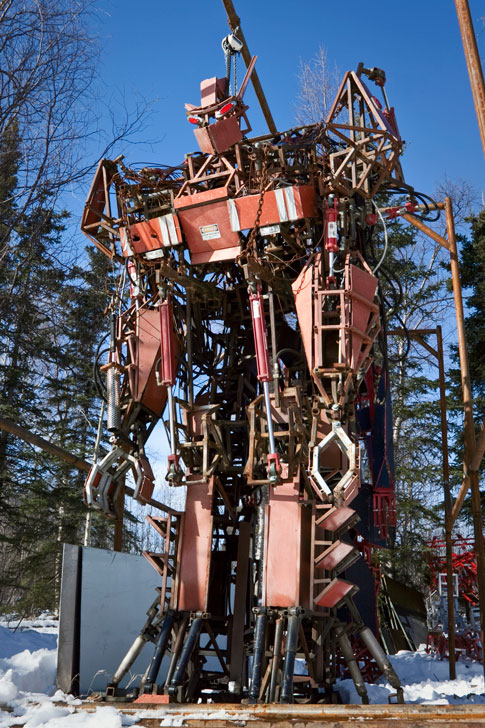
Army Mechanic's Garage Tinkering Yields 18-Foot Mecha Exoskeleton | Popular Science
Owens, 31, began building an 18-foot-tall, one-ton prototype at his home in Wasilla, Alaska, in 2004. Working without blueprints, he first built a full-scale model out of wood. Moving on to steel, he had to devise a hydraulics system that would provide precisely the right leverage and range of movement. He settled on a complex network of cables and hydraulic cylinders that can make the mecha raise its arms, bend its knees, and even do a sit-up.
If I were Palin, I'd take this thing on David Letterman and play a little Letterman Ping Pong.
So I saw this story (linked from the Instapundit, of course) about the FTC starting to monitor blog postings, and read this paragraph.
FTC to Monitor Blogs
Savvy consumers often go online for independent consumer reviews of products and services, scouring through comments from everyday Joes and Janes to help them find a gem or shun a lemon. What some fail to realize, though, is that such reviews can be tainted: Many bloggers have accepted perks such as free laptops, trips to Europe, $500 gift cards or even thousands of dollars for a 200-word post. Bloggers vary in how they disclose such freebies, if they do so at all.
You might think my reaction to this would be outrage at my free speech being curtailed. Or fear that the Obama administration will see my "This man is dangerous" comment and throw me in a political prison somewhere.
But no, my initial reaction, which I am still having a hard time getting past is.
"What?! Free laptop? Where the heck is MY free laptop!?" Heck, I might even say a nice thing or two about Jay Cutler for a free friggin' laptop!!!
He only says things in his speeches to get the reaction he wants from people. He has absolutely no intention of turning what he says into what he does. What he says is just part of setting things up to be able to do what he wants to do. Case in point:
Obama Walks Back Promise On Keeping Your Private Insurance » The Foundry
Less than 24 hours after Heritage Foundation President Ed Feulner questioned the veracity of President Obama’s persistent claim that, under his health care proposals, “if you like your insurance package you can keep it”, the White House has begun to walk the President’s claim back. Turns out he didn’t really mean it.
He NEVER "means" anything. Anyone who listens to anything Obama says and thinks that will have any bearing whatsoever on what he does, simply has not been paying attention.
So, now that I'm working on my novel again (geez, that sounds so sophomore English Lit pretentious, doesn't it?), and I can see the light at the end of the tunnel, I've started to investigate the minor detail of "How the heck do you get a novel published?"
Back in the dark ages, when I was first trying to get published, it was pretty simple. You really had two options. You either sent your manuscript off to a publishing house and hoped for the best, or you engaged a "Vanity Press" outfit who printed them for you at your expense. And when I say "expense" I'm not kidding. Vanity Press printings of a self-published book could run into the tens of thousands of dollars.
As with so much else in the world, things have changed. There are now several options if you want to become a "published author" and actually SELL your finished result.
Obviously you can still go the traditional route. There is a lot to say about that route, the most important of which is that if your manuscript gets chosen out of the thousands their editors review every day, you may well be on your way to fame and fortune. If they like it they will assign an editor, arrange for cover art, help with copy editing, and perhaps even pay you an advance on the sales they anticipate. That's still the way cool way to go.
But that is becoming less and less common these days. Publishing houses are suffering in much the same way that traditional newspapers and other media are suffering. Technology has taken the keys to the printing press and distributed them to people with the time, skill and equipment to do the same thing on a much smaller scale. The end result is that traditional publishers are publishing fewer and fewer new authors as they seek to maximize their profit margins by pushing book after book from their stable of best-selling authors. From what I read on the web, right now is perhaps the worst time EVER for a struggling new author to try to break into the ranks of best-selling authors whose first book is published by a traditional publishing house.
But that's because there are options. The question is whether the options are better for a new author or not.
Of course the Vanity Press approach is still there too, but Vanity Press outfits are no doubt being harder hit even than traditional publishers since the new means to publish really play in the same limited printing space as Vanity Press outfits have always done. But they are still around if you want to go that way.
Probably the fastest growing new publishing technique is the "Publish on Demand" technology that has sprouted up as computers, printers and computer aided binding techniques have become cheaper and cheaper every year. "Publish on Demand" or "POD" businesses typically charge an up-front fee to format and load your manuscript files into their system, and then when someone orders a book, they print it "on demand" using their high-tech publishing tools. Amazon.com has entered this in a big way lately with their "Booksurge" product. There is very little up-front cost to POD, and that means that the author generally gets a higher royalty for each book they sell compared to a traditional publishing house. It's really pretty simple to do this, all you have to do is generate your manuscript in the proper file formats, upload them to the POD website, and pay them the money they want to put your book in their catalog. Once that is done the author can create a link from an e-commerce site and when an order is placed, the book is printed, bound and shipped.
Another option is to "self-publish" your book. This means you have to do all the things the POD company does. Believe it or not, you can actually do this. Or if not, you can find other people who have figured out how to self-publish and work with them. Self-publishing is exactly that. You do the printing, binding and shipping yourself. Like this guy:
Or you can just create an eBook and forget the whole paper part of the process.
Or you can do eBook downloads and have the paper book for folks who prefer paper.
I have come to the conclusion that writing and editing utilize two entirely different portions of your brain. When I am writing I can churn out words at a prodigious rate. I type over 60 words per minute on a regular basis, and when I have a thought I am pursuing, I type as I think. So if I have the basic outline of how a scene is going to go in my mind, I can generally write that scene at about that speed, meaning I can fill up page after page of the story without any real effort.
But then eventually I have to go back and edit it. Ouch. That's when I get real discouraged about my writing. "Who wrote this crap!?" I shout internally. "Why can't I write in active voice!? Geez! This whole paragraph has to be rewritten it sucks so bad!"
Last night in rereading the latest results of my editing efforts I realized that I used the word "realized" three or four times in one paragraph. The main character "realized" his hand was numb, or "realized" the sun was setting, etc. So I decided to do a search on "realized". IT TOOK ME 30 MINUTES TO REPLACE DOZENS OF "realized" USES!!
Sheesh. I used "realized" when I should have used "saw", "felt", "learned", "discovered", etc.
But you wanna bet that when I get heads down and start writing the final five or six chapters that I put "realized" all over the friggin' place?
Aaarggg.
Some long-time readers of this blog (all two or three of you) might recall that a couple years ago I was making steady progress on a fantasy novel. In fact I had written about 78,000 words of it, which is about 3/4 of the size of a typical fantasy or sci fi novel.
When my father passed away, that interrupted my writing and for months afterward I just didn't feel like getting back to it. In some perverse Freudian corner of my mind I had no doubt connected the novel with that whole negative period of my life. So I more or less ignored the novel from that time on.
Well, that's over. It's been almost two and a half years now since I put it down, and I picked it back up last week (mostly at the urging of the Cosmic Daughter) and decided to re-read it to see if it was worth resurrecting.
Well, to my surprise, I decided that it actually was worth resurrecting. It suffers horribly from my most egregious writing fault, that of using passive voice all the time, but that can be corrected with editing. But the fundamental story still felt worthwhile to complete. So for the past week or so I have been laboriously editing the story, fixing errors, improving grammar, putting it more into active voice, etc. Plus I have fleshed out the final 1/4 of the book in the outline and now have a definitive ending and all of the remaining highlights determined. The rest is just the work of taking the highlights and providing the detail and character interaction taht makes it readable.
It's a dark story. But, to paraphrase William Golding in "The Princess Bride" it has swords and magic and heros fighting monsters and great armies and battles and death and dying and even some love and romance.
In part I'm posting this to provide another incentive for me to keep at it. If I write like I was writing two years ago I should finish it sometime next month. Wish me luck.