I know I am an odd bird. I tend to get fixated on certain things just because in my personal view they are incredible examples of human ingenuity and engineering. The ten-speed bicycle is an example of this. I can hardly imagine a more efficient and effective technology for moving a human being at a remarkably rapid clip (accomplished cyclists can maintain speeds in excess of 20mph for long periods of time on flat ground on a ten-speed bicycle).
Another example is the Stirling engine. I have been a huge fan of stirling engines for years, primarily because they offer remarkably high energy transfer potential running off of just about any energy source you can imagine. In theory a Stirling engine achieves the highest conversion of heat into mechanical energy that any known engine technology provides. In practice this becomes problematical because Stirling engines are only as effective as their heat transfer and fluid seal technology is. Still, in general, the higher the heat differential between the engine's energy source and its cooling sink, the more efficient it is.
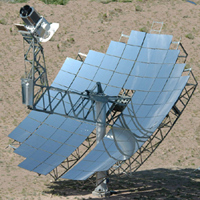
So naturally I always thought it would be a good candidate for a highly concentrated solar energy system. And guess what? Somebody actually has created exactly what I had envisioned myself as a Stirling engine solar energy system to generate commercially usable electricity. Here's a photo of the turnkey system from "Stirling Energy Systems":
Here's the company's promo:
SunCatcher | SES Stirling Energy Systems
The SES SunCatcher is a 25 kW solar power system that has been designed to automatically track the sun and focus solar heat onto a power conversion unit (PCU). This in turn converts the intense heat to grid-quality electricity. The concentrator consists of a 38-foot diameter dish structure that supports 82 curved glass mirror facets, each three feet by four-feet in area. These mirrors concentrate solar energy onto the heater head of a high efficiency, 4 cylinder reciprocating Stirling cycle engine, generating up to 25 kW of electricity per system.
I love this stuff!
Of course solar cells are getting more efficient all the time, so perhaps this is dead end technlology, but I still LOVE it.
We have used star wars anti-missile technology to create a death star for mosquitoes.
No sh*t! This is the most pure awesome thing I've seen in years. A literal laser cannon that blasts mosquitoes out of the air! By the thousands! 24x7!
'Star Wars' scientists create laser gun to kill mosquitoes - CNN.com
The laser, which has been dubbed a "weapon of mosquito destruction" fires at mosquitoes once it detects the audio frequency created by the beating of its wings.
The laser beam then destroys the mosquito, burning it on the spot.
I love science.
I WANT ONE! "Honey, remember after you set up the tent, you need to set up the anti-mosquito laser cannon shield!" "RIGHT!"
Regular readers of this blog know that I have serious problems with the current Relativistic model of the universe, particularly where it relates to black holes, singularities and the "infinitely dense" point which supposedly marked the instant of the Big Bang which began the universe.
Well, I'm not the only one.
Loop quantum gravity: getting closer to reality - Ars Technica
Among the many contenders for combining gravity and quantum mechanics is loop quantum gravity. As with all proposals of this sort, this one has its detractors. One of the most serious failings of the theory is that it was thought that it might not be possible to perform what are called gauge transformations using it. This would have been a significant problem, because gauge transformations are fundamental to quantum mechanics and it would be unlikely that loop quantum gravity would be able to encompass all of quantum mechanics without them—a major failing for a theory aiming to replace the standard model. A recent publication, by scientists at the University of Rome, shows that gauge transformations generally do work in loop quantum gravity.
For almost a century physicists have attempted to reconcile pure Relativity theory against the common-sensical view of the universe which views singularities as physical impossibilities. Recently a new model of the universe called "Loop Quantum Gravity" has been gaining more and more support. In one sense Loop Quantum Gravity can be considered a rival to String Theory. My fundamental problems with String Theory are well known. In the final analysis it is my opinion that String Theory will eventually be seen as a productivity sucking "black hole" of thought and effort which obscured, instead of revealed, the real nature of reality for a generation.
Whether Loop Quantum Gravity becomes the replacement for the "Standard Model" or not, the more I look at it, the more I think it is putting physics back on the right track. At the very least it reconciles the fundamental physical paradoxes and logical contradictions that Relativity creates. In Loop Quantum Gravity black holes do not collapse to singularities, they reach a physical limit that is supremely dense to be sure, but does not become infinite. This alone is a major step forward in any model which is supposed to reflect reality.
I once met with a group of Google developers. This was probably five years ago, I'm not sure. What I do remember from that meeting is that every Google person in the meeting agreed with the statement that "Content is everything." Google "got it" even back then. That's why Google went after the market to index and provide search technology for content.
When Youtube became a phenomenon, Google looked at it and said "Hey, that's content." So they bought it. Again, Google "got it."
Now I'm no big fan of Google, but it shows that there are some visionaries in the world who not only see the future, but actively work to make the future real.
In another post I talked about how the demise of the Rocky Mountain News presaged the wholesale restructuring of all media markets, including radio and television.
In the end content will be the only thing that matters. Delivery of all media will eventually be accomplished through digital point-to-point streaming technology, whether over a wire or wireless.
What that means is that eventually ALL of your content will come from the same source, which will be your always on internet conduit. That content will include your news, your entertainment, and your online activies (such as banking and shopping). And it will be seamless whether you are at your desk in your home office or at the wheel of your car.
If you are interested in local content, you will subscribe to it just as you would subscribe to general content. In other words, if you want to hear a local morning personality show like you hear on the radio dial today, you'll find it and subscribe to it and it will come through your car stereo just as it does today. The difference will be that the people providing that content, the "local talent" will NOT be in the employ of a monolithic radio station. Instead they will be represented by agents and their content will be syndicated through the web just like any other content.
In the same manner, video programming will no longer be dominated by broadcast studios. Instead there will be companies which focus on content only, and which provide their content to subscribers through the same syndicates as the local talent.
The real trick is going to be how people like you and I navigate through the turbulent sea of content to find the nuggets we are interested in.
And that's what Google wants to be doing for us.
Last Friday the Rocky Mountain News printed it's last edition, a few weeks shy of their 150th birthday. As such the News became the latest casualty in a decade-long (and continuing) decline of the once-mighty newspaper industry.
The Rocky Mountain News is the only newspaper in Colorado that I subscribed to. The Denver Post is such a pathetic liberal rag that I wouldn't inflict it on Gitmo prisoners. But I canceled my subscription five years or so ago because I simply don't see any sense paying for day-old news that I've already digested the night before.
But here's the thing that really caught my attention. I listen to KOA, the local powerhouse AM radio station here in Denver as I drive to and from work. KOA basically had an all-day wake for the Rocky Mountain News on Friday, which continued into the weekend and there was still a good bit of it going on this morning. The general tone of the whole KOA coverage of the event was how sad it was that such a media icon was closing its doors, and how much the internet had eroded the traditional role of the newspaper. After interviewing several News employees and oozing concern and empathy over their loss of jobs and loss of a historic media giant (locally anyway), the KOA reporters and talking heads went back to business as usual completely unaware of the shot that has just been fired across their own bow.
See, the decline of the newspaper industry is just the first visible impact of the new digital content model which will eventually reshape ALL media, including radio and TV. Those platitude-spouting radio "personalities" who oozed such empathy over the news reporters this past few days are just as surely doomed to obsolescence as their wretched ink-stained brethren.
Radio rules the airwaves now because people listen to it in their cars. But the age of broadcast radio is destined to end when the age of always on mobile internet finally arrives, and it's much, much closer than you think. When people can control their "radio" content in their cars the same way they control their news content on their home computers, local radio will find itself in the same viciously competitive world-wide content race as newspapers are. What I listen to on my car stereo will be driven by what I WANT TO HEAR, not by what happens to be broadcast over the local radio waves. This is already starting with podcasts which people download to their iPods and listen in their cars, but soon it won't be necessary to download and plug in what you want to hear. Soon you'll be able to choose content in your car from whatever is available on the internet, and have it streamed digitally directly to your mobile internet connection so you can listen to whomever and whatever you want, whenever you want.
Let's say you want to listen to nothing but Led Zeppelin on your drive home. You won't have to root around for your Led Zeppelin CD, all you'll have to do is navigate to the Led Zeppelin home page and stream the songs you want to hear directly to your car. If you want to hear a talk radio show, you will simply stream the audio to your car. And if you want to know the latest road conditions or traffic news, you'll stream that info too.
Radio is just as dead as print. And so is broadcast TV.
The future of content is digital on demand delivery. Newspapers are just the first old media to go.
Well, still operating at single-digit Kb/sec speeds anyway, which is hardly distinguishable from being "down." Hopefully Qwest can find a replacement 286 mother board in an old garage somewhere and fix their ailing gateway from our sleepy little rural community.
So when I called their technical support to report the problem and get status (in India as I have mentioned) the tech support person asked me what my DSL modem reported as current upload and download speeds. I told her that there was no point in that since the modem ALWAYS reports maximum speeds, I told her I considered that part of the administration page of the modem to be pure marketing text since I have NEVER seen actual speeds even close to the "reported" speeds and the "reported" speed never changes from the maximum values no matter what performance problems we had. So she checked from her side and confirmed that the actual speed was around 4Kb/sec when the modem claimed to be operating at 1,536 Kb/sec.
Nice to see our technology is so accurate at reporting its own status.
I'm not sure if everyone is aware of the concept of "squaring a circle." The traditional definition of "squaring the circle" is to go back the ancient Greek mathematician "Oenopides" and his challenge to the Pythagoreans of the time to convert a circle into a square of identical area using nothing but geometric tools (protractors and straight-edges, basically). At the time Pythagoreans believed that you could solve pretty much any mathematical problem geometrically.
This is one of the things that absolutely keeps me enthralled with mathematics. Such a simple request, but the pursuit of this request spawned entire branches of mathematics.
As it turns out the effort to create a square of equal area to a circle drags one kicking and screaming into concepts as profoundly strange as "irrational" and "transcendental" numbers. To even begin to understand such concepts leads inevitably to calculus and the mathematics of infinite numbers. (For example, did you know that there is a distinction between "countable" and "uncountable" infinite sets?)
The reality of the challenge is that it is physically impossible to solve the problem using geometric tools. This is actually a quite profound result, which gave physicists and mathematicians their first glimpse into the concept that our physical reality cannot be described in entirely "rational" ways. It is very hard to describe how bizarre this result was when it was finally accepted. Among other things it forces us to recognize that the value of pi is not representable in any finite value, nor is it representable in any ratio of existing numbers NOR is it representable in any numeric sum or product of rational numbers, nor is it representable by any exponential equation involving rational numbers.
Or to put it plainly, the value of pi, which is central to geometry, CANNOT be exactly expressed algebraically. And, to make matters worse, it turns out there are OTHER such numbers, in fact an infinite number of them.
I think what has made me contemplate the irrationality of pi and the impossibility of squaring circles is the Obama administration's attempts to "solve" our economic problems. Hopefully it won't take us fifteen hundred years to understand enough of the problem that we can make some headway on it.
 Here's the company's promo:
