When I was a kid I played Monopoly with my brothers. I'm sure that sounds pretty tame. I can assure you that there was nothing tame about the style of Monopoly we played, nor the fierceness of the competition. Usually my older brother (Drax, here on CC) and I played with a friend we called "Hatchie" (his real name was "Charles" or something like that...). We'd usually play at his house since our house was overrun with all the siblings our parents had thrown into the world. We all lived on the air force base and so a typical summer morning would begin with us trotting over to Hatchie's place where we'd instantly morph from grungy barefoot boys into world-striding corporate robber barons. There were few rules, other than no cheating. Finagling and trading were not only allowed, but were strongly encouraged. Buying a piece of property was as much a move to thwart the other players as to advance your own goals. We viciously employed the "crab rule", although we didn't call it that at the time. What's the crab rule? If you put crabs in a bucket, you don't have to put a top on the bucket, if one crab starts to crawl out, the other crabs pull him back down. That's how we played Monopoly. It was always two against one, but the two and the one shifted like the shadows under a willow tree. The only goal was to make sure nobody was able to dominate. Because of this our games did not last the 2-4 hours of most Monopoly games. Our games were more like 2-4 MONTHS.
It's interesting to look at the strategies we employed in playing the game. My strategy was dirt simple. All I wanted to own were the dark green properties (Pennsylvania, et. al.) all four railroads, both utilities and one more set of properties, preferably the orange ones, althouth the dark purple ones were OK. The key was to get the railroads, utilities and dark green properties. I've never mathematically analyzed it, but I am convinced the dark green properties were the best in the game. My next favorite were the orange properties because players getting out of jail increased the chances of players landing on that row. Boardwalk and Park Place had all the glamour and cachet, but opposing players had a 50% higher chance of landing on one of my dark green properties each pass around the board. Owning the railroads and utilities was nice because it was a potential to make cash on every other player's turn, plus there were cards that forced them to go there.
Our games would last so long because we kept anyone from winning, so the cash just built up. Also we played with the rule that any fines or fees were paid directly into the "free parking jackpot." That included the income tax proceeds, which grew as our wealth grew. It was not uncommon to receive thousands of dollars from free parking as our game advanced, which also tended to keep losing players in the game.
Eventually we would run out of money and have to print our own. Losing one of those games was an ego-destroying experience, but winning one was a dopamine rush of epic proportions. Cries of "Mwuhahahahaahaa!" could be heard for blocks around.
During those games one of the best things that could happen was to be sent to jail. Because while you were in jail, your opponents could land on your properties, but you couldn't land on theirs. If there had been a way to deliberately get put into jail, we'd have done it. Early in the game when properties were still up for sale, that wasn't the case, but once the board was set, and hotels were on every property... jail was the best place to be. As the money in the game soared, we'd set higher values for passing go, just to make it meaningful.
I wonder if kids today still play Monopoly at all? I suspect if they do it's only when their parents drag it out, and they mostly wish they were on the computer playing World of Warcraft or something....
After returning to the mainland from Guam, my father purchased some land in a rural area near where his sister and other family members lived. It was just a plot of land at first, and we spent a year or so getting it ready for actual living, and then my folks proudly announced that we were moving up in the world, soon to be living in the land of the trailer park.
We children were thrilled beyond measure.
The trailer was a single-wide, with three bedrooms as I recall, and into that trailer we packed two parents and six kids. At the same time my father and "the boys" began work on an A-frame what was intended to be our ultimate home.
It takes a while to build a house on your spare time, even with the reluctant and spiteful help of your teenage sons. But progress was made.
In the meantime, my brothers and I were discovering that there were, in fact, benefits to living free and wild in the country. Among those was the sudden lifting of the BB gun ban, a ban that had been in effect since our oldest brother had been caught pumping pellets from his pellet gun into a neighbor's shed.
Now, no more ban on BB guns.
Thus began the BB gun wars. The rules were simple. If you got hit with a BB in a critical spot, you were dead. If you cried about getting hit, you were a baby. If you told mom or dad, you were really dead.
We did have enough sense to wear sunglasses.
I think.
Maybe.
Those were fun times though. There's not much that gets your adrenaline pumping like diving for cover as dangerous projectiles pepper the underbrush around you and bounce off your heavy clothes.
It was the doctor who was investigating the headaches and pain in my left ear who found the BB, by the way.
"No, mom, I have no idea how a BB got in there."
One of the best things about growing up the son of a Air Force member was having access to the Air Force Bases. Even after my dad retired, we still had the ability to get on base and use the base parks, lakes and trails.
After my parent's divorce, my dad remarried, and the resulting collection of stepbrothers and stepsister was nothing like the Brady Bunch. Oh I've got stories to tell about those days... A few years later that marriage also ended, leading to another pack of step siblings... More stories there too...
Anyway, one summer weekend with the new stepfamily we were somewhat bored. So my stepbrother of about the same age and his oldest brother (also my stepbrother) decided to take advantage of the opportunity to go on base to go fishing at a lake that was relatively unused.
So we piled into the oldest stepbrother's white pontiac and headed off to the "reservation" which is what we called the area of the base "reserved" for recreational purposes. Getting there was a 30 minute drive around the airport and past a "secret" inner base where the "secret" nuclear bombs were "secretly" kept. Eventually you reached the end of the pavement and could picnic, canoe or fish in one of three or four reservoirs kept for the base's water supply.
On the way we stopped and bought some soda and some bags of popcorn.
Once we got to the dirt roads, it seemed the most natural thing in the world for me and the younger stepbrother to ride on top of the pontiac, munching popcorn and enjoying the fresh air.
Once we got on top of the car it seemed the most natural thing in the world for the oldest stepbrother to try to fling us off the car by jerking the wheel back and forth. Which he did with a wild, joyous abandon. But young teenage boys can be somewhat tenacious, and so we clung furiously to the roof as the car kicked up a tornado sized dust cloud and the tires sqealed under the stress of the gyrations inflicted upon it by it's malevolent driver.
Soon we came upon a pedestrian, an old man in casual clothes with a fishing rod on his shoulder, walking on the side of the road. This at least slowed down the oldest stepbrother so that we no longer needed fingers and toes to cling to the roof. In fact we were soon sitting comfortbly on the roof with our popcorn as we passed the old man.
You'd have done the same thing. Of course you would. Anyone would.
Soon we were again squealing away in a cloud of dust, leaving an old man shouting and cursing from within the remains of the popcorn assault.
We failed to consider that colonels could read license plates.
So the next day, when my dad came back from the base with the story of how he and his entire family had almost been permanently banned from the base for assaulting the base lieutenant commander with popcorn while driving dangerously and breaking all sorts of vehicle laws, I didn't think that would eventually be a funny story.
So, for two years as a child, my father was stationed at the Air Force Base on Guam. I believe it was called "Anderson Air Force Base." It was in many ways an idyllic island paradise, and I have many memories of snorkeling in the ocean, finding sea shells on the beach, etc. But school there was mostly just like school anywhere, and at recess we had to find ways to amuse ourselves. One of those ways was to play marbles.
Ah, marbles! What an awesome game! To this day when I think about marbles, my right hand curls up into a launching tube and my thumb tucks back down into the tube making a nest for my favorite "shooter." I loved to play marbles.
There were two basic versions of playing marbles. One required the drawing of a circle in flat dirt, and so that was the sought after game since it was both a game to participate in and to be a spectator of. The other game involved simply shooting a marble into the free range and alternating shots until one marble strikes the other, thus winning the struck marble.
The circle game was much riskier. Each player put a set number of their own marbles in the center of the circle, and then attempted to knock them out of the circle using a "shooter," which was a marble that was perfectly tuned to your forefinger and thumbnail for the most accurate shots possible. Good shooters were prized possessions and typically were uncommon in design. Most marbles were glass balls with a couple linked pieces of foil or paper inside to give them some color. Shooters were special. I had several shooters, most of which were colored glass balls slightly larger than the more common marbles. My prized shooter was a clear crystalline marble with an absolute lack of unattractive or distracting bubbles inside. This was the shooter that won a thousand marbles games.
I was good. I'm not much of an athlete, really, but what I was blessed with as a youth were remarkable eye-hand coordination, unparalleled vision and depth perception, and an ability to concentrate amidst the most raucous background noise.
By the end of our first year in Guam, I was one of the acknowledged marbleslingers in the school. I was sought out by challengers. Once I took control of a circle, I owned that circle until the bell rang. My "clearie" shooter had emptied the pockets of many a sad child, and I was quite proud of that. For that entire year I never lost that shooter. You can lose a shooter if you leave it in the circle and lose your turn. Your opponent can then knock your own shooter out of the circle and claim it. In fact that was one of the prime goals of the true marbleslingers, not just to defeat your opponent, but to break his will entirely by taking his shooter away.
One day, while playing tetherball due to a lack of suitably worthy marble opponents for some time, a group of my classmates came to my tetherball pole. A discussion of some note was underway, and the group was clearly agitated.
"He's cheating!" one boy lamented.
"Ah, he beat you fair and square!" said another.
"His shooter is illegal!" chimed a third.
"Somebody has to beat him and get my shooter back!" Cried the first.
At the end of my tetherball game, I reluctantly relinquished control of the pole and went to the group to find out what was going on.
"He's got a steel shooter, that's cheating."
"It's too big, even if it weren't steel!"
Something was amiss in the world of second grade marbledom. So with the boys I went to see what was happening.
When I reached the marble fields, there was a large crowd around one circle, and at the edge of that circle was the new kid whose father had just been assigned to the AFB. He was crouched low on the ground, his face red in the bright sun, one eye closed and his open eye peering over his clenched fist. And in that fist, perched firmly on the end of his thumb, ready for launch, was a large steel ball.
"Thwack!" the steel ball shot out and annihilated the smaller glass balls in the circle, sending three or four over the line. The momentum of the ball carried it out the other side, giving the boy another shot.
"Thwack!" again and again the steel ball did it's mayhem on the smaller marbles as the audience erupted into bedlam. Soon the new kid had a bulging sack of marbles and a smug expression on his face.
This could not be endured!
So that night I gathered my collection of marbles and plotted.
The next day I challenged the new kid. The steel marble laid waste to my collection of my least desirable marbles. I barely even got a chance to shoot before he gloated over my ignominious loss.
Again that night I plotted. It wasn't about beating the new kid, it was about getting his shooter. That was the only way to stop the mayhem and return order to the blissful marble fields of my memory. But how?
Looking at my collection of marbles I realized there was only one thing to do. I had to sacrifice. The only way to get his shooter was for it to hit something big enough that it stopped his shooter inside the circle. And there was only one marble big enough for that job.
The clearie. My prized marble. The victor of a thousand battles.
But no great victory comes without sacrifice.
The big day dawned. It was, as most days in Guam were, a hot, sunny day. The dust of the marble fields puffed up from my torn canvass sneakers as recess began. The new kid was already there, having owned his circle for a week now. The line of challengers was skimpy, as the other kids had decided there was no way to beat "the steelie." So there was not long to wait.
My turn.
My eyes locked with his piggish, squinty eyes as I carefully placed my ten marbles in the middle of the circle. There, shining brightly in the sun, was the clearie. The intensity of the refraction caused the new kid to squint even more, his sweaty eyes disappearing entirely as he surveyed the prize.
A voice cried out from behind me. "Hey! It's a shooter! He put the clearie in the circle!" A murmer arose from the marble fields as games were suddenly forgotten. "A shooter? The clearie? You're kidding!" A dust cloud raised from the sneakers of two dozen boys blew across the circle as the new kid placed his mundane collection of throwaway marbles in the circle.
"Let's play" he said.
He went right for the prize. "Thwack!" his shot scattered the smaller marbles all around as it smacked directly into the clearie. All eyes were on the circle as the clearie shot well clear of the circle.
"He lost the clearie!" someone said behind me. "His best shooter!"
My eyes were glued to the steelie. It lumbered on, but I could already tell that it would not clear the circle, although it stopped a mere inch from the edge. I smiled and stared at the new kid. He smiled back. "You'll never get it." he said.
My turn. I moved to the far side of the circle with my second best shooter, a transparent orange sphere with only a single bubble marring it's perfection. The circle was a foot across, so I had eleven inches to shoot. I knew the steelie was heavy, but I was confident. Leaning down low to the ground, I closed one eye. Dimly in the background I could hear the voices of my classmates, some cheering me on, some jeering since I had been the cause of many lost marbles for them myself.
A trickle of sweat caught my eye, making me blink. I took a deep, calming breath, refined my aim and let fly with the orangie. "Clack!" A solid hit! The orange sphere careened off the steel ball and flew out of the circle. The steelie moved about a half inch closer to the edge of the circle.
His turn. But having depended so long on sheer mass and size, his results were not nearly as good with normal marbles. After knocking out a few marbles, he missed.
My turn. Again I sighted in with the deadly orange sphere. Again I let it fly. "Clack!" Again the orange marble flew out of the circle, and the steelie crawled another quarter inch to the edge.
Twice more the orange marble flew. "Clack!" "Clack!" On the last blow, a bit of orange shrapnel flew back, hitting me in the forehead. Retrieving my shooter, I saw it had been chipped. But the steelie was now directly on top of the line. The new kid was sweating. He was nervous. His aim was off and there were still marbles in the circle.
He missed again.
It was now or never. One more blow should do the trick. Again I knelt down low and sighted along my thumb knuckle. Again I let the heroic orange glass sphere fly. "Smash!" The orange marble exploded as it struck the steel sphere. Glass fragments showered the combatants and the spectators. Everyone ducked and closed their eyes for a split second.
Then all eyes were on the steelie. A low murmer rose, then a shout. "It's OUT! It's OUT!" The new kid's face fell, and his lower lip trembled. Then, grabbing his sack he turned and fled.
The steelie was mine.
We outlawed steelies the next day.
Although I spent a great deal of time as a child living in rural areas, we were poor rural folks, not the kind who own acres and acres of grassland and therefore have horses to ride and cattle to herd. As such I never rode a horse until I was in my teens.
I had a buddy whose family owned a ranch, and a couple of times we were allowed to visit and actually sit on some old, slow nags and as such get some acquaintance with horse riding.
Then in high school I met a girl whose uncle owned a ranch. She was a vivacious young thing, red haired and outgoing. Not really the sort of girl I normally found myself spending time with. But somehow we sort of connected and out of the blue she invited me to spend the day with her at her uncle's ranch which was a couple hours drive from our neighborhoods. Having recently acquired a vehicle, and feeling very mature and on my own, I agreed to the invitation.
Unknown to me at the time, she had also invited another boy from our class, so it was with some surprise when I arrived at the ranch following her directions that I found her laughing and chatting with him. "What's up with that?" I said, feeling like a third wheel.
But they both came over, (the guy was actually a good friend of mine) and we spent the rest of the morning touring the ranch, finally eating a really nice country lunch with her uncle and aunt. It was really a pretty nice time, although I was a bit disappointed that the day had not turned out to be the romantic rendezvous I had hoped for. Not the first time, and not the last I'm afraid...
So after lunch she took us to the horse corral and said it was time to go for a ride. We saddled up three horses and led them out to the open range and prepared to mount and ride off into the sunset.
Now, these were no nags. These were strong, powerful beasts in the prime of their life. Mine pawed the ground and tossed its head, yanking on the reins while giving me a knowing stare with one eyeball. I must admit that I was somewhat concerned about the prosect of climbing atop that huge beast, but there is little in life that will motivate a male more than the presence of an attractive and attentive female. So there was no doubt about it, I was getting on.
My buddy seemed to be having similar thoughts as he surveyed his own beast. The girl was sort of smirking as she moved around tightening cinches and warning us to mount from the left side and to avoid letting the horse get the bit in its mouth and similar advice.
"You two better get on first." She said finally, and so I stuck my sneaker-clad foot into the stirrup and lurched aboard, quickly finding the right stirrup and surreptitiously holding tight to the saddle horn with my left hand while trying to control the tossing head with my right.
Within a minute or so, both of us were mounted, and both had managed to settle the horses down, so I sat there, thighs clenched and left hand with a death grip on the saddle horn while we waited for her to saddle up and join us.
Then, without warning, she slapped both horses hard on the butt.
I barely hung on. Thank goodness I had that death grip on the saddlehorn! My horse reared and leapt forward, and I pulled back hard on the reins, not knowing what else to do, and saying "Whoah there! Whoah!" as if I had any clue what I was doing. After a couple of seconds I got the horse calmed down and I turned to say "What was that for?" when I saw my buddy lying on the ground, holding his back and groaning loudly.
So I dismounted, tied the horse to the rail and the girl and I helped him to his feet and took him to the house. He had no idea what had happened, and he was a bit woozy, having hit his head when he landed. (He was a big guy, a football player in fact). So we took him to the couch, and she brought him some lemonade and after a while he felt better.
Leaving him on the couch, the girl and I then returned to the horses and went for a long ride in the open range, spending most of the afternoon alone together.
And that was the beginning of my first real relationship with a female. It was quite a day actually. Very romantic in fact. Riding horses, stopping for a picnic snack. Watching the wildlife and sitting in the shade of the trees under the hot sun.
Later that year she moved to a city 300 miles away, and at that age it's pretty much impossible to have a long-distance relationship. So we broke up, amicably. Finally, my curiosity getting the better of me, I asked her about that first day at her ranch and she said that at the time she liked both of us and couldn't make up her mind who to date, so she devised this plan to test us out on her uncle's ranch, with her picking the winner as the one she would date. I never asked her what other tests she had planned if both of us had managed to stay on the horse when she slapped them. I'm not sure I want to know.
To this day I have mixed feelings about the whole thing. In retrospect what she did wasn't very nice, and I had my suspicions from that first day. But having never had a girlfriend before, and being quite pleased with the experience, I somehow managed to avoid entangling myself in any complicated moralistic or ethical concerns.
(This was a comment in another thread, but I thought I'd promote it to actual post and perhaps even start a series of stories from my life. Just for the sake of posterity, you know.)
I don’t know why, but as a child I developed a rather strange game to keep me occupied. It was a sort of stick-whacking single-elimination tournament. I spent quite a bit of an entire summer playing this game.
I would go out in the yard and find two sticks, and then I’d toss one up in the air and whack it with the other one. Then I’d reverse the sticks and do it again and again until one of them broke. The unbroken stick would survive to the next round.
Eventually I found this one stick that was, I think, part of an old gnarled root. It wasn’t very thick, except on one end where a gnarly knot swelled up. It was sturdy enough to swing like a bat, but flexible enough to bend when whacked with another stick.
Once I picked up that stick, it was unbeatable. It easily defeated sticks twice as thick as itself time after time. Held on the knotless end, the gnarly knot became the head of a wooden club that whipped into opposing sticks with thunderous force.
For weeks that one stick dispatched dozens of sturdier looking sticks. It was the Spiderman of stickdom. Small and scrawny, it hid an inner strength of ten normal sticks. Wiry and tough, it absorbed the crushing blows of bigger sticks and snapped back into shape with no more than the loss of bits of bark.
So of course that meant the competition had to escalate. Eventually that wiry little knot-headed stick was breaking sticks as thick as my leg (well, I was pretty scrawny then). And it wouldn’t be one hit either, these were epic battles, with each blow on the wiry little stick sending it dozens of yards downfield, sometimes leading to frantic searches in underbrush to retrieve it.
That little stick never failed me, but I failed the little stick. One day, in yet another epic battle with a bruiser of a log, My whipping aim was off, and instead of catching the log with the knot, it hit just below the knot, and with that one hit, the Spiderstick was destroyed. I looked in stunned silence at the broken remains in my hand as the knot head whirled through the air to be lost forever in the woods behind our trailer.
A sad day. I never had the heart to play the stick olympics again.
When I was, oh, about 12 years old, I wanted to play in the school band. Back then we called it "Junior High School" today it's called "middle school" because I guess "junior" was too traumatic for some people.
For some reason I decided I wanted to play trombone. I don't know why, but that's the instrument that caught my attention. After a bit of playing on checked out school instruments, I decided I needed my own trombone, so I started saving up my money from mowing lawns and doing other odd jobs I could find. After a while I had saved up about $50 or so, which was a lot of money back then for a 12 year old kid.
Finally I found an ad in the classifieds for a used Elk Hart trombone (I think that's what it was called) for $40, as I recall. So I called them up and they still had it, so my dad drove me over to their house to pick it up.
Things were different then. When we got there the father told us the trombone was in the attic, and pulled down the ladder thing and told me to go up and get it. Can you imagine someone doing that today? But that's what he did. So up I went, and sure enough, there it was, so I opened the case, looked at it, it looked in real good shape, so I closed the case and headed back to the stairs.
But then something caught my eye. An old rusted up rifle lay beside the trombone. I mean seriously rusted, and the stock was pitted with age. I could tell it was a .22 rifle though, and I had been wanting one for a while, but my dad was holding out mostly because my mom thought I was too young to own a rifle. And of course I couldn't afford a new one. But there one was, looking tattered and beaten down by life and thrown up in an attic.... So I picked it up too.
Again, can you imagine that in today's world?
Bringing both of them down, I showed the rifle to the house owner and asked if it was for sale too. He asked me how much money I had, and I said "After the $40 on the trombone, I've got $10 left."
"Sold." He said. My dad gave me a "you are going to get me in serious trouble" look, but did not say anything. So I handed the guy my $50 and we headed to the car.
"That gun probably won't even work." My dad said. "You probably just wasted $10."
"Well, it was my $10 to waste." I said.
"You'll have to fix it up yourself, I'm not going to do it, and I'm certainly not going to pay a gun shop to fix it." he said with an exasperated sigh, probably trying to figure out how to explain to my mom how I ended up with a rifle.
When I got home, my mother was predictably upset, but my dad argued that as a 12 year old, I was old enough to be trusted with a .22, that he'd teach me to use it responsibly, that I had always been a responsible kid, and besides, the thing was so messed up it probably wouldn't shoot anyway. Finally my mother reluctantly agreed to let me own it at least long enough to see if I'd actually do the work required to clean it up.
And it did require some serious work. The barrel was pitted and rusted, the stock was covered in dirt and in general the thing had a disreputable look that you might expect to find in a gun left in a mud puddle over a winter. But putting my eye to the inside of the barrel, the rifling looked to be in good shape and the inside of the barrel was shiny and pure.
The bolt didn't even work though, it was so gummed up and rusty.
My recollection is that it took me weeks, maybe more than a month of daily sanding and polishing to get the gunk off of the gun. The barrel had to be sanded down by hand and it took a lot of elbow grease to get all the rust off the barrel. I had to take apart the bolt and individually clean, sand and oil all of the moving parts to get it working again. I had to carefully clean, sand and polish the breech to get it to hold a shell. The stock was the easiest part, and as such was the first thing I worked on. As it turned out the stock was actually in pretty good shape, it was just covered in mud and grit which sanded off pretty easily. Once I had sanded it down, polished an oiled it, the stock actually looked quite beautiful. It was looking at the stock that kept me motivated to keep on the tedious and difficult work of sanding, polishing and reassembling the barrel and bolt.
But finally it was "done." By done I mean I had removed all of the rust and had taken off all of the grit and had polished oiled and tested all the parts. The barrel still had clear signs of the abuse of the years of neglect, but I had managed to remove all the active decay. To try to sand down all of the pits and gouges in the barrel would take months of daily sanding. So I purchased a small bottle of chemical gun blueing and blued the shiny steel barrel, then I put it all back together again.
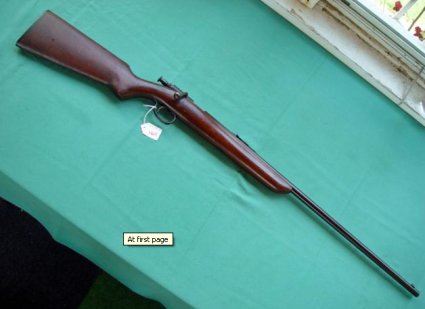
It looked like this:
I thought it was the most beautiful gun I'd ever seen.
So then came the day I actually loaded it up with .22 short (my dad insisted that I start with short before moving to long, and finally long rifle) cartridges. We had recently moved into the suburbs, but still had family who lived in the "woods" in a rural area, and my brothers frequently went to my aunt's house to target shoot. So I went with them and spent a wonderful day plinking at tin cans. Everyone was impressed with the little .22's accuracy. Soon I was hunting squirrels and rabbits with the little gun. And I treated it with respect, always cleaning it immediately upon returning from target shooting or hunting.
That was over 35 years ago. I've had that sweet little rifle ever since, and I have pumped a lot of .22 shells through it over the years. But it's been a decade at least since I've shot it. In my memory it is a highly accurate gun, but memories can be funny things. For example, my cousins had a favorite beer, I think it was called "Pearl" and the cans had a red circle in the middle of the front of the can about the size of a penny. My memory is that if I could see that red dot, I could put a bullet in it. And even if the can was so far away that the red circle wasn't actually visible, I could still put the bullet close or in it just from knowing where it was on the can.
I never put a scope on the rifle, and it took the life of a lot of innocent squirrels. But in all the years I owned it, all I ever knew about it was that it was a Remington single-shot .22. All of the model information had been sanded off with the corrosion on the outside of the barrel.
But thanks to the magic of the internet, today I was able to finally definitively identify the rifle as a Remington Model 41 "TargetMaster". In looking it up on the web I have found that it was made in the mid 1930s (for only 3 years) and that it had a reputation for being a highly accurate .22 rifle.
Somehow knowing the name and history of the gun actually gives me a sense of well-being. It turns out that it's not worth that much, a "good condition" version is worth about $150 or so. Mine is probably only worth about $50 or so since I foolishly took it to a gun shop and had it professionally blued since the chemical bluing I put on was wearing off after a decade or so. That no doubt ruined the collectible value of the gun. But I'm not much into collecting, and I have no intention of selling this thing anyway. I put way too much of myself into this gun, and I intend to keep it around as long as I'm around to keep it.
He was born between the Great Wars, in the middle of what became known as the "Great Depression", in 1933. His mother gave birth in a charity hospital in Shreveport, Louisiana, and returned to the little town of Dubach with the new baby. She and her husband named him "Wilford Eugene" and they called him "Gene." He was seven years younger than his next youngest sibling, his sister Erma Lou.
As war engulfed the world, Gene grew up working the red clay soil of north-central Louisiana with his father. He graduated from Dubach High School in 1950. His older brother, Melvin, served in the military, as did most young men during WWII and immediately afterwards.
So it was no surprise when Gene enlisted in the new United States Air Force, which had before been the Army Air Corps. He soon found himself flying around the world in one of the biggest airplanes ever built, the B-36, which had both turboprops and jet engines. It also carried nuclear weapons. Gene's job was to sit in the extreme end of the fuselage and man the guns mounted at the rear. He was a "tailgunner."
He served in two wars, Korea and Vietnam. He never talked about combat much. He moved from the B-36 to the B-52 when the great StratoFortress took to the air. He talked about the extreme cold at high altitude, cramped quarters, and the constant fear of sudden death that all crew members felt. But he would also talk about beauty he found even in the midst of war. Such as the roiling vortices of contrails spiraling from wingtips, corkscrewing behind the plane as it flew. When flying east at sunset he described the vortices as looking down twin spiraling tunnels of rainbow-colored ice crystals. It was one of the most beautiful things he ever saw.
He got married in Spokane and took his young wife, Marie, to Texas after giving birth to their first son, Keven. Keven had a difficult childhood, his bones did not form properly and he lived much of his infancy in a full-body cast. Gene and Marie drove to El Paso, Texas with Keven in his cast. Marie also had health problems that nearly took her life, but a miraculous surgery repaired her ailing intestines and she made a full recovery.
In El Paso the couple gave birth to three more sons, Scott, Huey, and Sean. These were heady days for Gene, he was moving up the enlisted ranks, and found himself flying a desk more than a plane eventually. During the Cuban Missile Crisis though, he was on patrol over the Gulf of Mexico, with nuclear weapons just a few feet in front of him in the belly of the B-52.
They moved to Mississippi for a short time, long enough to have their only daughter, Tammy, and their last son, Mike. Then he was stationed in Guam where he was the top NCO in the command center during the height of the Vietnam war. It was there that he met and talked strategy with Jimmy Stewart, by then a Brigadier General in the Air Force, and one of the most respected men in the country. He described Jimmy as respectful, polite and extremely competent. He played golf there with Bob Hope one blissful day, and would speak of that for the rest of his life.
When his tour in Guam ended, he returned to Barksdale Air Force Base in Louisiana, just a short drive west of his boyhood home in Dubach. After more than 20 years serving his country honorably and with distinction, he retired in 1972. A divorce followed soon after and the children went their separate ways, Gene keeping the oldest four boys, and Marie taking the youngest two children. The divorce was bitter and the family was estranged for decades.
He took a job in the Civil Service, working for the Louisiana Employment Office to pay the bills. He bought two airplanes and flew them everywhere. He married again, to a woman named Viona who had children of her own. For a few years he and Vi tried to make one family out of two broken ones, and eventually gave up on that effort. The divorce was not so bitter, but just as final.
At the age of 45 he met the last great love of his life, Laura, just as he decided to embark on a new career as an attorney. He quit his job, sold his airplanes, and when his last remaining son went off to college, he did too. He graduated with a law degree at the age of 47 and embarked on another 20+ year career where he again served his profession with honor and distinction. He and Laura married and they shared a 20 year life together before it too ended in divorce.
His oldest son, Keven, had struggled with his health his entire life, and was killed in a car accident one sad day. Gene never really got over that. His three other sons moved on in their own lives. Sean was long married with two kids of his own. Scott married late and had no children. Huey finally gave him another grandchild just last year. But he usually had at least one son around to play golf with.
And Gene loved golf. He played golf well. As a young man he was a long ball hitter, but his short game was the envy of all his peers. As he got older his ability to hit the ball past his partners faded, but his short game never left him. He loved more than anything else playing golf with his sons.
He came to Colorado the summer before last to play golf with Scott and me (I'm sure you've guessed by now, I'm Sean). We played at the Evergreen golf course and had to dodge elk roaming around the golf course. He beat us both, he always beat me. He was 72 years old.
Last year he had his first heart attack, which almost took him from us. He survived it, but never really regained his health. We played our last round of golf with him in July of last year, and it was cut short due to the birth of his last grandchild. At the time we were sure it was just a temporary interruption to our golf plans.
Four weeks ago he was diagnosed with inoperable gastro-intestinal cancer. The doctors said there was no hope. He was given just weeks to live. It is difficult to accept such a thing, especially when he was still "Dad." He joked and laughed and told stories just as he always had. Denial is a difficult thing to overcome. Scott and I drove down to Shreveport to see him in the Hospital and were there to move him to a place to care for him. Even then it seemed that it was all some sort of mistake.
Gene passed away about this time last night, Februrary 8th, 2007. Just two days past his 74th birthday. Huey was with him his final days, as was his ex-wife Laura. Huey held his hand as he departed.
He started his life behind the back of a mule plowing the red clay of Dubach for a share of the harvest on land his father did not own. He flew tens of thousands of miles in the most advanced aircraft in the world, just a few yards away from nuclear weapons. He saw a man land on the moon. He always believed the cigarettes would get him, but they never did.
I'm proud that he was my Dad. I'll miss him.