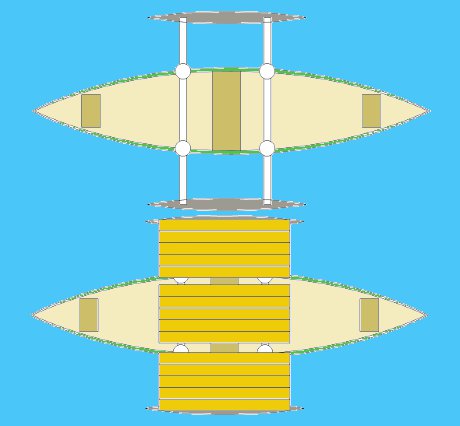
OK, this isn't perfect, I'm not the best artist, but here's a basic concept of what I am thinking about doing for my canoe.
The top illustration is just the canoe with the outriggers. The outriggers themselves are dirt simple to understand. I figure two long aluminum tubes front and back, with 90 degree elbow joints at the end connected to some closed-cell foam elliptical floats. The aluminum tubes will be clamped, or even bolted, to the canoe gunwales. That means there would be aluminum poles going across the canoe, but nothing's perfect.
For simple stability that's really all there is. It's essentially a basic outrigger.
But the bottom illustration shows one thing you could do with the outriggers. This is just a simple set of thin wooden planks to create platforms port, starboard and amidships. Those platforms should be strong enough to hold people, meaning that you could relax on the platforms, or even stand on them to fish.
The whole thing should be simple to assemble, carry and attach, so the canoe could be used with or without the outriggers on a whim.
The only problem is that once you are in the water, you can't really reconfigure the canoe until you get back to shore.
Other possibilities are to have the outriggers hold storage bins and/or ice chests. Perhaps you could put the platform in the middle and one side and the other side could hold the ice chest and storage...
What do you think?
Yeah, some of you probably saw it coming...
Now that I own a canoe, I can't help but contemplate how to improve canoeing in general.
Back in my younger days I owned a bass boat, and so I never really spent much time in canoes. Every now and then I'd rent a canoe or use a canoe someone else owned in a small lake or pond.
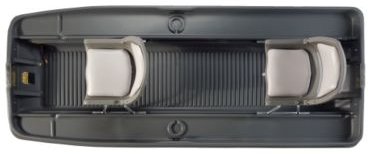
When not able to launch my bass boat in smaller ponds, my fishing buddy at that time had a small fishing platform boat, which was sort of like a miniature version of a party barge. Here's a modern version:
As you can see, it's a wide bottomed boat with the weight of the boat supported by "keels" along each side. It's designed to be able to sit high off the water or to cast while standing up. It's a very stable fishing platform.
But it's heavy, bulky and inefficient in the water. It's very difficult to paddle and wears out a trolling motor quickly. You can put a small outboard motor on them, but they are clumsy to use.
Still, they are perfect for tooling around in small lakes or ponds and fishing for bass or panfish. And I caught a lot of fish out of the one we used.
The point is that I never really spent much time in a canoe, and when I did, I mostly was just messing around and paddling from place to place. I had never used a trolling motor in a canoe, nor had I ever gone out into deep water on a large lake.
Well, after having spent an afternoon on the lake, and cruising across a significant chunk of deep, choppy water in our canoe, I've noticed several things that I think could bear some thought and potential modification.
Canoes are not good places to store stuff. Everything ends up on the bottom of the canoe, and settles along the center of the boat.
Canoes are long and skinny, and because everything tends to settle into the middle of the boat, you have about a 50% chance of being able to reach an item you need when you need it. Most of the time it's on the other side of the middle seat.
Moving around in a canoe is, for all intents and purposes, impossible. It's technically possible, but it's pretty much never worth the trouble, even when the ice chest is on the other side of the middle seat, or the backpacks have gotten switched somehow.
Canoes are great for slipping through the water and move along at a respectable clip even using a 45 lb thrust trolling motor... but they are wobbly as heck. They don't handle swells well and even the slightest leaning causes the whole boat to tip. Just trying to turn around in your seat can cause the canoe to tip and yaw like a drunken teeter-totter.
Canoes are not a good place to relax. Even if you get one of the "comfortable canoe seats" you're still pretty much stuck sitting in one tiny little spot constantly maintaining your balance to ensure that you don't sneeze or hiccup and tip the whole boat over.
So... what to do about all this?
The answer is simple, I think.
Outrigger storage.
Instead of trying to keep all your stuff in the bottom of the canoe, why not have a simple outrigger that attaches to the side(s) of the canoe to keep your stuff in? that keeps it all out of your way, plus it provides additional stability for the canoe. It seems a simple design could be made that combines a small ice chest with a small waterproof storage area, and you could lash your fishing rods and paddles to them as well.
It seems such an obvious solution that I started looking for one online.
They don't exist.
Oh, outriggers do exist, but they are just that, outriggers. They are also crazy expensive. A simple outrigger that appears to be mostly a piece of closed-cell foam attached to a couple of aluminum tubes costs almost $200. They are not storage devices.
So of course now I'm thinking about making one. Or two.
The problem is how they would attach to the canoe. I have some ideas about that, but nothing firm yet. For the most part I am hoping they can just be clamped to the side of the canoe.
If the idea works it would solve just about every one of the items above. Except for making a canoe a comfortable place to recline. Of course having the canoe be more stable and getting all the junk out of the boat might help with that too.
Hmm...
Well. Jury is still out.
Between a lot of time spent at work, a date night watching "Battleship" and steady rain the last few days, I've only had a short time to test out the newly arrived pellet gun.
Friday night I had just enough light left to take a dozen shots before putting it away. I hadn't done anything to sight it in, I just took it out of the box, ran a cleaning rod through it a few times with a cotton swab on the end and then took it out and shot it.
The result was rather odd.
Six holes in a group about six inches to the right of my target. All in a reasonably tight (1.5") group for shoulder-holding it at roughly 20 yards. But there was another group of five, also in roughly the same size group about four inches at roughly 11:00 from the bullseye. The distance between the two groups was about seven inches. As for the twelfth shot... well either it was such a "flyer" that it didn't even hit the target, or else it went through a previous hole.
I've never seen anything like that.
But I figured that sort of thing was still promising. Something was affecting the shots, but the shots were still consistent. So I got my miniature sculpting glasses out and inspected the baffling. It looked to me like the baffling was just barely intruding into the path of the pellets. Just barely. So I took a round sanding stick and sanded down the baffles. But I couldn't shoot it again.
So after doing some shopping today I took it out and tried to sight it in, this time at about 15 yards.
This time I used a bench rest (actually a sawhorse) and took twelve shots.
They were all over the place. But on about the tenth shot I realized I had resumed my natural tendency to grip the rifle firmly against my shoulder and tightly with my hands. Bad form for these guns. My final two shots I took with a diligent attempt to execute the "artillery hold". Those final two shots were much better.
So I set out a new target and shot four artillery hold shots. All of them were about three inches from the bullseye at about the 10:00 position. So I reset the scope's reticle to the right and down. Of my next fourteen shots, 2 were more than an inch up and right, 8 of them were within an inch of the bullseye but slightly up and right, two were just below the bullseye and one was well low and right. The final shot was a "flyer" and was way low, and had that funny sound again, so I think it clipped the baffle again.
So I'm seriously considering drilling the baffles out by a quarter inch or so, just to be sure they never get in the way.
Now, how do I feel about thirteen shots with only ten within an inch of the bullseye from a mere fifteen yards away?
Pretty damn bad actually.
Normally I would consider that sort of shooting to be borderline incompetent.
But I have to consider that I got steadily better as I shot the gun. These guns are notorious for needing to be "broken in". Many reviewers and owners say that you can't really judge the accuracy of one until you've put at least 200 pellets through it.
But actually I think the issue is holding the gun. It is amazingly difficult for me to execute the artillery hold properly. It more or less violates almost every lesson I've ever learned about shooting a rifle. Plus it's a heavy gun. It weighs over ten pounds. My .22 rifle weighs about four pounds.
I have to admit that the more I felt I was doing the hold right, the more consistent the gun seemed to shoot. After sighting it in as above, I took one final shot at about 25 yards, shoulder held, and nailed it almost perfectly.
I am almost convinced that using a bench may be one of the most difficult ways to shoot the gun. So far my consistency has been much better simply holding the gun. I think that's because the gun recoil is so violent that even with my hand between the bench and the gun, it's still bouncing off the bench.
Also, I think the pellets I am using are not good for the gun, even though they are the ones recommended. The reason I think they are a poor choice is because they are the heaviest pellets you can buy for the gun. Or at least the heaviest I've found so far. And that means they take longer to get out of the barrel of the gun, giving the gun more time to have the recoil affect the trajectory of the pellet.
So I am going to buy some lighter pellets that have been recommended for the gun. Those should clear the barrel faster and shoot faster too, meaning they will have less drop on shots of up to sixty yards or so, which is probably about the maximum distance the gun should be expected to be accurate.
Unfortunately I have to buy them on the internet and have them shipped.
But still, I don't currently feel a need to send this one back.
Oh, and one more thing. These pellets hit hard man. They are so much more powerful than my pellet pistol that it's downright scary. I would not want to be shot by this gun. I am quite sure that a well aimed shot would be lethal to even a medium sized animal. I would not be surprised to be able to take down deer with this gun.
If you live in an arc from West Texas through parts of Arizona, New Mexico, Nevada and California (as well as up into Washington I believe) you will have a good chance to view an annular solar eclipse Sunday evening.
Annular eclipses are those where the moon's apparent size is smaller than the sun's apparent size and so the edges of the sun will shine like a golden ring in the sky.
However, by sunset pretty much anywhere west of Kansas you should have a view of a partial solar eclipse, and those are rare enough.
So enjoy!
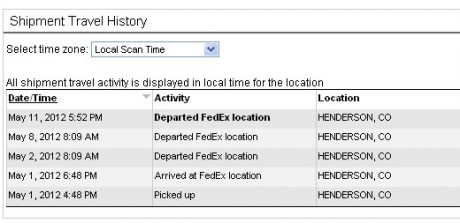
Here's what the Fedex tracking site shows today:
Yeah, my package has apparently left Henderson Colorado three separate times.... Awesome!
So Pyramyd is now handling the claim with FedEx and they say they will ship out my replacement gun on Monday.
I have to say Pyramyd has been really great through all of this. If this last gun doesn't work, I dunno what I'm gonna do.
Cry maybe...
Yes. My pursuit of the most powerful and accurate spring-action air rifle has become so insane that it would work quite well as a Monty Python skit. Not a whole movie.
Yet.
But it's getting there.
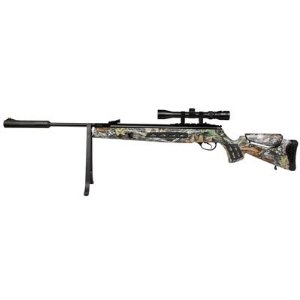
So... you might all remember that I purchased said pellet rifle almost a month ago. Here's a photo of one.
So I purchased one online, using a couple of work "reward" gift certificates and about a hundred bucks of my own money. I thought that was a deal. The gun costs $300. Well, unless you buy it at one of those places that sells it for $260 or $270, but I didn't know about them at the time...
So a week after ordering it, I received it and began shooting it. And shooting it. And shooting it.
Roughly 250 pellets later I still couldn't get the thing sighted in. Not free holding it, not shooting from the bench, not using the famed "artillery hold" not with a mouse, not with a louse, it would not shoot a real tight group, not with a duck, not with a goose....
So I sent it back. And waited. And waited. It took near a week to ship back, and the replacement took near a week to arrive. Actually it arrived in Denver Friday morning, but missed the shipment to our tiny mountain town so all day Friday I had to sit at work within a couple miles of the gun, but the location is not a "customer pickup" location so I had to wait until it arrived on Monday.
So... excited to have a new gun to try, I took it out and took a few shots.
The first three shots were very promising, especially considering the performance of the first gun. But the fourth shot went wild and the fifth shot went wild and damaged the sound dampening baffling at the end of the barrel.
So back it went to the company for a new one.
And now FedEx has lost it.
So it looks like a claim will need to be filed.
Yeah. Lost it. No record of it since last Wednesday. Just gone.
"Ten days to two weeks to settle a claim"
Then another week to complete the order.
That skunk's gonna die of old age before I get to shoot him.
I'm going to put this in the category of "reviews" just because it's sort of a review. But it's really more of a stream of consciousness reaction to the series.
For those who may not know, "Top Shot" is one of those silly "reality shows" that have infected the television landscape like pustules on a plague victim. The host, named "Colby" something or other, is one of those deliberately-primped-to-be-rugged guys that irritate me to no end just by their preening, strutting affected hyper-masculinity. Everything about the guy annoys me, from the way he has a six-day growth of beard every day (the look initially made famous by Don Johnson in "Miami Vice" and I hated it just as much then), to the way he wears just slightly faded and worn jeans, to the way he stands to the way his blinding white teeth burst through his Clint Eastwood-esque squint when he spits his cliche phrases for the camera....
I've described the concept of the show before, so I'll just reiterate that it's based on the "Survivor" model except instead of voting someone off the island, there is a vote to determine two candidates in each show who have to face each other in an "elimination challenge" to see who goes and who stays. This gives Colby a chance to strut and preen as he says in his patented, clipped delivery, "you have fired your last shot" as he sends the hapless loser packing.
But in spite of Colby's pervasive and irritating presence, the show itself has managed to do something that very few TV programs have done in the past decade. It has made me actually look forward to each episode. I do watch a couple of other shows right now ("Swamp People", "American Pickers", and "Pawn Stars") but I can take or leave those shows. I typically bring my laptop computer in and watch with the Cosmic Wife. They are engaging and I do enjoy them, particularly "American Pickers" but if I miss an episode or two, I don't sweat it. I make an effort to watch "Top Shot."
Why?
Because guns.
So many guns. And bows, slingshots and atlatls. Not to mention rocket launchers, grenade launchers, sub-machine guns, gatling guns and twice now...
Cannons.
I mean, if you can't get a thrill out of watching a super slow-motion video of an artillery shell being fired directly at the camera... well, you might want to check your pulse.
So anyway, this is the fourth season of the show. I've posted a couple of reactions to specific shows this year, including one where I was very disappointed with the overall accuracy that was demonstrated by these supposed "world-class shooters."
But that was really an anomaly. In general the shooting is extremely good.
But there is another dimension to the show, and that is the dimension that probably is intended to draw in viewers, although I admit that it doesn't really draw me in that much. Except in rare cases I almost never "root" for anyone. I have a few shooters that I like more than others, and I have to admit that I like seeing the hot chick shooters compete, even though they tend to get booted pretty early, but usually I don't get into the personalities of the shooters. I just like watching the shooting.
This season though, I found myself getting drawn in. And as it happened the final two in the season finale who went up against each other were one of my favorites (Chris, the IT guy) vs one of my least favorites (Greg, the ex-soldier).
From the start of the show it was clear that the military, police or competitive shooters were rather dismissive of Chris, who had never shot in any competition or been a member of any armed force. He was just a self-described IT geek who shot recreationally but who survived the auditions and ended up on the show. On I think the first episode, he and Greg both performed poorly on a specific team challenge, and Chris ended up being voted to do an elimination challenge, which he survived. The challenge involved using a pistol to shoot a series of plates where you had to shoot six plates in a row without a miss to move to the next row. Both Greg and Chris failed to complete a row of plates in that challenge.
But after that, Chris steadily and quietly performed well in challenge after challenge. He showed a specific skill in being able to pick up a weapon he had never seen before and master it quickly. For example, using the atlatl, he nailed a perfect bullseye at the farthest distance, shutting out his opponent in the elimination challenge by scoring 9 points on one throw. Nobody else even got close to the bullseye on the farthest target.
Greg, in the meantime, continued to spectacularly fail in challenge after challenge. Plus he demonstrated extremely poor interpersonal skills, repeatedly frustrating and angering both his teammates and the other team. He formed an early clique with three other shooters and they voted to protect each other instead of voting to send the worst performers to the elimination challenges. Even so Greg was sent to three elimination challenges during the season. And I have to give him credit. For whatever reason, while working as part of a team, Greg repeatedly choked badly in competition. in one competition he seemed to completely freeze up for an agonizingly long time trying to make difficult shots. In one case he took forever to make a shot, only to realize he still had the safety on, and then went through the whole agonizing process again, taking forever and missing his shot to boot. But in the elimination challenges, with him one on one vs another shooter, he was a totally different person. He survived all three elimination challenges, sending home shooters that I personally believed were far superior to him.
So, in the end, both Chris and Greg survived the team challenges and entered the individual rounds. Both were considered to be the weakest remaining challengers, even though Chris had been perhaps the strongest shooter overall since that first episode.
By now I was rooting for Chris and rooting against Greg.
Well, in the end they ended up being the final two. And the final challenge was a series of seven individual shooting tests consisting of a flintlock pistol, an ancient British pistol, a Colt pistol, a crossbow, two different rifles and ending with a six-shot grenade launcher. Oh, did I mention that Greg's main credential for appearing on the show was that he was the military's champion grenade launcher in 2003? The second pistol challenge was a repeat of the "perfect series" test that both Chris and Greg had failed so spectacularly back in episode 1.
Well... of the four season finales, this one was by far the closest. Chris took a small but significant early lead over Greg until they got to the crossbow, where Greg caught up. Both nailed the perfect series test shooting 12 plates in a row with a Colt revolver without a single miss. Good for them. Greg took the lead in the rifle challenges, ending up on the final challenge a good six seconds ahead of Chris. And the final challenge was the grenade launcher. They had to hit two targets with grenades one at 25 yards and one at 50 yards I think. Anyway, Greg hit his first target before Chris even got his grenade launcher loaded and into firing position. It looked very bad for Chris.
When Chris missed his first shot, it looked like all was over, but Greg missed his shot at the farthest target.
Then Chris nailed both targets with two successive shots in a stunning example of his uncanny ability to master unfamiliar weapons. His winning shot not only hit the target, it nailed the exact center of the bullseye, while Greg's final shot went just wide.
I actually cheered.
So I have bragged on here a few times about my shooting prowess. I've posted some of my results shooting my Crosman 1377 pump-action pellet pistol. I've posted about how I was unable to sight in my Hatsan 125 Striker pellet rifle, and how they agreed to replace it based on my description of it's accuracy problems. The replacement is supposed to arrive today. So I'll hopefully get a chance to do some shooting tonight to see if the new gun performs as advertised.
In the meantime I have been doing some Youtube surfing for pellet gun shooting tips. In that surfing I stumbled across a couple of different guys who use pellet guns for pest control and hunting small game. They post videos of their shooting, meaning you get to see the raw footage of birds, squirrels, chipmunks, crows, etc. being blasted by pellets.
Yeah, sorta gruesome, but in a fascinating sort of way.
But the thing that has really interested me is in how they shoot.
When I was a kid I used to hunt quite a bit. My hunting more or less stopped when I got married, and I haven't hunted now in over 25 years. Back when I did hunt, the only hunting I ever did with a scope was hunting for deer. All of my squirrel and rabbit hunting was done with barrel sights, and all of my bird hunting (mostly quail, duck, geese and dove) was done with a shotgun.
Since I did very little deer hunting, and never took what I would call a "challenging" shot at a deer (by design, I always wanted a quick, clean kill when hunting) I never really learned much about scopes.
But these guys use their scopes on everything.
What they do is mount a digital camera onto their scope, attached directly where your eye would go, and they then look at the image on the camera back to sight in on their target. They record the whole thing, so you get to see the shot exactly as if you were looking through the scope when the shot is made.
I have learned a lot from this. Because pellets travel much slower than .22 bullets, even relatively short shots have to factor in pellet drop and windage. And while each has their own unique way to set up and execute the shot, their basic process is very similar.
Basically everything is done according to "mil-dots." What is a "mil-dot?" Well, when you look through a scope you obviously see the crosshairs (known as a "reticle" in the scope biz). But on the crosshairs going vertically and horizontally you should see a series of dots or hash lines regularly spaced across them. These are mil-dots. The standard mil-dot spacing is set to indicate 100mm of target size at 100 meters. Yeah, they are built in metric units. That converts to 3.6" at 100 yards. That means that if you are zeroed in on the exact center of a bullseye at 100 yards, the mil-dots will indicate 3.6" steps away from the bullseye.
Now, scopes with variable magnification will sometimes have variable mil-dot distance, but for the sake of argument I'll stick with the "standard" mil-dot sizing.
Now, how does this help you?
Like most novices I assumed that it mostly was a way to do on-the-fly adjustments for windage and elevation. Meaning if your scope was sighted in at 60 yards, then at 40 yards you might need to sight in a mil-dot below the bullseye, or on a 100 yard shot you might need to sight in 3 mil-dots above the target.
I figured it was a sort of "trial and error" thing until you got comfortable with the scope and gun. And that works OK, you can do that. But it turns out that there is an actual science that you can apply to this such that if you know your gun and scope (and your targets) well enough, you can do pretty amazing shots on your first shot.
For example... anyone who has ever been trained to shoot a gun knows about "windage and elevation". For elevation, the idea is that you should know where your bullet/pellet will hit based on the range of the shot. Windage is trickier, but elevation is really almost pure ballistics.
For target shooting this isn't all that much of a deal. You typically know what the distance is for your shot, and if you know your gun, based on that range, you know how high or low the gun will shoot.
The problem most folks have is that when you are hunting, you have to estimate the range of your target. As anyone who has ever played golf will tell you, the difference between 120 yards and 130 yards is frequently the difference between a par and a double-bogey. And not many people have the skill to use their eyes to estimate distance that accurately.
So, one of the two shooters uses a laser range-finder. That's fine, but it's a step you have to take and if your batteries die, or you drop the range-finder, or it just stops working for some reason, you're back to guesstimating range. And the difference of ten yards in your guesstimate when shooting at something the size of a clenched fist is usually the difference between a hit and a miss.
But, the secret to this is that you can use your scope as a rangefinder. But to do that, you have to know how big your targets are.
Let's say you are hunting starlings. Why would you be hunting starlings? Well, mostly because starlings are an invasive species which crowd out native species for nesting and food. If you like to see cardinals, bluebirds or other songbirds, you might want to thin out the starling population a bit. Hunting starlings as pest eradication is pretty common.
A starling is about six inches tall. And they don't vary much in size. So you can pretty well assume that the starling you might be looking at through your scope is six inches tall.
How does that help? Well.... if you are looking at a starling through your scope, and it is a bit less than two mil-dots tall, then that starling is right at about 100 yards away. Now you know the range. Knowing the range should let you know how to adjust for elevation.
Windage is a bit trickier, however, knowing the range also allows you to at least realize how long the bullet/pellet will be in the air, and with practice you can learn how far to adjust for windage. Of course you can be as scientific with windage as you are with elevation if you really want to, but that would mean knowing the exact speed of the wind. Most hunters, and both of the ones I watched on Youtube, just use their "experience" to factor in windage. And when they miss, it's usually due to miscalculating windage. But they usually only miss once or twice before zeroing in.
So, how do you apply all this to shooting your actual gun?
Well, for a pellet gun it means you need to shoot one, and only one, brand and make of pellet. Using different pellets means different muzzle velocities and wind resistance.
What you have to do is actually plot out your preferred pellet's ballistic profile. Both of these guys created a ballistic profile that looks like this:
That would show the ballistic trajectory of a pellet fired at 750 feet per second muzzle velocity with a scope set two inches above the muzzle, and the muzzle angled up with respect to the scope at about 1/3 of a degree. This would correspond to a pellet gun "sighted in" at 60 yards. Because of the way the barrel and scope work, that means the pellet actually crosses the horizontal line of the scope twice, once going up as it comes out of the barrel, and once going down as gravity takes over.
This is important because using this chart tells you how far off your pellet will be vertically based on the distances involved. Since a mil-dot is 3.6 inches, then for me to hit the bullseye of a target at 80 yards, I would need to move the scope up 1.4 mil-dots (five inches).
At 100 yards I'd need to adjust upwards roughly 3 mil-dots. At 30 yards I'd have to adjust down about 2/3 of a mil-dot.
At ranges farther than 100 yards, the drop-off of the pellet is so great that it's almost silly to try to use the scope to target anything. At 120 yards I'm probably right at the edge of the scope's visible area. at roughly 6 mil-dots.
Now, one of the guys on the Youtube video was hitting starlings at 120 yards with a six mil-dot adjustment. That's pretty frickin' awesome.
The above graph is purely hypothetical. What you really need to do is to empirically determine your gun's ballistic profile using the pellets you intent to shoot with. Obviously the faster your gun shoots, the flatter the ballistic trajectory and therefore the less adjustment you have to make.
Assuming my new gun is accurate enough for this stuff to matter, I'll have to figure out it's ballistic performance with the pellets I have.
This would be one reason to use lighter pellets, just to flatten that curve and reduce the amount of adjustment you have to make...
This isn't going to be a "review" because I don't think I'm ready to provide an opinion on my new pellet gun, but I thought I'd report status.
The Hatsan Mod 125 Sniper in .25 caliber arrived with 800 .25 caliber pellets on Friday. I got home early Friday (but was still working from home) but that meant when I finally did finish work, I was able to go outside and shoot the gun.
So I did. I shot it once at a stump I use as a target for my pellet pistol and my slingshot.
The pellet blasted through the stump like it was nothing but sawdust. Luckily the stump is on a hill and the pellet just buried itself in the ground behind it.
"Cripes!" I thought. "What the hell!?"
So I decided to find another target. I figured a sturdier, live tree would be a fine target, and would let me see how powerful the pellet was.
Well, more about accuracy in a minute. I hadn't yet even tried to sight the gun in, and I actually missed the tree. It wasn't a big tree and it was about 20 yards away, and I should have known better than to shoot an unsighted gun at something that far away, but everyone does stupid things sometimes I suppose.
So instead of hitting the thigh-thick tree I was shooting it, it instead hit a wrist-thick tree behind it, but not dead on. Instead it ricocheted.
And you could HEAR it ricochet. It "zinged" off into my neighbors yard, caroming off one of his trees.
"Shit!" I said. Yeah, I did. I was stunned. That was like a frickin' BULLET. So I decided it was unsafe to shoot in my backyard until I built a shooting backstop that could actually stop one of the pellets.
So no more shooting Friday night. Instead I researched bullet stops. Finally I realized that trying to make one would just end up with another pellet eventually tearing through the plywood or whatever and I turned to the web to locate commercial bullet traps for .22 rifles.
Turns out that you can buy one for about $80. They are essentially boxes made of high-strength steel angled in such a way that the bullets you shoot (yes, bullets, I decided I needed something that would stop a .22 long rifle) would collect down in a trap at the bottom. The idea is that frequent target shooters can collect the bullets and recycle the lead. I doubt I'll do that, but who knows... Those pellets ain't that cheap. They cost me roughly $.04 each.
So... the bullet trap I purchased is 10"x11". Which you would think is big enough that you would never miss it from shots up to 25 yards away, but just in case I backed it up with some dense particle board and some 2x6s for an area roughly 4'x4' that definitely will stop any pellet. But since the vast majority of pellets should be hitting the steel, there shouldn't be any problem with my backstop getting splintered by repeated hits...
Between building the backstop and driving into town (fifty miles remember) to buy the bullet stop, I used up most of Saturday, so it was late Saturday afternoon before I got to do any real shooting. And then today it snowed like heck and I had a game session in town, so not much time today either.
But still, I've put about 100 pellets through the gun now.
Which should be plenty to sight it in, you would think.
But I'm not doing well with sighting it in.
First of all, the scope like totally sucks. The scope of virtually every pellet gun sold as part of a combo is roundly derided by the reviewers (and this one was too) who all say to buy one of the $60-100 scopes that actually work. This is a 3-9x scope with a 32mm objective lens. That would be perfectly fine, except the scope has no means to adjust focus distance, and it appears to be set to focus at infinity. That means the closer you try to focus, the blurrier the image gets. Even at 25 yards the image is too blurry to use the 9x setting, and it is annoying (to say the least) to use even the 5x power. You more or less have to leave it on 3x power at that distance, and even then it's not sharp enough to engender much confidence in what you are seeing. The red bullseye on the targets I am shooting at is a round blur and to shoot you just sort of aim at the center of the blur.
To say I am disappointed in the scope is a vast understatement. However, I knew going in that the scope was junk, every review said it was. I wasn't buying the gun for the scope. Although I have to admit I did think that the "this scope is a blurry, worthless piece of crap!" comments in the reviews must surely have been hyperbole. They weren't.
Still I was determined to make it work. So I tried to sight it in.
My first couple of groups were not terrible at ten yards... but they weren't very good either. Certainly not up to my own expectations. But what made me feel even worse was that the more I shot, the worse I was getting.
I was totally amazed by this until I took one shot and the scope's back mount popped off the rail.
This gun KICKS! I mean it is like holding a pipe with a firecracker going off in it. Apparently I had not tightened the scope fasteners well enough and by my second grouping it was working itself loose, getting more and more out of alignment with each shot, until if just flat fell off.
So... OK, at least that explained why my first couple dozen shots kept getting worse. So I reattached the scope and this time really bore down on the screws to hold it as tight as I could. Then I set about re-sighting in the scope at ten yards.
This time I got a reasonably decent grouping. Not as good as I hoped, but seven of ten shots in the red bullseye and the other three I blamed myself for missing. I was free-standing with the rifle, not feeling like I needed to brace myself for such a close shot, and I could feel the barrel wiggle a couple of times when I pulled the trigger. I put that down to unfamiliarity with the gun, but figured I was ready to sight in at 25 yards, which is what I intend to have it set for since that's about the distance I expect to get a shot at my pesky yard skunk.
But it was late by now and I figured I could finish the 25 yard sighting in on Sunday morning.
So this morning I set it all up and shot probably 60 shots at the target.
I may have hit the bullseye (about the size of a nickel) five times out of sixty shots. So now I'm over 100 shots total and still am not consistently shooting groups. The last twenty or so shots I finally broke down and set up a bench to rest the gun on and shoot. That was definitely better, but still I was missing by four inches on some shots, and in random directions.
So now I'm worried that the gun isn't what the reviews claimed. But to be fair, I'm not using the pellets the reviewer said to use either, like an idiot I listened to the guy on the phone when I bought the gun and he recommended the pellets I'm using now. They are super-heavy, over 30 grain when an average .25 caliber pellet is about 25 grain or less. So they are heavy.
I may have to just purchase the ones that were listed as the most accurate to finish sighting the gun in, but I dunno... I find it hard to believe that the pellet itself can make that much difference.
So, what's the deal?
Have I forgotten how to shoot?
Well, I took my pellet pistol out there and was nailing things like I always do with it (and it has no scope) so I don't think that's the problem.
Here's where my head is right now.
1. This is an incredibly heavy gun. It is easily twice as heavy as my .22 rifle. It is also fairly top heavy and the balance point is a bit forward on on the stock, where the stock splits to allow the barrel to cock. So it's taking some adjustment to find a comfortable way to hold the gun.
2. Cocking this thing is a BEAST. It's a literal workout to cock this thing a dozen times. It makes your arms tired.
3. The scope. I'm still not sure that it isn't getting knocked around even though I've got it screwed tight.
4. The recoil/kick is really amazing. It kicks harder than my .22. It's a fairly violent process. I am concerned that it is so violent that it keeps knocking the cheap scope's innards out of alignment. I know just enough about gun scopes to know that the fine windage and elevation adjustments are made with an internal barrel that fits inside the main barrel and if that isn't locked down tightly, it can get out of alignment even on guns that don't kick like a mutant mule.
5. I'm old now. My eyes aren't what they once were. I have to wear glasses and the glasses I have are graduated bifocals. I'm not convinced that I am consistently using the same part of the glasses to look through.
6. Maybe the pellets really are that inaccurate. They are massive. I bought them because they were the highest rated energy delivering pellets, which is what you want if you are hunting. But you have to hit something before you can kill it.
So, what to do?
First, next chance I get (when the snow melts, we got about a foot in the past 24 hours), I think I'm just going to remove the scope entirely and see if I can sight it in with the normal barrel sights. Those shouldn't be getting jacked around by the recoil anyway. If I can, at least I'll believe the gun is worth keeping.
Second, I'm going to have to really work on that "artillery hold" technique I guess. The worse my results are, the more I tend to clamp down on the gun to keep it still, and that's exactly what they say causes poor results with these break-barrel guns. I honestly did not realize how hard it would be to do that. All of the experts said it was very difficult for shooters accustomed to the standard hunting/target shooting styles taught for "real" guns to adjust to the artillery hold for these pellet rifles, but of course I thought that couldn't possibly apply to ME. Perhaps I was wrong. I will keep working on it.
Third, there are quite a few comments about these guns needing a couple hundred pellets fired through them to "settle down" before they attain their true accuracy. The gun comes from the manufacturer with oil in the compression chamber, and that oil does something called "dieseling" which means the oil in the chamber will actually ignite from the adiabatic heat generated by the gas compression, resulting in a small explosion that affects accuracy (while boosting pellet speed). But dieseling is supposed to stop after about twenty shots and I've fired over 100. Still, I see smoke drifting up from the gun barrel after some shots, so I suspect there is still some dieseling going on.
Fourth, I need to get a more stable "bench" to do my shooting from. I just stacked two plastic storage bins on top of each other and they were pretty shaky, and I was hunched over pretty far so it was pretty uncomfortable. And if you are uncomfortable when shooting, you will not shoot well.
I am disappointed and concerned though. I definitely expected to be happier than I am right now. In fact, I am concerned enough that right now I would not use the gun to shoot the skunk, I don't feel confident enough that I can get a one-shot kill, and that was the whole point of buying the gun in the first place.
There's room to grow with Shapeways as well. Once you're satisfied with your design, you can list it for sale on the site. You choose the material options and markup, and they handle the ordering, printing, and shipping. "Three-D modeling started as a hobby," says van der Linden, but after launching a product line that includes kinetic toys, geometric sculpture, jewelry, and desk lamps (Shapeways can print objects up to about 27 × 15 × 22 inches), it's quickly becoming a healthy source of income.
Roman Vasyliev, a freelance designer, had been building model cars and airplanes for years before discovering 3D printing. His obsessively detailed World War I—era aircraft models now net a steady stream of income. (The top seller is a 1:44-scale model of the Caudron G.4, a French biplane bomber.) "I was really surprised that 3D modeling has become another branch of my hobby," he says, "and now, my work."
Read more: How to Get Started 3D Modeling and Printing - Popular Mechanics
 The top illustration is just the canoe with the outriggers. The outriggers themselves are dirt simple to understand. I figure two long aluminum tubes front and back, with 90 degree elbow joints at the end connected to some closed-cell foam elliptical floats. The aluminum tubes will be clamped, or even bolted, to the canoe gunwales. That means there would be aluminum poles going across the canoe, but nothing's perfect.
For simple stability that's really all there is. It's essentially a basic outrigger.
But the bottom illustration shows one thing you could do with the outriggers. This is just a simple set of thin wooden planks to create platforms port, starboard and amidships. Those platforms should be strong enough to hold people, meaning that you could relax on the platforms, or even stand on them to fish.
The whole thing should be simple to assemble, carry and attach, so the canoe could be used with or without the outriggers on a whim.
The only problem is that once you are in the water, you can't really reconfigure the canoe until you get back to shore.
Other possibilities are to have the outriggers hold storage bins and/or ice chests. Perhaps you could put the platform in the middle and one side and the other side could hold the ice chest and storage...
What do you think?
 As you can see, it's a wide bottomed boat with the weight of the boat supported by "keels" along each side. It's designed to be able to sit high off the water or to cast while standing up. It's a very stable fishing platform.
But it's heavy, bulky and inefficient in the water. It's very difficult to paddle and wears out a trolling motor quickly. You can put a small outboard motor on them, but they are clumsy to use.
Still, they are perfect for tooling around in small lakes or ponds and fishing for bass or panfish. And I caught a lot of fish out of the one we used.
The point is that I never really spent much time in a canoe, and when I did, I mostly was just messing around and paddling from place to place. I had never used a trolling motor in a canoe, nor had I ever gone out into deep water on a large lake.
Well, after having spent an afternoon on the lake, and cruising across a significant chunk of deep, choppy water in our canoe, I've noticed several things that I think could bear some thought and potential modification.
 Yeah, my package has apparently left Henderson Colorado three separate times.... Awesome!
So Pyramyd is now handling the claim with FedEx and they say they will ship out my replacement gun on Monday.
I have to say Pyramyd has been really great through all of this. If this last gun doesn't work, I dunno what I'm gonna do.
Cry maybe...
 So I purchased one online, using a couple of work "reward" gift certificates and about a hundred bucks of my own money. I thought that was a deal. The gun costs $300. Well, unless you buy it at one of those places that sells it for $260 or $270, but I didn't know about them at the time...
So a week after ordering it, I received it and began shooting it. And shooting it. And shooting it.
Roughly 250 pellets later I still couldn't get the thing sighted in. Not free holding it, not shooting from the bench, not using the famed "artillery hold" not with a mouse, not with a louse, it would not shoot a real tight group, not with a duck, not with a goose....
So I sent it back. And waited. And waited. It took near a week to ship back, and the replacement took near a week to arrive. Actually it arrived in Denver Friday morning, but missed the shipment to our tiny mountain town so all day Friday I had to sit at work within a couple miles of the gun, but the location is not a "customer pickup" location so I had to wait until it arrived on Monday.
So... excited to have a new gun to try, I took it out and took a few shots.
The first three shots were very promising, especially considering the performance of the first gun. But the fourth shot went wild and the fifth shot went wild and damaged the sound dampening baffling at the end of the barrel.
So back it went to the company for a new one.
And now FedEx has lost it.
So it looks like a claim will need to be filed.
Yeah. Lost it. No record of it since last Wednesday. Just gone.
"Ten days to two weeks to settle a claim"
Then another week to complete the order.
That skunk's gonna die of old age before I get to shoot him.
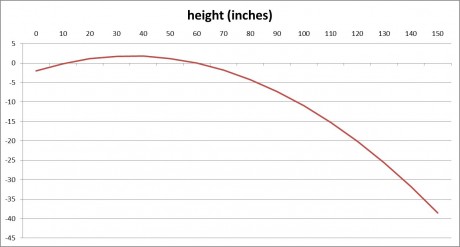 That would show the ballistic trajectory of a pellet fired at 750 feet per second muzzle velocity with a scope set two inches above the muzzle, and the muzzle angled up with respect to the scope at about 1/3 of a degree. This would correspond to a pellet gun "sighted in" at 60 yards. Because of the way the barrel and scope work, that means the pellet actually crosses the horizontal line of the scope twice, once going up as it comes out of the barrel, and once going down as gravity takes over.
This is important because using this chart tells you how far off your pellet will be vertically based on the distances involved. Since a mil-dot is 3.6 inches, then for me to hit the bullseye of a target at 80 yards, I would need to move the scope up 1.4 mil-dots (five inches).
At 100 yards I'd need to adjust upwards roughly 3 mil-dots. At 30 yards I'd have to adjust down about 2/3 of a mil-dot.
At ranges farther than 100 yards, the drop-off of the pellet is so great that it's almost silly to try to use the scope to target anything. At 120 yards I'm probably right at the edge of the scope's visible area. at roughly 6 mil-dots.
Now, one of the guys on the Youtube video was hitting starlings at 120 yards with a six mil-dot adjustment. That's pretty frickin' awesome.
The above graph is purely hypothetical. What you really need to do is to empirically determine your gun's ballistic profile using the pellets you intent to shoot with. Obviously the faster your gun shoots, the flatter the ballistic trajectory and therefore the less adjustment you have to make.
Assuming my new gun is accurate enough for this stuff to matter, I'll have to figure out it's ballistic performance with the pellets I have.
This would be one reason to use lighter pellets, just to flatten that curve and reduce the amount of adjustment you have to make...